


Improved prediction of direction-dependent, acute axonal injury in piglets
- PMID: 28833411
- PMCID: PMC5803402
- DOI: 10.1002/jnr.24108
Improved prediction of direction-dependent, acute axonal injury in piglets
Abstract
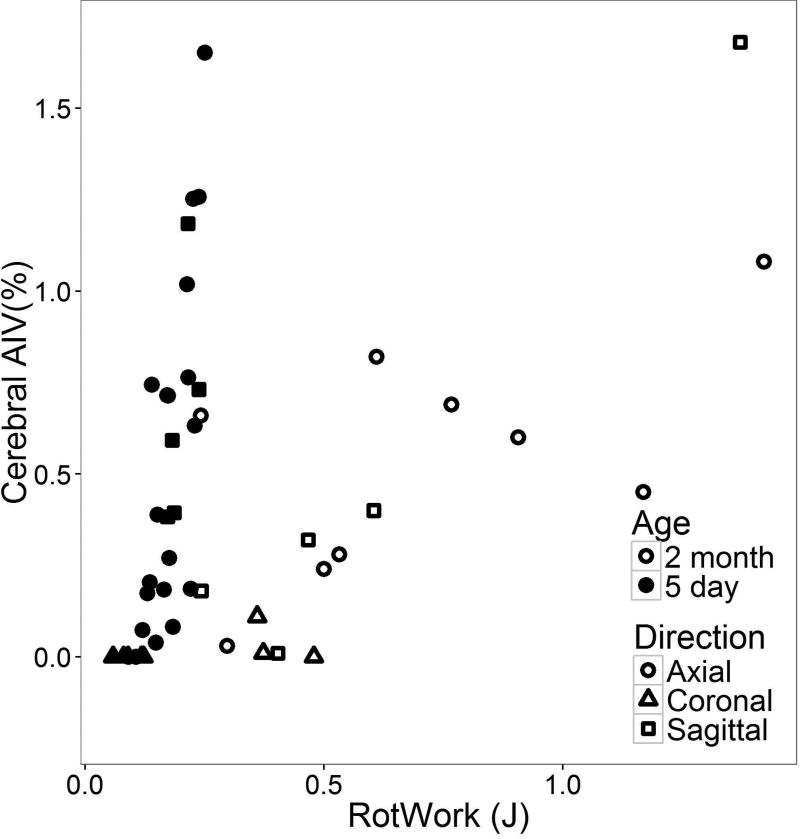
To guide development of safety equipment that reduces sports-related head injuries, we sought to enhance predictive relationships between head movement and acute axonal injury severity. The severity of traumatic brain injury (TBI) is influenced by the magnitude and direction of head kinematics. Previous studies have demonstrated correlation between rotational head kinematics and symptom severity in the adult. More recent studies have demonstrated brain injury age- and direction-dependence, relating head kinematics to white matter tract-oriented strains. We have recently developed and assessed novel rotational head kinematic parameters as predictors of white matter damage in the female immature piglet. We show that many previously published rotational kinematic injury predictor metrics poorly predict acute axonal pathology induced by rapid, non-impact head rotations and that inclusion of cerebral moments of inertia (MOI) in rotational head injury metrics refines prediction of diffuse axonal injury following rapid head rotations for two immature age groups. Rotational Work (RotWork) was the best significant predictor of traumatic axonal injury in both newborn and pre-adolescent piglets following head rotations in the axial, coronal, and sagittal planes. An improvement over current metrics, we find that RotWork, which incorporates head rotation rate, direction, and brain shape, significantly enhanced acute traumatic axonal injury prediction. For similar injury extent, the RotWork threshold is lower for the newborn piglet than the pre-adolescent.
Keywords: biomechanics; brain trauma; kinematics; pediatric; rotational.
© 2017 Wiley Periodicals, Inc.
Conflict of interest statement
Conflict of interest
Authors have no conflicts of interest.


References
-
- Armstead WM. Age-dependent cerebral hemodynamic effects of traumatic brain injury in newborn and juvenile pigs. Microcirculation. 2000;7(4):225–235. - PubMed
-
- Armstead WM. Age and cerebral circulation. Pathophysiology. 2005;12(1):5–15. https://doi.org/10.1016/j.pathophys.2005.01.002. - DOI - PubMed
-
- Benson RR, Meda SA, Vasudevan S, Kou Z, Govindarajan KA, Hanks RA, Haacke EM. Global white matter analysis of diffusion tensor images is predictive of injury severity in traumatic brain injury. Journal of Neurotrauma. 2007;24(3):446–459. https://doi.org/10.1089/neu.2006.0153. - DOI - PubMed
-
- Bryan MA, Rowhani-Rahbar A, Comstock RD, Rivara F Collaborative, on behalf of the S. S. C. R. Sports- and Recreation-Related Concussions in US Youth. Pediatrics. 2016;138(1):e20154635. https://doi.org/10.1542/peds.2015-4635. - DOI - PubMed
-
- Buckley NM. Maturation of circulatory system in three mammalian models of human development. Comparative Biochemistry and Physiology Part A: Physiology. 1986;83(1):1–7. https://doi.org/10.1016/0300-9629(86)90080-0. - DOI - PubMed
Publication types
MeSH terms
Grants and funding
LinkOut - more resources
Full Text Sources
Other Literature Sources
Medical
