. 2017 Dec;27(12):1224-1229.
doi: 10.1002/hipo.22768. Epub 2017 Aug 28.

Estradiol rapidly increases GluA2-mushroom spines and decreases GluA2-filopodia spines in hippocampus CA1

Affiliations

Estradiol rapidly increases GluA2-mushroom spines and decreases GluA2-filopodia spines in hippocampus CA1

Jorge A Avila et al. Hippocampus. 2017 Dec.

Abstract

Hippocampal dendritic spine density rapidly increases following estradiol (E2 ) treatment, but the types of spines and trafficking of synaptic markers have received little investigation. We assessed rapid effects of E2 over time on the density of four spine types (stubby, filopodial, long thin, and mushroom) and trafficking of AMPA receptor subunit GluA2 and PSD95 on tertiary, apical dendrites in CA1. Castrated male rats received 20 μg kg-1 of E2 or vehicle and were sacrificed 30 or 120 min later. Images of Golgi-Cox impregnated and PSD95/GluA2 stained dendrites were captured under the confocal microscope and quantified with IMARIS-XT. Stubby and filopodial spine densities did not change following treatment. Long-thin spines significantly decreased at 30 min while mushroom spines significantly increased at 120 min. GluA2, PSD95, and GluA2/PSD95 colocalization levels in stubby or long thin spines did not change, but filopodial spines had significantly reduced GluA2 levels at 30 min. Mushroom spines showed significantly increased levels for GluA2, PSD95 and GluA2/PSD95 colocalization at 120 min. Because GluA2 is important for memory consolidation, current results present novel data suggesting that trafficking of GluA2 to mushroom spines provides one mechanism contributing to estradiol's ability to enhance learning and memory by the PI3 signaling pathway.

Keywords: AMPA receptors; estradiol; hippocampus; mushroom spines.


Figures

Figure 1
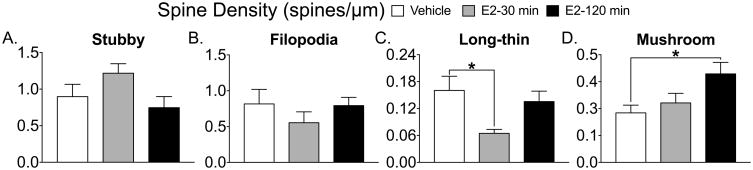
Figure 1. Estradiol treatment decreases the density of long-thin spines and increases mushroom spines
Stubby (A) and filopodia (B) spines did not change as a consequence of E2 treatment. Long-thin spines show a significant reduction 30 min following E2 compared to vehicle (*p=0.04, C). Mushroom spines show a significant increase 120 min following E2 treatment compared to vehicle (*p=0.03, D).
Figure 2
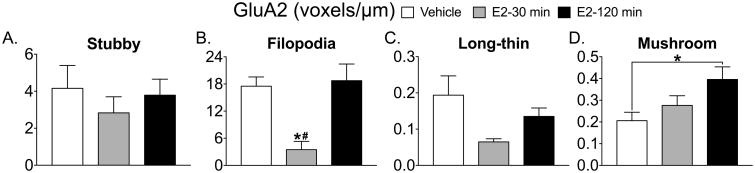
Figure 2. Estradiol treatment decreases GluA2 levels in filopodia spines and increases GluA2 levels within mushroom spines
GluA2 levels in stubby spines did not change with E2 treatment (A). 30 min following E2, GluA2 levels were significantly lower within filopodia spines compared to vehicle and compared to 120 min after E2 treatment (*p=0.005, #p=0.006 respectively, B). GluA2 levels within long-thin spines did not change as a consequence of E2 treatment (C). GluA2 levels within mushroom spines show a significant increase 120 min following E2 treatment compared to vehicle (*p=0.027, D).
Figure 3
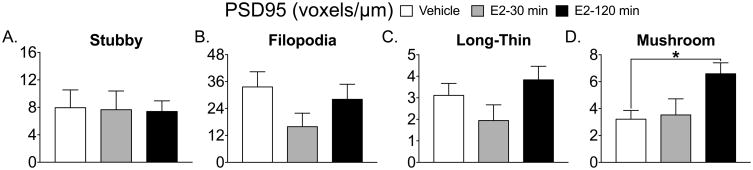
Figure 3. Estradiol increases PSD95 levels within mushroom spines
PSD95 levels within stubby (A), filopodia (B) and long-thin spines (C) did not change following E2 treatment. PSD95 levels within mushroom spines show a significant increase 120 min following E2 treatment compared to vehicle (*p=0.038, D).
Figure 4
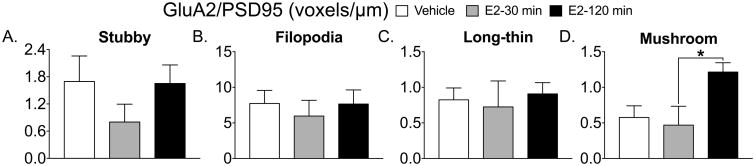
Figure 4. Estradiol increases GluA2/PSD95 colocalization levels within mushroom spines
GluA2/PSD95 colocalization levels within stubby (A), filopodia (B), and long-thin (C) spines did not significantly change following E2 treatment. GluA2/PSD95 colocalization levels significantly increase 120 min following E2 treatment compared to 30 min after E2 (*p=0.036; D).
Figure 5
Figure 5. Identification of spine-specific changes in the CA1 region of the hippocampus following Estradiol administration
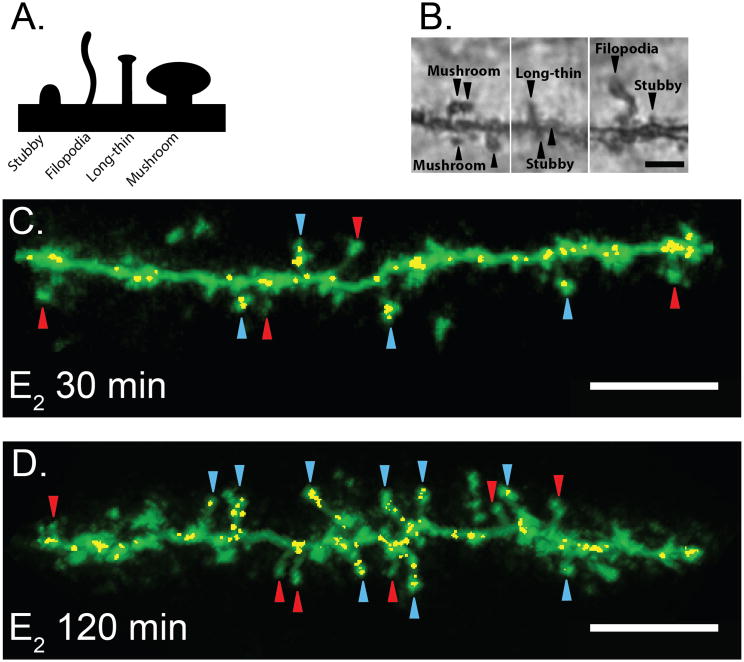
(A) Classification of dendritic spine morphology. (B) Representative Golgi-impregnation of hippocampus CA1 spines captured at 100x magnification. Scale bar =3μm. (C, D) Estradiol increases colocalization of GluA2 and PSD95 within Mushroom spines. Representative dendrites from E30 min (C) and E120 min (D). Yellow voxels indicate colocalized GluA2 and PSD95 within Mushroom spines. All carats indicate mushroom spines. Red carats indicate mushroom spines that do not contain colocalized GluA2 and PSD95. Blue carats indicate mushroom spines that contain colocalized GluA2 and PSD95. Scale bar =5μm.

References

    1. Almey A, Milner TA, Brake WG. Estrogen receptors in the central nervous system and their implication for dopamine-dependent cognition in females. Horm Behav. 2015;74:125–138. - PMC - PubMed
    1. Anggono V, Huganir RL. Regulation of AMPA receptor trafficking and synaptic plasticity. Curr Opin Neurobiol. 2012;22:461–469. - PMC - PubMed
    1. Beltran-Campos V, Prado-Alcalá R, Leon-Jacinto U, Aguilar-Vazquez A, Quirarte G, Ramirez-Amaya V, Diaz-Cintra S. Increase of mushroom spine density in CA1 apical dendrites produced by water maze training is prevented by ovariectomy. Brain research. 2011;1369:119–130. - PubMed
    1. Bourne J, Harris KM. Do thin spines learn to be mushroom spines that remember? Curr Opin Neurobiol. 2007;17:381–386. - PubMed
    1. Bourne JN, Harris KM. Balancing structure and function at hippocampal dendritic spines. Annu Rev Neurosci. 2008;31:47–67. - PMC - PubMed