


Electrochemically Enabled, Nickel-Catalyzed Amination
- PMID: 28834098
- PMCID: PMC5792186
- DOI: 10.1002/anie.201707906
Electrochemically Enabled, Nickel-Catalyzed Amination
Abstract
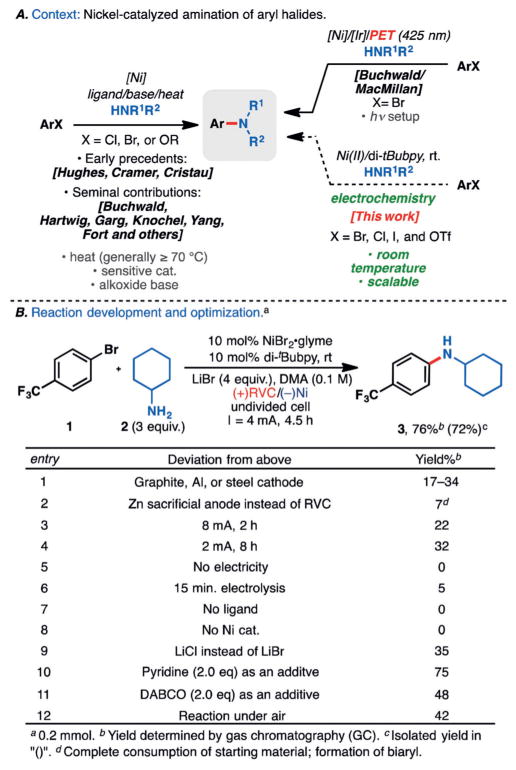
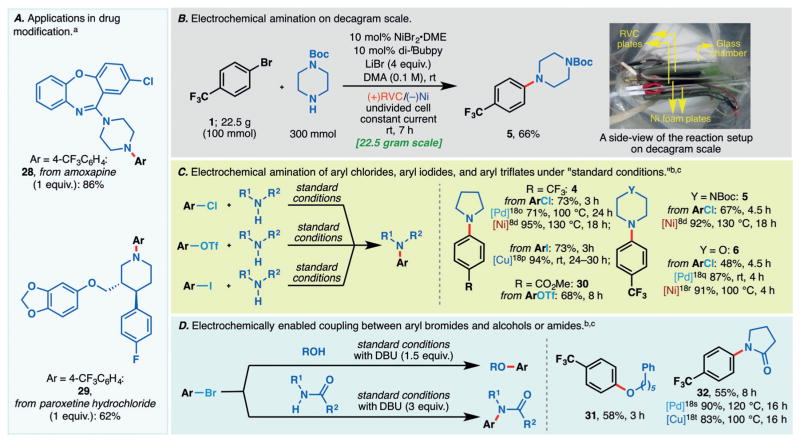
Along with amide bond formation, Suzuki cross-coupling, and reductive amination, the Buchwald-Hartwig-Ullmann-type amination of aryl halides stands as one of the most employed reactions in modern medicinal chemistry. The work herein demonstrates the potential of utilizing electrochemistry to provide a complementary avenue to access such critical bonds using an inexpensive nickel catalyst under mild reaction conditions. Of note is the scalability, functional-group tolerance, rapid rate, and the ability to employ a variety of aryl donors (Ar-Cl, Ar-Br, Ar-I, Ar-OTf), amine types (primary and secondary), and even alternative X-H donors (alcohols and amides).
Keywords: amination; arylation; cross-coupling; electrochemistry; nickel.
© 2017 Wiley-VCH Verlag GmbH & Co. KGaA, Weinheim.
Conflict of interest statement
The authors declare no conflict of interest.
Figures

References
-
-
Ruiz-Castillo P, Buchwald SL. Chem Rev. 2016;116:12564.Hartwig JF. Angew Chem Int Ed. 1998;37:2046.Angew Chem. 1998;110:2154.For another recent summary, see: Ishihara Y, Montero A, Baran PS. The Portable Chemist’s Consultant, version 2.7.1. Apple Publishing Group; New York: 2016.
-
-
-
Analysis based on representative publications in J Med Chem Brown DG, Boström J. J Med Chem. 2016;59:4443.
-
-
-
For a review on the Ullmann coupling, see: Sambiagio C, Marsden SP, Blacker AJ, McGowan PC. Chem Soc Rev. 2014;43:3525.
-
-
- Hughes EC, Veatch F, Elersich V. Ind Eng Chem. 1950;42:787.
-
-
For a review on nickel-catalyzed amination of aryl halides, see: Mar%n M, Rama RJ, Nicasio MC. Chem Rec. 2016;16:1819.
-
Publication types
MeSH terms
Substances
Grants and funding
LinkOut - more resources
Full Text Sources
Other Literature Sources
Research Materials
