


Cytoreductive nephrectomy for metastatic renal cell carcinoma: inequities in access exist despite improved survival
- PMID: 28834281
- PMCID: PMC5633591
- DOI: 10.1002/cam4.1137
Cytoreductive nephrectomy for metastatic renal cell carcinoma: inequities in access exist despite improved survival
Abstract
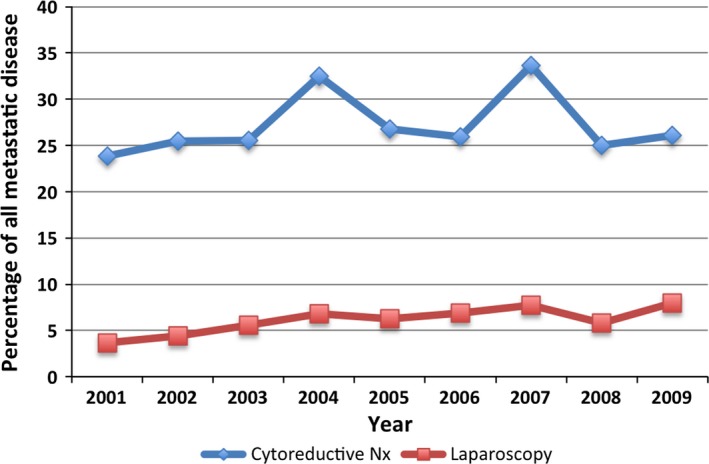
The use of cytoreductive nephrectomy (CRN) in the targeted therapy era is still debated. We aimed to determine factors associated with reduced use of CRN and determine the effect of CRN on overall survival in patients with metastatic renal cell carcinoma (RCC). All advanced RCC diagnosed between 2001 and 2009 in New South Wales, Australia, were identified from the Central Cancer Registry. Records of treatment and death were electronically linked. Follow-up was to the end of 2011. Multivariable logistic regression analysis was used to determine factors associated with the receipt of CRN. Cox proportional hazards model was used to determine factors associated with survival. A total of 1062 patients were identified with metastatic RCC of whom 289 (27%) received CRN. There was no difference in the use of CRN over the time period of the study. Females (OR 0.68 (95% CI: 0.48-0.96)), unmarried individuals (OR 0.68 (95% CI: 0.48-0.96)), treatment in a nonteaching hospital (OR 0.26 (95% CI: 0.18-0.36)) and individuals without private insurance (OR 0.29 (95% CI: 0.20-0.41)) all had reduced likelihood of receiving CRN. On multivariable analysis, not receiving CRN resulted in a 90% increase in death (HR 1.90 (95% CI: 1.61-2.25)). In addition, increasing age (P < 0.001), increasing Charlson comorbidity status (P = 0.002) and female gender also had a significant independent association with death. Despite a strong association with improved survival, individuals who are elderly, female, have treatment in a nonteaching facility or have no private insurance have a reduced likelihood of receiving CRN.
Keywords: Cytoreductive; Renal cell carcinoma; inequity; laparoscopic; metastatic; survival.
© 2017 The Authors. Cancer Medicine published by John Wiley & Sons Ltd.
Figures
References
-
- Motzer, R. J. , Bacik J., Schwartz L. H., Reuter V., Russo P., Marion S., et al. 2004. Prognostic factors for survival in previously treated patients with metastatic renal cell carcinoma. J. Clin. Oncol. 22:454–463. - PubMed
-
- Flanigan, R. C. , Salmon S. E., Blumenstein B. A., Bearman S. I., Roy V., McGrath P. C., et al. 2001. Nephrectomy followed by interferon alfa‐2b compared with interferon alfa‐2b alone for metastatic renal‐cell cancer. N. Engl. J. Med. 345:1655–1659. - PubMed
-
- Mickisch, G. H. , Garin A., vanPoppel H. , dePrijck L. , and Sylvester R., European Organisation for R, Treatment of Cancer Genitourinary G . 2001. Radical nephrectomy plus interferon‐alfa‐based immunotherapy compared with interferon alfa alone in metastatic renal‐cell carcinoma: a randomised trial. Lancet 358:966–970. - PubMed
-
- Motzer, R. J. , Hutson T. E., Tomczak P., Michaelson M. D., Bukowski R. M., Rixe O., et al. 2007. Sunitinib versus interferon alfa in metastatic renal‐cell carcinoma. N. Engl. J. Med. 356:115–124. - PubMed
MeSH terms
LinkOut - more resources
Full Text Sources
Other Literature Sources
Medical
Miscellaneous
