


Pharmacological inhibition of the triggering receptor expressed on myeloid cells-1 limits reperfusion injury in a porcine model of myocardial infarction
- PMID: 28834656
- PMCID: PMC6410538
- DOI: 10.1002/ehf2.12029
Pharmacological inhibition of the triggering receptor expressed on myeloid cells-1 limits reperfusion injury in a porcine model of myocardial infarction
Abstract
Aims: Limitation of ischemia/reperfusion injury is a major therapeutic target after acute myocardial infarction (AMI). Toll-like receptors are implicated in the inflammatory response that occurs during reperfusion. The triggering receptor expressed on myeloid cells (TREM)-1 acts as an amplifier of the immune response triggered by toll-like receptor engagement. We hypothesized that administration of a TREM-1 inhibitory peptide (LR12) could limit reperfusion injury in a porcine model of AMI.
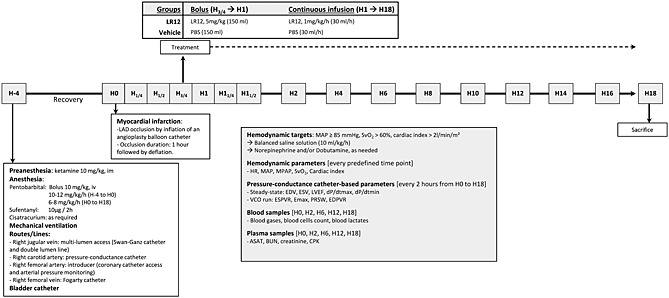
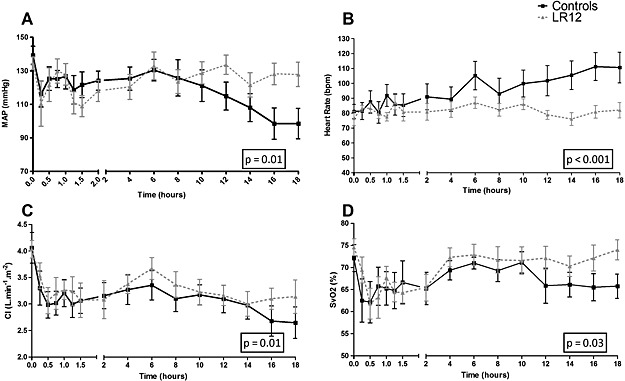
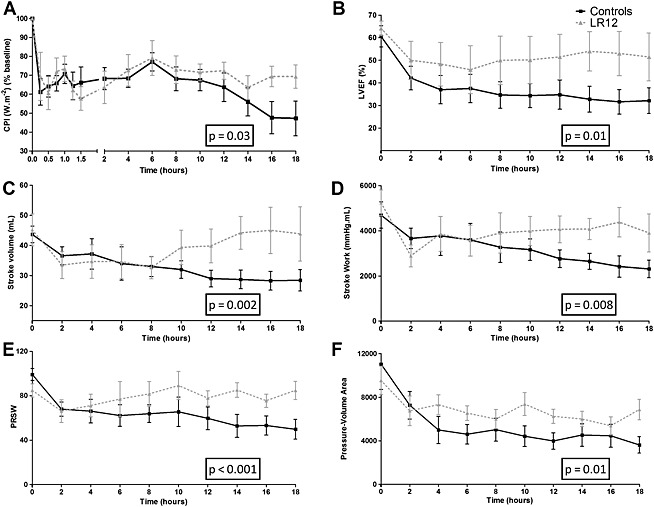
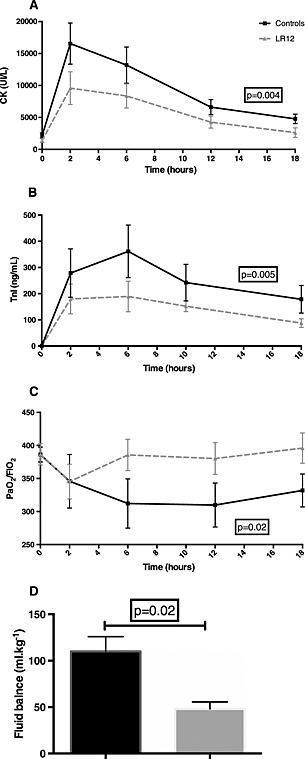
Methods and results: AMI was induced in 15 adult minipigs by a closed-chest coronary artery occlusion-reperfusion technique. Animals were randomized to receive LR12 or vehicle before reperfusion (LR12 n = 7, vehicle n = 8), and were monitored during 18 h. AMI altered hemodynamics and cardiac function, as illustrated by a drop of mean arterial pressure, cardiac index, cardiac power index, ejection fraction, and real-time pressure-volume loop-derived parameters. TREM-1 inhibition by LR12 significantly improved these dysfunctions (P < 0.03) and limited infarct size, as assessed by lower creatine phosphokinase and troponin I concentrations (P < 0.005). Pulmonary, renal, and hepatic impairments occurred after AMI and were attenuated by LR12 administration as assessed by a better PaO2 to FiO2 ratio, a less positive fluid balance, and lower liver enzymes levels (P < 0.05).
Conclusion: Inhibition of the TREM-1 pathway by a synthetic peptide limited myocardial reperfusion injury in a clinically relevant porcine model of AMI.
Keywords: Immune system; Inflammation; Myocardial infarction; Reperfusion.
© 2015 The Authors. ESC Heart Failure published by John Wiley & Sons Ltd on behalf of the European Society of Cardiology.
Conflict of interest statement
Marc Derive and Sébastien Gibot are co‐founders of INOTREM, a company developing TREM‐1 inhibitors
Figures
References
-
- Puymirat E, Simon T, Steg PG, Schiele F, Guéret P, Blanchard D, Khalife K, Goldstein P, Cattan S, Vaur L, Cambou J‐P, Ferrières J, Danchin N. USIK USIC 2000 Investigators, FAST MI Investigators . Association of changes in clinical characteristics and management with improvement in survival among patients with ST‐elevation myocardial infarction. JAMA 2012; 308: 998–1006. - PubMed
-
- Fröhlich GM, Meier P, White SK, Yellon DM, Hausenloy DJ. Myocardial reperfusion injury: looking beyond primary PCI. Eur Heart J 2013; 34: 1714–1722. - PubMed
-
- Arslan F, de Kleijn DPV, Timmers L, Doevendans PA, Pasterkamp G. Bridging innate immunity and myocardial ischemia/reperfusion injury: the search for therapeutic targets. Curr Pharm Des 2008; 14: 1205–1216. - PubMed
-
- Arslan F, de Kleijn DP, Pasterkamp G. Innate immune signaling in cardiac ischemia. Nat Rev Cardiol 2011; 8: 292–300. - PubMed
LinkOut - more resources
Full Text Sources
Other Literature Sources
