


Skeletal muscle weakness is related to insulin resistance in patients with chronic heart failure
- PMID: 28834658
- PMCID: PMC6410535
- DOI: 10.1002/ehf2.12035
Skeletal muscle weakness is related to insulin resistance in patients with chronic heart failure
Abstract
Background: Chronic heart failure (CHF) is associated with insulin resistance, indicating impairment in the control of energy metabolism. Insulin resistance in CHF relates to symptomatic status and independently predicts poor prognosis. We sought to determine whether insulin sensitivity is related to skeletal muscle strength in patients with CHF, taking into account muscle size and perfusion.
Methods: Quadriceps muscle size (square centimetre cross-sectional area at mid-femur level, computed tomography), isometric quadriceps muscle strength [absolute (in N) and strength per unit muscle area (N/cm2 )], resting-leg blood flow (plethysmography) and maximal oxygen consumption (treadmill exercise test) were measured in 33 patients with CHF (left ventricular ejection fraction 28 ± 3.2%, mean ± Standard Error of the mean (SEM)) and 20 healthy controls. Insulin sensitivity was assessed by intravenous glucose tolerance tests and minimal modelling analysis.
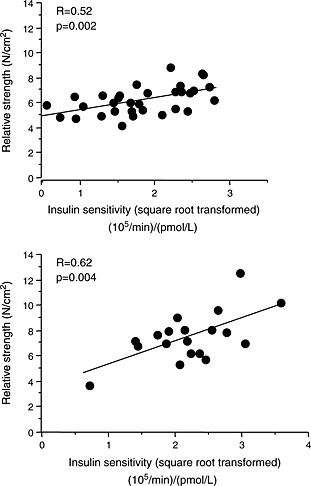
Results: Right quadriceps strength (-27.0%, P < 0.0001), strength per muscle area (-18.0%, P < 0.003) and insulin sensitivity (-64.2%, P < 0.001) were lower in patients with CHF. The correlation between insulin sensitivity and absolute muscle strength was significant in the CHF group (r = 0.54, P = 0.001) and borderline in controls (r = 0.47, P = 0.06). This association remained significant between insulin sensitivity and strength per muscle area (CHF: r = 0.52, P < 0.01; controls: r = 0.62, P < 0.05). In stepwise regression analyses in CHF, only insulin sensitivity emerged as a predictor of strength per unit area of muscle [standardized coefficient (SC) = 0.45, P = 0.006; diuretic dose, SC = -0.31, P = 0.051; R2 = 0.37, P = 0.001], while age, left ventricular ejection fraction, maximal oxygen consumption, fasting glucose and insulin and blood flow were excluded. In controls, only insulin sensitivity remained in the final regression model (SC = 0.62, P = 0.004; R2 = 0.39, P = 0.004).
Conclusions: The myofibril contractile function of the quadriceps, i.e. functional quality of skeletal muscle, is strongly related to insulin sensitivity in patients with CHF and in healthy controls, independently of muscle size. Therapies aimed at improving insulin sensitivity in patients with CHF may clarify whether this relationship is causal.
Keywords: Chronic heart failure; Insulin sensitivity; Skeletal muscle.
© 2015 The Authors. ESC Heart Failure published by John Wiley & Sons Ltd on behalf of the European Society of Cardiology.
Figures
References
-
- Mancini DM, Walter G, Reichek N, Lenkinski R, McCully KK, Mullen JL, Wilson JR. Contribution of skeletal muscle atrophy to exercise intolerance and altered muscle metabolism in heart failure. Circulation 1992; 85:1364–73. - PubMed
-
- Doehner W, Frenneaux M, Anker SD. Metabolic impairment in heart failure: the myocardial and systemic perspective. J Am Coll Cardiol 2014; 64: 1388–400. - PubMed
-
- Sullivan MJ, Green HJ, Cobb FR. Skeletal muscle biochemistry and histology in ambulatory patients with long‐term heart failure. Circulation 1990; 81:518–27. - PubMed
-
- Williams AD, Carey MF, Selig S, Hayes A, Krum H, Patterson J, Toia D, Hare DL. Circuit resistance training in chronic heart failure improves skeletal muscle mitochondrial ATP production rate‐‐a randomized controlled trial. J Card Fail 2007; 13: 79–85. - PubMed
LinkOut - more resources
Full Text Sources
Other Literature Sources
