


Plasmodium falciparum malaria parasite var gene expression is modified by host antibodies: longitudinal evidence from controlled infections of Kenyan adults with varying natural exposure
- PMID: 28835215
- PMCID: PMC5569527
- DOI: 10.1186/s12879-017-2686-0
Plasmodium falciparum malaria parasite var gene expression is modified by host antibodies: longitudinal evidence from controlled infections of Kenyan adults with varying natural exposure
Abstract
Background: The PfEMP1 family of Plasmodium falciparum antigens play a key role in pathogenesis of severe malaria through their insertion into the surface of parasite infected erythrocytes, and adhesion to host cells. Previous studies have suggested that parasites expressing PfEMP1 subclasses group A and DC8, associated with severe malaria, may have a growth advantage in immunologically naïve individuals. However, this idea has not been tested in longitudinal studies.
Methods: Here we assessed expression of the var genes encoding PfEMP1, in parasites sampled from volunteers with varying prior exposure to malaria, following experimental infection by sporozoites (PfSPZ). Using qPCR, we tested for associations between the expression of various var subgroups in surviving parasite populations from each volunteer and 1) the levels of participants' antibodies to infected erythrocytes before challenge infection and 2) the apparent in vivo parasite multiplication rate.
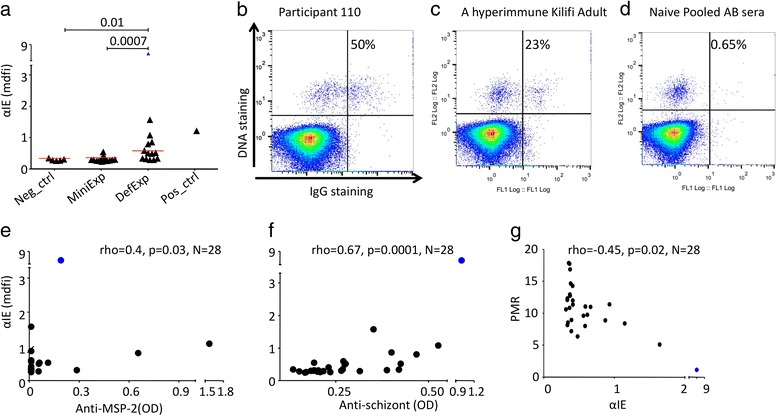
Results: We show that 1) expression of var genes encoding for group A and DC8-like PfEMP1 were associated with low levels of antibodies to infected erythrocytes (αIE) before challenge, and 2) expression of a DC8-like CIDRα1.1 domain was associated with higher apparent parasite multiplication rate in a manner that was independent of levels of prior antibodies to infected erythrocytes.
Conclusions: This study provides insight into the role of antibodies to infected erythrocytes surface antigens in the development of naturally acquired immunity and may help explain why specific PfEMP1 variants may be associated with severe malaria.
Trial registration: Pan African Clinical Trial Registry: PACTR201211000433272 . Date of registration: 10th October 2012.
Keywords: Antibodies; Controlled human malaria infection (CHMI); Immunity; P. falciparum; PfEMP1; Sporozoite.
Conflict of interest statement
Ethics approval and consent to participate
Ethical approval was obtained from Kenya Medical Research Institute Scientific and Ethical Review Unit (KEMRI-SERU) and written informed consent was obtained from the study participants who were all Kenyan adults. The study methods were carried out in accordance with the approved guidelines.
Consent for publication
This paper was published with the permission of the director of KEMRI.
Competing interests
Sanaria Inc. manufactured PfSPZ challenge used in the study. Thus, Stephen L. Hoffman has potential conflicts of interest.
Publisher’s Note
Springer Nature remains neutral with regard to jurisdictional claims in published maps and institutional affiliations.
Figures
References
-
- Miller LH, Baruch DI, Marsh K, Doumbo OK. The pathogenic basis of malaria. Nature. 2002;415(6872):673–9. - PubMed
Publication types
MeSH terms
Substances
Associated data
Grants and funding
LinkOut - more resources
Full Text Sources
Other Literature Sources
Miscellaneous
