A statewide evaluation of seven strategies to reduce opioid overdose in North Carolina
- PMID: 28835443
- PMCID: PMC5795575
- DOI: 10.1136/injuryprev-2017-042396
A statewide evaluation of seven strategies to reduce opioid overdose in North Carolina
Abstract
Background: In response to increasing opioid overdoses, US prevention efforts have focused on prescriber education and supply, demand and harm reduction strategies. Limited evidence informs which interventions are effective. We evaluated Project Lazarus, a centralised statewide intervention designed to prevent opioid overdose.
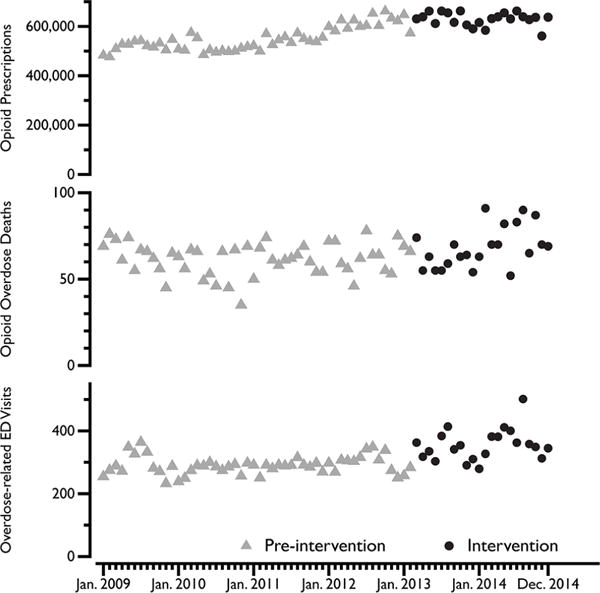
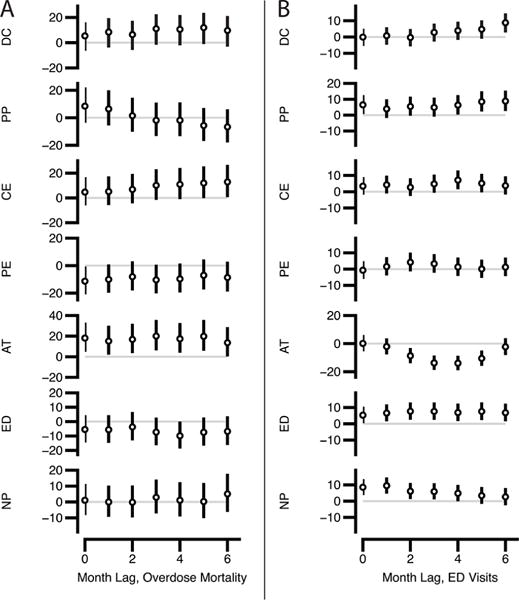
Methods: Observational intervention study of seven strategies. 74 of 100 North Carolina counties implemented the intervention. Dichotomous variables were constructed for each strategy by county-month. Exposure data were: process logs, surveys, addiction treatment interviews, prescription drug monitoring data. Outcomes were: unintentional and undetermined opioid overdose deaths, overdose-related emergency department (ED) visits. Interrupted time-series Poisson regression was used to estimate rates during preintervention (2009-2012) and intervention periods (2013-2014). Adjusted IRR controlled for prescriptions, county health status and time trends. Time-lagged regression models considered delayed impact (0-6 months).
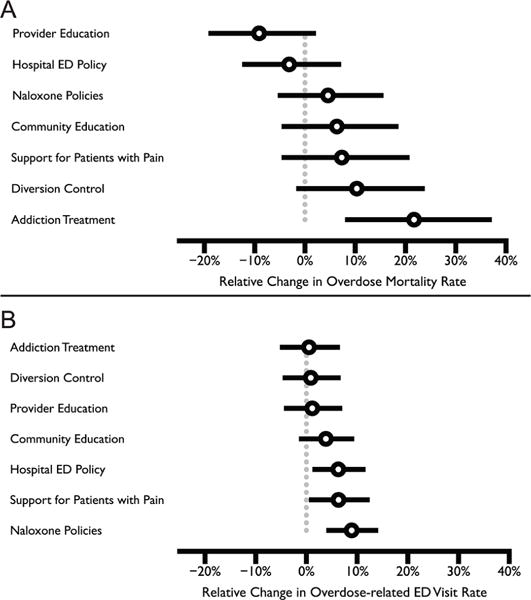
Results: In adjusted immediate-impact models, provider education was associated with lower overdose mortality (IRR 0.91; 95% CI 0.81 to 1.02) but little change in overdose-related ED visits. Policies to limit ED opioid dispensing were associated with lower mortality (IRR 0.97; 95% CI 0.87 to 1.07), but higher ED visits (IRR 1.06; 95% CI 1.01 to 1.12). Expansions of medication-assisted treatment (MAT) were associated with increased mortality (IRR 1.22; 95% CI 1.08 to 1.37) but lower ED visits in time-lagged models.
Conclusions: Provider education related to pain management and addiction treatment, and ED policies limiting opioid dispensing showed modest immediate reductions in mortality. MAT expansions showed beneficial effects in reducing ED-related overdose visits in time-lagged models, despite an unexpected adverse association with mortality.
Keywords: Epidemiology; Outcome Evaluation; Poisoning; Surveillance; Time Series.
© Article author(s) (or their employer(s) unless otherwise stated in the text of the article) 2018. All rights reserved. No commercial use is permitted unless otherwise expressly granted.
Conflict of interest statement
Competing interests: KM is an employee of the United States Centers for Disease Control and Prevention, which funded the evaluation of the study.
Figures
References
-
- Rudd RA, Aleshire N, Zibbell JE, et al. Increases in drug and opioid overdose deaths– United States, 2000-2014. MMWR Morb Mortal Wkly Rep. 2016;64:1378–82. - PubMed
-
- Center for Behavioral Health Statistics and Quality. Behavioral Health Trends in the United States: Results from the 2014 National Survey on Drug Use and Health. Rockville, Maryland: Substance Abuse and Mental Health Services Administration; 2015. (HHS Publication No. SMA 15-4927, NSDUH Series H-50).
-
- Gladden RM, Martinez P, Seth P. Fentanyl Law Enforcement Submissions and increases in Synthetic Opioid-Involved Overdose Deaths – 27 States, 2013–2014. MMWR Morb Mortal Wkly Rep. 2016;65:837–43. - PubMed
-
- Peterson AB, Gladden RM, Delcher C, et al. Increases in Fentanyl-Related Overdose Deaths – Florida and Ohio, 2013-2015. MMWR Morb Mortal Wkly Rep. 2016;65:844–9. - PubMed
-
- United States. National drug control strategy. Washington, DC: Office of National Drug Control Policy, Executive Office of the President; 2015.
Publication types
MeSH terms
Substances
Grants and funding
LinkOut - more resources
Full Text Sources
Other Literature Sources