


Ventilation inhibits sympathetic action potential recruitment even during severe chemoreflex stress
- PMID: 28835525
- PMCID: PMC5686238
- DOI: 10.1152/jn.00381.2017
Ventilation inhibits sympathetic action potential recruitment even during severe chemoreflex stress
Abstract
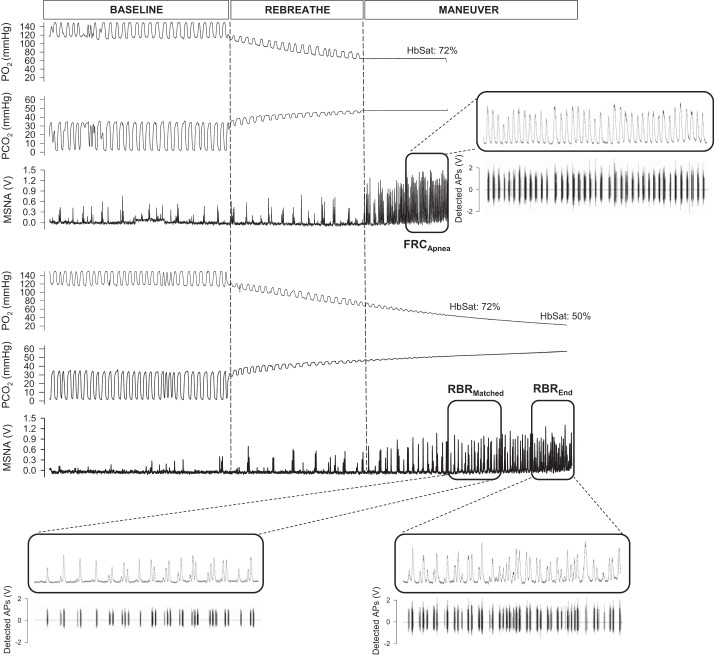
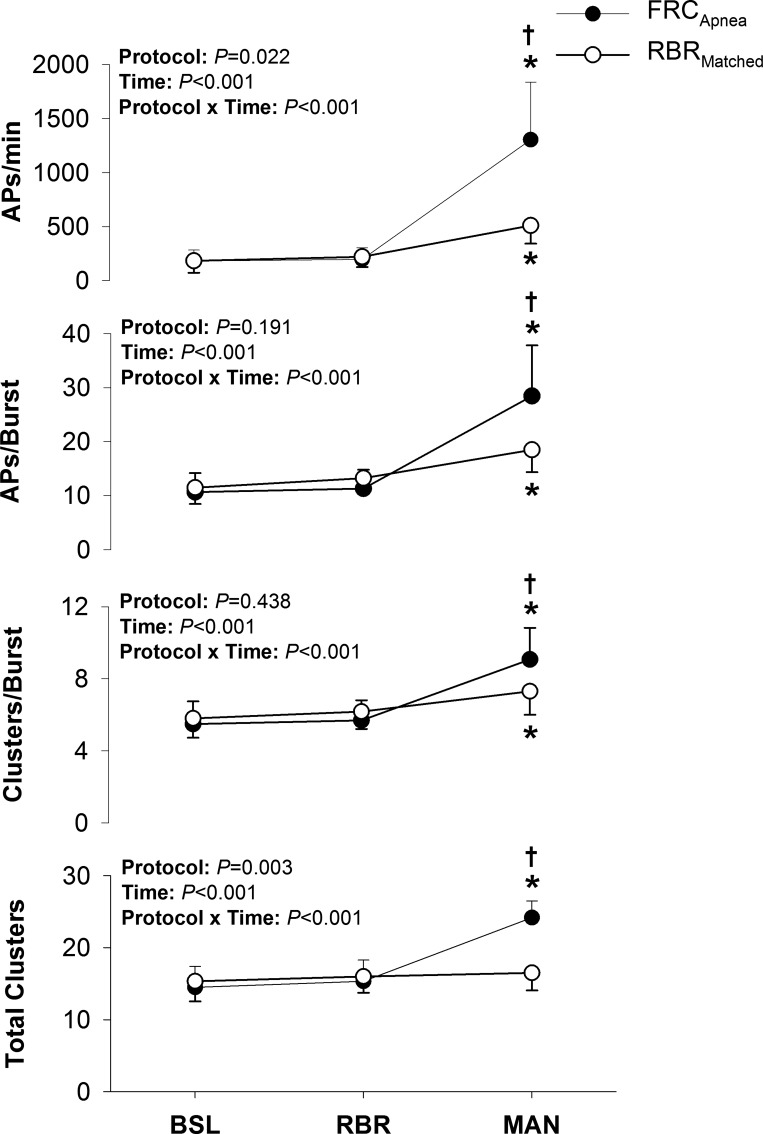
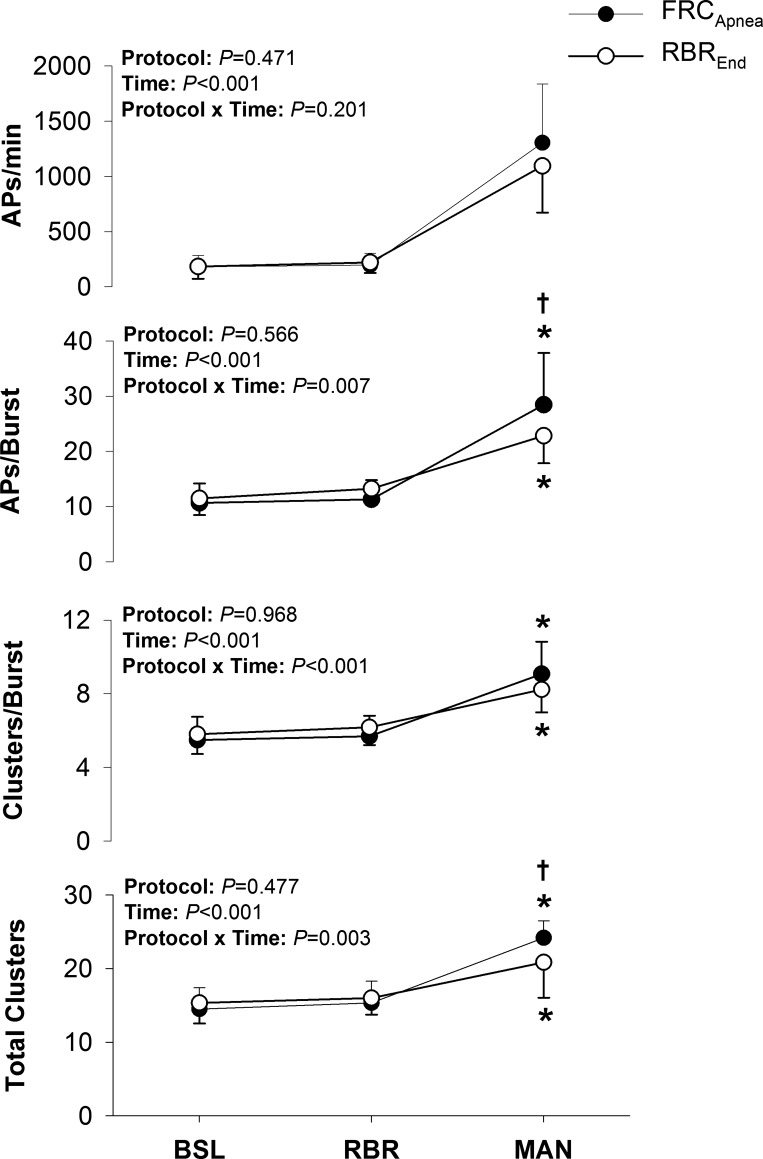
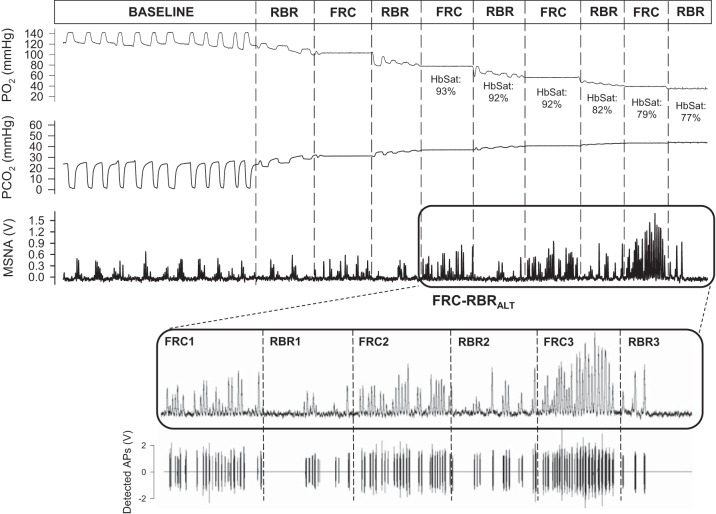
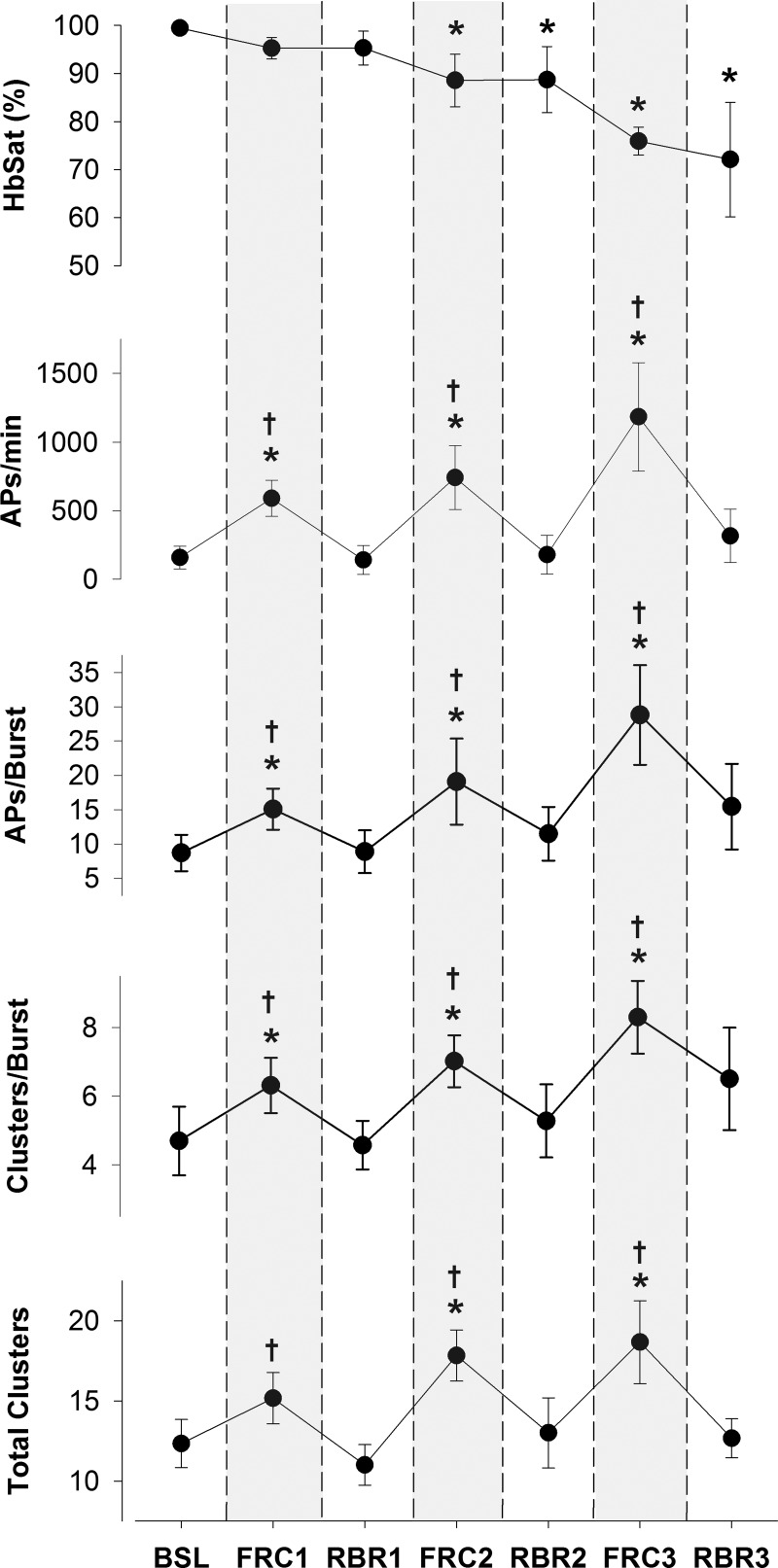
This study investigated the influence of ventilation on sympathetic action potential (AP) discharge patterns during varying levels of high chemoreflex stress. In seven trained breath-hold divers (age 33 ± 12 yr), we measured muscle sympathetic nerve activity (MSNA) at baseline, during preparatory rebreathing (RBR), and during 1) functional residual capacity apnea (FRCApnea) and 2) continued RBR. Data from RBR were analyzed at matched (i.e., to FRCApnea) hemoglobin saturation (HbSat) levels (RBRMatched) or more severe levels (RBREnd). A third protocol compared alternating periods (30 s) of FRC and RBR (FRC-RBRALT). Subjects continued each protocol until 85% volitional tolerance. AP patterns in MSNA (i.e., providing the true neural content of each sympathetic burst) were studied using wavelet-based methodology. First, for similar levels of chemoreflex stress (both HbSat: 71 ± 6%; P = NS), RBRMatched was associated with reduced AP frequency and APs per burst compared with FRCApnea (both P < 0.001). When APs were binned according to peak-to-peak amplitude (i.e., into clusters), total AP clusters increased during FRCApnea (+10 ± 2; P < 0.001) but not during RBRMatched (+1 ± 2; P = NS). Second, despite more severe chemoreflex stress during RBREnd (HbSat: 56 ± 13 vs. 71 ± 6%; P < 0.001), RBREnd was associated with a restrained increase in the APs per burst (FRCApnea: +18 ± 7; RBREnd: +11 ± 5) and total AP clusters (FRCApnea: +10 ± 2; RBREnd: +6 ± 4) (both P < 0.01). During FRC-RBRALT, all periods of FRC elicited sympathetic AP recruitment (all P < 0.001), whereas all periods of RBR were associated with complete withdrawal of AP recruitment (all P = NS). Presently, we demonstrate that ventilation per se restrains and/or inhibits sympathetic axonal recruitment during high, and even extreme, chemoreflex stress.NEW & NOTEWORTHY The current study demonstrates that the sympathetic neural recruitment patterns observed during chemoreflex activation induced by rebreathing or apnea are restrained and/or inhibited by the act of ventilation per se, despite similar, or even greater, levels of severe chemoreflex stress. Therefore, ventilation modulates not only the timing of sympathetic bursts but also the within-burst axonal recruitment normally observed during progressive chemoreflex stress.
Keywords: action potential; chemoreflex; muscle sympathetic nerve activity.
Copyright © 2017 the American Physiological Society.
Figures
References
-
- Badrov MB, Lalande S, Olver TD, Suskin N, Shoemaker JK. Effects of aging and coronary artery disease on sympathetic neural recruitment strategies during end-inspiratory and end-expiratory apnea. Am J Physiol Heart Circ Physiol 311: H1040–H1050, 2016a. doi: 10.1152/ajpheart.00334.2016. - DOI - PubMed
-
- Badrov MB, Olver TD, Shoemaker JK. Central vs. peripheral determinants of sympathetic neural recruitment: insights from static handgrip exercise and postexercise circulatory occlusion. Am J Physiol Regul Integr Comp Physiol 311: R1013–R1021, 2016b. doi: 10.1152/ajpregu.00360.2016. - DOI - PMC - PubMed
Publication types
MeSH terms
Substances
Grants and funding
LinkOut - more resources
Full Text Sources
Other Literature Sources
Miscellaneous
