


Comparison of patterns and prognosis among distant metastatic breast cancer patients by age groups: a SEER population-based analysis
- PMID: 28835702
- PMCID: PMC5569011
- DOI: 10.1038/s41598-017-10166-8
Comparison of patterns and prognosis among distant metastatic breast cancer patients by age groups: a SEER population-based analysis
Abstract
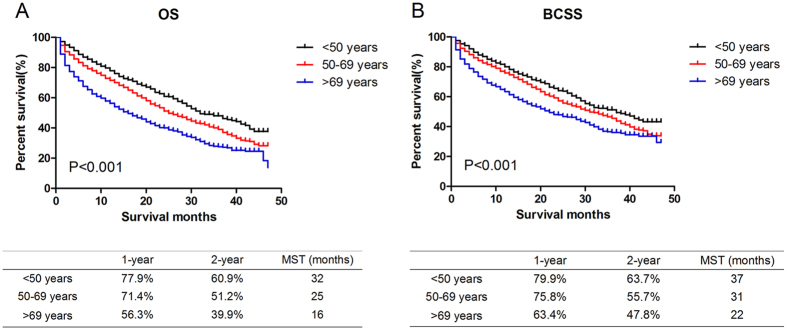
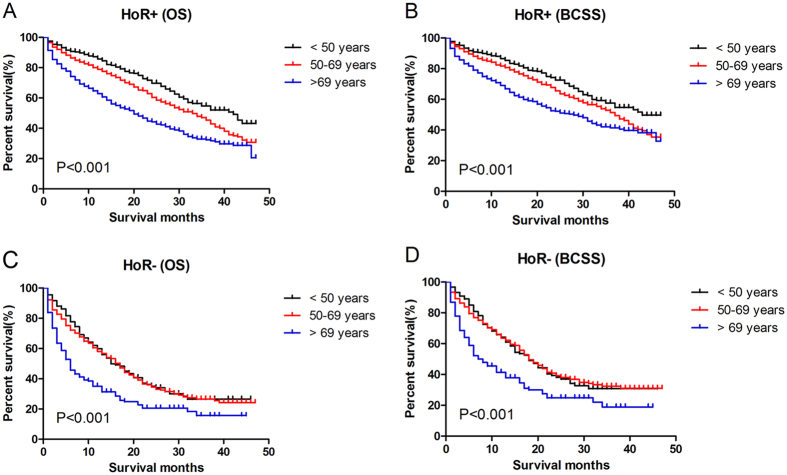
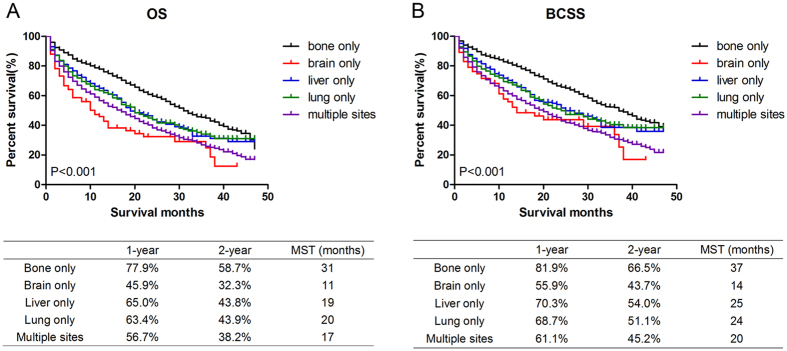
To investigate the effects of age at diagnosis on metastatic breast cancer and patients' prognosis, we collected patient data from the Surveillance, Epidemiology, and End Results (SEER) database. We finally identified 4932 eligible metastatic breast cancer patients diagnosed between 2010-2013, including 850 younger patients (<50 years), 2,540 middle-aged patients (50-69 years) and 1,542 elder patients (>69 years). The results revealed that in stage IV patients, elder patients were more likely to have lung metastasis (P < 0.001) and less likely to have only distant lymphatic spread (P = 0.004). Higher proportion of younger (34.9%) and middle-aged (36.2%) patients had multiple metastatic sites than elder patients (28.3%) (P < 0.001). In survival analysis, younger patients presented the best prognosis, while elder patients had the worst both in overall survival (χ2 = 121.9, P < 0.001) and breast cancer-specific survival (χ2 = 69.8, P < 0.001). Age at diagnosis was an independent prognostic factor for metastatic breast cancer patients. Moreover, patients with bone metastasis only had superior survival compared to other metastatic patients (P < 0.001). Brain metastasis only group and multiple sites metastasis group had the poorest prognosis (P < 0.05). We hope the results will provide insights into a better understanding of distant metastatic breast cancer.
Conflict of interest statement
The authors declare that they have no competing interests.
Figures
References
-
- Miller KD, et al. Cancer treatment and survivorship statistics, 2016. CA: a cancer journal for clinicians. 2016;66:271–289. - PubMed
-
- DeSantis CE, et al. Breast cancer statistics, 2015: Convergence of incidence rates between black and white women. CA: a cancer journal for clinicians. 2016;66:31–42. - PubMed
Publication types
MeSH terms
LinkOut - more resources
Full Text Sources
Other Literature Sources
Medical
