Review
. 2017 Aug 21:3:31.
doi: 10.1186/s40942-017-0084-9. eCollection 2017.

Retinal and choroidal angiogenesis: a review of new targets

Affiliations
Review

Retinal and choroidal angiogenesis: a review of new targets

Thiago Cabral et al. Int J Retina Vitreous. .

Abstract

Retinal and choroidal neovascularization are a major cause of significant visual impairment, worldwide. Understanding the various factors involved in the accompanying physiopathology is vital for development of novel treatments, and most important, for preserving patient vision. The intraocular use of anti-vascular endothelial growth factor therapeutics has improved management of the retinal and choroidal neovascularization but some patients do not respond, suggesting other vascular mediators may also contribute to ocular angiogenesis. Several recent studies examined possible new targets for future anti-angiogenic therapies. Potential targets of retinal and choroidal neovascularization therapy include members of the platelet-derived growth factor family, vascular endothelial growth factor sub-family, epidermal growth factor family, fibroblast growth factor family, transforming growth factor-β superfamily (TGF-β1, activins, follistatin and bone morphogenetic proteins), angiopoietin-like family, galectins family, integrin superfamily, as well as pigment epithelium derived factor, hepatocyte growth factor, angiopoietins, endothelins, hypoxia-inducible factors, insulin-like growth factors, cytokines, matrix metalloproteinases and their inhibitors and glycosylation proteins. This review highlights current antiangiogenic therapies under development, and discusses future retinal and choroidal pro- and anti-angiogenic targets as wells as the importance of developing of new drugs.

Keywords: Age-related macular degeneration; Angiogenesis; Anti-angiogenesis; Choroidal neovascularization; Cytokine; Ocular neovascularization; Targets; Vascular endothelial growth factor.


Figures
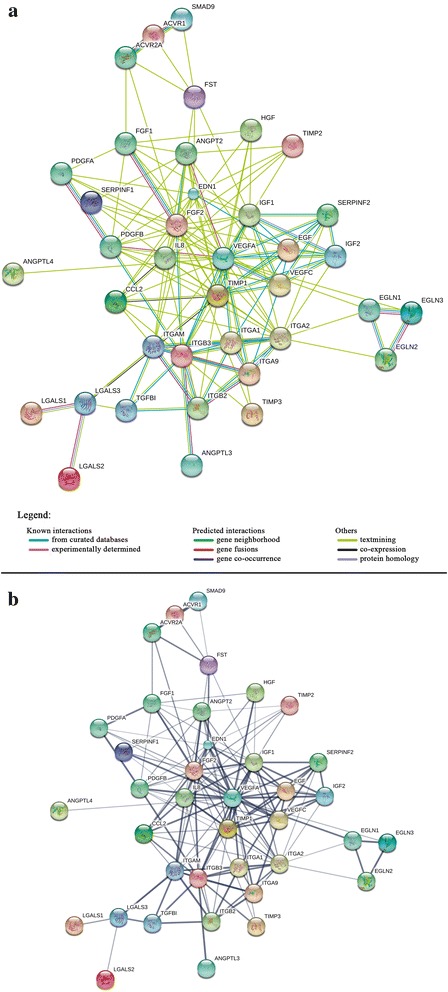
Fig. 1
Fig. 1
Protein–protein interaction (PPI) network of 38 potential angiogenesis-related proteins targets, based on STRING v10 data. This figure shows an important part of the retinal and choroidal angiogenesis-related PPI network and highlights the molecules with more and stronger interactions which we consider to be the main targets for future therapies. In this figure, proteins are represented as nodes, while interactions between them are represented as edges. Small and large nodes represent, respectively, proteins of unknown and known (or predicted) 3D structure. a Colored lines between the proteins indicate the various types of interaction evidence, as described in the figure legend. b Thickness indicates the strength of data support. Abbreviations: ACVR1 activin A receptor, type I; ACVR2A activin A receptor, type IIA, ANGPT2 angiopoietin 2, ANGPTL3 angiopoietin-like 3, ANGPTL4 angiopoietin-like 4, EDN1 endothelin 1, EGF epidermal growth factor, EGLN1 EGL nine homolog 1, EGLN2 EGL nine homolog 2, EGLN3 EGL nine homolog 3, FGF1 fibroblast growth factor 1, FGF2 fibroblast growth factor 2, FST follistatin, HGF hepatocyte growth factor, IGF1 insulin-like growth factor 1 (somatomedin C), IGF2 insulin-like growth factor 2 (somatomedin A), IL8 interleukin 8, CCL2 chemokine (C–C motif) ligand 2, ITGA1 integrin, alpha 1, ITGA2 integrin, alpha 2 (CD49B, alpha 2 subunit of VLA-2 receptor), ITGAM integrin, alpha M (complement component 3 receptor 3 subunit), ITGB2 integrin, beta 2 (complement component 3 receptor 3 and 4 subunit), ITGB3 integrin, beta 3 (platelet glycoprotein IIIa, antigen CD61), ITGA9 integrin, alpha 9, LGALS2 lectin, galactoside-binding, soluble, 2, LGALS1 lectin, galactoside-binding, soluble, 1, LGALS3 lectin, galactoside-binding, soluble, 3, PDGFA platelet-derived growth factor alpha polypeptide, PDGFB platelet-derived growth factor beta polypeptide, SERPINF1 serpin peptidase inhibitor, clade F (alpha-2 antiplasmin, pigment epithelium derived factor), member 1, SERPINF2 serpin peptidase inhibitor, clade F (alpha-2 antiplasmin, pigment epithelium derived factor), member 2, SMAD9 SMAD family member 9, TGFBI transforming growth factor, beta-induced, TIMP1 tissue inhibitor of metalloproteinases-1, TIMP2 tissue inhibitor of metalloproteinases-2, TIMP3 tissue inhibitor of metalloproteinases-3, VEGFA vascular endothelial growth factor A, VEGFC vascular endothelial growth factor C

References

    1. Campochiaro PA, Aiello LP, Rosenfeld PJ. Anti-vascular endothelial growth factor agents in the treatment of retinal disease: from bench to bedside. Ophthalmology. 2016;123:S78–S88. doi: 10.1016/j.ophtha.2016.04.056. - DOI - PubMed
    1. Bressler SB. Introduction: understanding the role of angiogenesis and antiangiogenic agents in age-related macular degeneration. Ophthalmology. 2009;116:S1–S7. doi: 10.1016/j.ophtha.2009.06.045. - DOI - PubMed
    1. Dreyfuss JL, Giordano RJ, Regatieri CV. Ocular angiogenesis. J Ophthalmol. 2015;2015:892043. doi: 10.1155/2015/892043. - DOI - PMC - PubMed
    1. Chang AA, Hong T, Ewe SY, Bahrami B, Broadhead GK. The role of aflibercept in the management of diabetic macular edema. Drug Des Devel Ther. 2015;9:4389–4396. doi: 10.2147/DDDT.S62778. - DOI - PMC - PubMed
    1. de Oliveira Dias JR, de Andrade GC, Novais EA, Farah ME, Rodrigues EB. Fusion proteins for treatment of retinal diseases: aflibercept, ziv-aflibercept, and conbercept. Int J Retina Vitreous. 2016;2:3. doi: 10.1186/s40942-016-0026-y. - DOI - PMC - PubMed
