


The contribution of alcohol consumption and smoking to educational inequalities in life expectancy among Swedish men and women during 1991-2008
- PMID: 28835983
- PMCID: PMC5766714
- DOI: 10.1007/s00038-017-1029-7
The contribution of alcohol consumption and smoking to educational inequalities in life expectancy among Swedish men and women during 1991-2008
Abstract
Objectives: To assess the level and changes in contribution of smoking and alcohol-related mortality to educational differences in life expectancy in Sweden.
Methods: We used register data on the Swedish population at ages 30-74 during 1991-2008. Cause of death was used to identify alcohol-related deaths, while smoking-related mortality was estimated using lung cancer mortality to indirectly assess the impact of smoking on all-cause mortality.
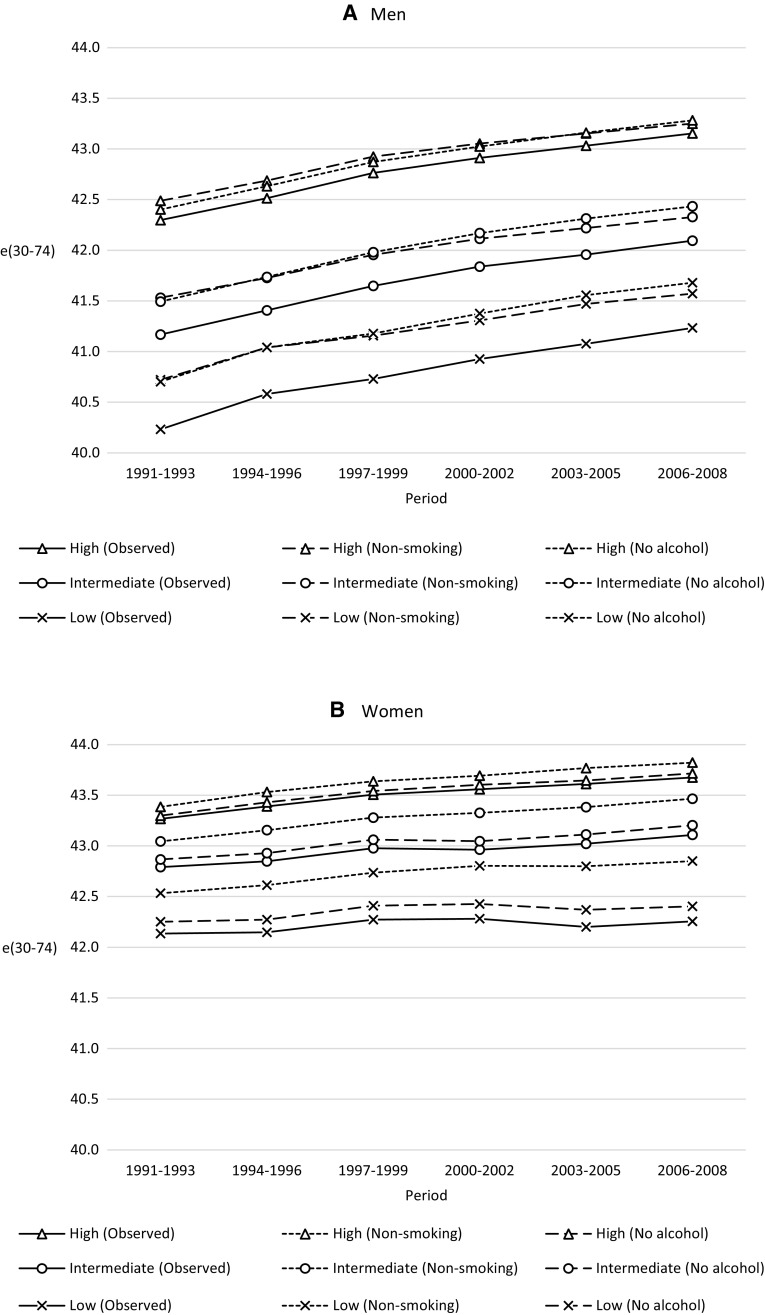
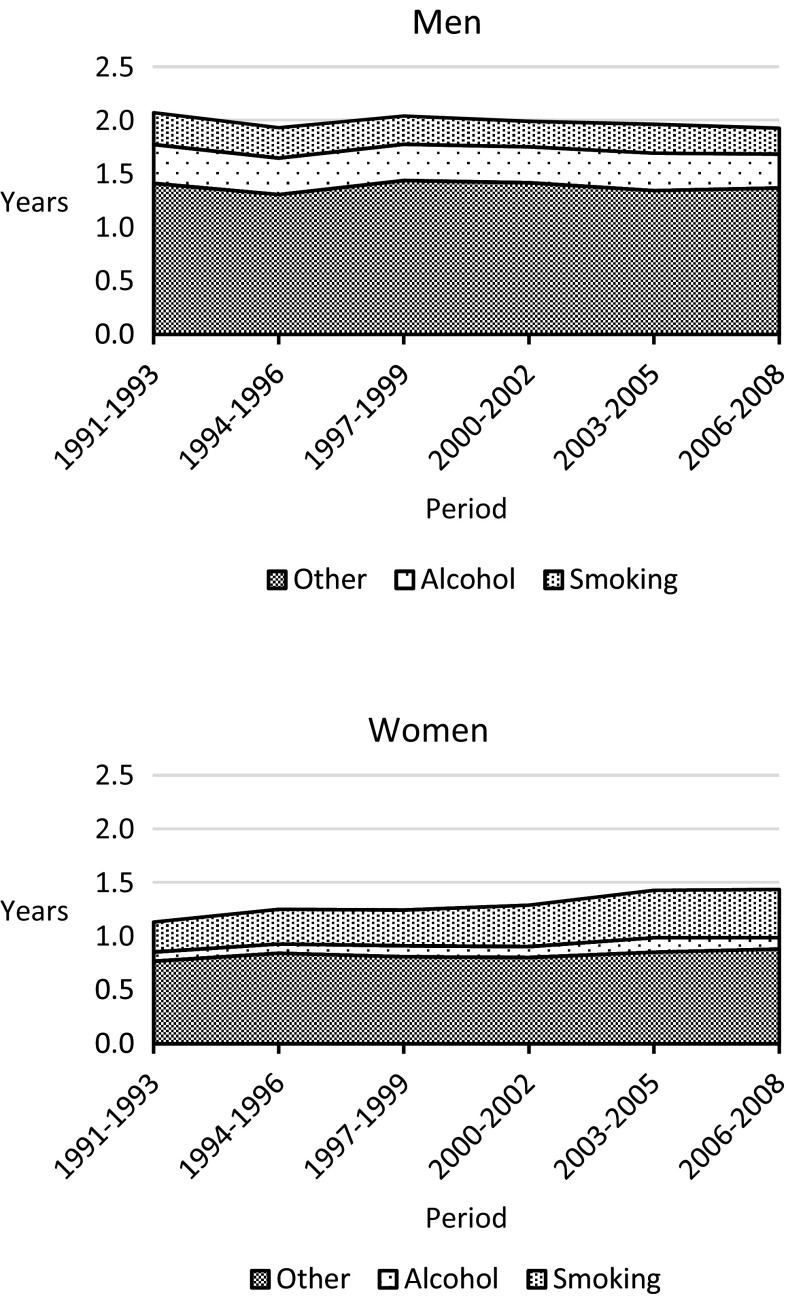
Results: Alcohol consumption and smoking contributed to educational differences in life expectancy. Alcohol-related mortality was higher among men and contributed substantially to inequalities among men and made a small (but increasing) contribution to inequalities among women. Smoking-related mortality decreased among men but increased among women, primarily among the low educated. At the end of the follow-up, smoking-related mortality were at similar levels among men and women. The widening gap in life expectancy among women could largely be attributed to smoking.
Conclusions: Smoking and alcohol consumption contribute to educational differences in life expectancy among men and women. The majority of the widening in the educational gap in mortality among women can be attributed to alcohol and smoking-related mortality.
Keywords: Alcohol; Health inequalities; Mortality; Registers; Smoking.
Conflict of interest statement
Conflict of interest
The authors declare that they have no conflict of interest.
Ethical permission
The use of data was approved by the KI regional ethics committee (Ref. 02-481).
Funding
This work was supported by the Faculty of Social Sciences, Stockholm University, the Academy of Finland, the Swedish Research Council for Health, Working Life and Welfare (Grant No. 1933006), as well as the Joint Committee for Nordic Research Councils for the Humanities and the Social Sciences (NOS-HS) (Project No. 4.4-2015-61).
Figures
References
-
- Agardh E, Boman U, Allebeck P (2015) Alkohol, narkotika och tobaksrökning ger stor del av sjukdomsbördan. Läkartidningen 112:C4TH - PubMed
-
- Backhans M, Stjernschantz Forsberg J, Lager A (eds) (2015) Folkhälsorapport 2015. Centrum för epidemiologi och samhällsmedicin, Stocklms läns landsting, Stockholm
MeSH terms
Grants and funding
LinkOut - more resources
Full Text Sources
Other Literature Sources
Medical
Miscellaneous
