


Readability of the Most Commonly Accessed Online Patient Education Materials Pertaining to Pathology of the Hand
- PMID: 28836453
- PMCID: PMC6300184
- DOI: 10.1177/1558944717726138
Readability of the Most Commonly Accessed Online Patient Education Materials Pertaining to Pathology of the Hand
Abstract
Background: The American Medical Association (AMA) and National Institutes of Health (NIH) recommend that patient education materials be written at no higher than a sixth-grade reading level.
Methods: We examined 100 online educational materials for the 10 hand conditions most commonly treated by hand surgeons, as reported by the American Society for Surgery of the Hand. The listed conditions were carpal tunnel syndrome, basal joint arthritis of the thumb, de Quervain syndrome, Dupuytren's contracture, ganglion cysts, hand fractures, trigger finger, extensor tendon injuries, flexor tendon injuries, and mallet finger. Following a Google search for each condition, we analyzed the 10 most visited websites for each disorder utilizing the Flesch-Kincaid formula.
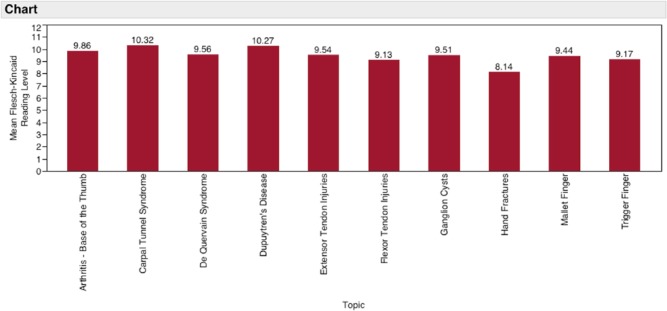
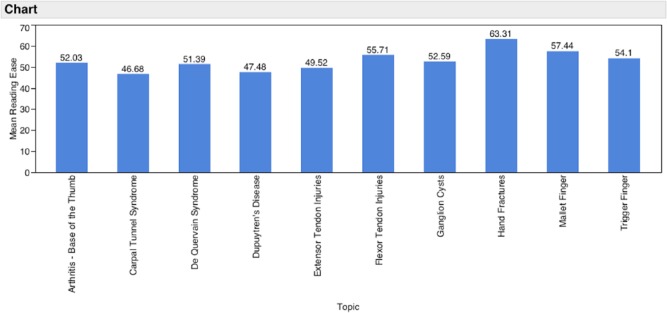
Results: The average grade reading level of the 100 websites studied was 9.49 with a reading ease of 53.03 ("fairly difficult high school"). Only 29% of the websites were at or below the national average of an eighth-grade reading level. Carpal tunnel syndrome had the highest average grade reading level at 10.32 (standard deviation: 1.52), whereas hand fractures had the lowest at 8.14 (2.03). Every hand condition in this study had an average readability at or above the ninth-grade reading level.
Conclusions: The most frequently accessed materials for common maladies of the hand exceed both the readability limits recommended by the AMA and NIH, and the average reading ability of most US adults. Therefore, the most commonly accessed websites pertaining to hand pathology may not be comprehended by the audience for which it is intended.
Keywords: ASSH; Flesch-Kincaid; Google; hand conditions; readability; reading level.
Conflict of interest statement
Figures
Comment in
-
Letter to Editor: Comments on "Readability of the Most Commonly Accessed Online Patient Education Materials Pertaining to Pathology of the Hand".Hand (N Y). 2019 Sep;14(5):709-710. doi: 10.1177/1558944719862646. Epub 2019 Jul 17. Hand (N Y). 2019. PMID: 31311323 Free PMC article. No abstract available.
-
Response to Letter Regarding "Readability of the Most Commonly Accessed Online Patient Education Materials Pertaining to Pathology of the Hand".Hand (N Y). 2019 Sep;14(5):711. doi: 10.1177/1558944719862645. Epub 2019 Jul 31. Hand (N Y). 2019. PMID: 31364425 Free PMC article. No abstract available.
References
-
- Albright J, de Guzman C, Acebo P, et al. Readability of patient education materials: implications for clinical practice. Appl Nurs Res. 1996;9(3):139-143. - PubMed
-
- Beredjiklian P, Bozentka D, Steinberg D, et al. Evaluating the source and content of orthopaedic information on the internet. The case of carpal tunnel syndrome. J Bone Joint Surg Am. 2000;82-A(11):1540-1543. - PubMed
-
- Bluman E, Foley R, Chiodo C. Readability of the patient education section of the AOFAS website. Foot Ankle Int. 2009;30(4):287-291. - PubMed
MeSH terms
LinkOut - more resources
Full Text Sources
Other Literature Sources
