


Disposing of Excess Vaccines After the Withdrawal of Oral Polio Vaccine
- PMID: 28838168
- PMCID: PMC5853297
- DOI: 10.1093/infdis/jiw572
Disposing of Excess Vaccines After the Withdrawal of Oral Polio Vaccine
Abstract
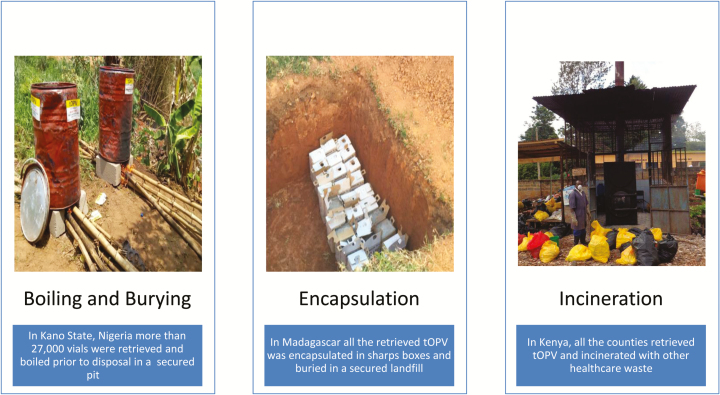
Until recently, waste management for national immunization programs was limited to sharps waste, empty vaccine vials, or vaccines that had expired or were no longer usable. However, because wild-type 2 poliovirus has been eradicated, the World Health Organization's (WHO's) Strategic Advisory Group of Experts on Immunization deemed that all countries must simultaneously cease use of the type 2 oral polio vaccine and recommended that all countries and territories using oral polio vaccine (OPV) "switch" from trivalent OPV (tOPV; types 1, 2, and 3 polioviruses) to bivalent OPV (bOPV; types 1 and 3 polioviruses) during a 2-week period in April 2016. Use of tOPV after the switch would risk outbreaks of paralysis related to type 2-circulating vaccine-derived poliovirus (cVDPV2). To minimize risk of vaccine-derived polio countries using OPV were asked to dispose of all usable, unexpired tOPV after the switch to bOPV. In this paper, we review the rationale for tOPV disposal and describe the global guidelines provided to countries for the safe and appropriate disposal of tOPV. These guidelines gave countries flexibility in implementing this important task within the confines of their national regulations, capacities, and resources. Steps for appropriate disposal of tOPV included removal of all tOPV vials from the cold chain, placement in appropriate bags or containers, and disposal using a recommended approach (ie, autoclaving, boiling, chemical inactivation, incineration, or encapsulation) followed by burial or transportation to a designated waste facility. This experience with disposal of tOPV highlights the adaptability of national immunization programs to new procedures, and identifies gaps in waste management policies and strategies with regard to disposal of unused vaccines. The experience also provides a framework for future policies and for developing programmatic guidance for the ultimate disposal of all OPV after the eradication of polio.
Keywords: OPV; disposal; oral polio vaccine; polio; poliovirus; waste management.
© The Author 2017. Published by Oxford University Press for the Infectious Diseases Society of America.
Figures
References
-
- Patel M, Orenstein W.. A world free of polio—the final steps. Massachusetts Medical Society; 2016; http://dx.doi.org/101056/NEJMp1514467. - PubMed
-
- Morales M, Tangermann RH, Wassilak SGF. Progress toward polio eradication—worldwide, 2015–2016. MMWR Morb Mortal Wkly Rep 2016; 65:470–3. http://www.cdc.gov/mmwr/volumes/65/wr/mm6518a4.htm Accessed 14 August 2016. - PubMed
-
- Jorba J, Diop OM, Iber J, Sutter RW, Wassilak SG, Burns CC. Update on vaccine-derived polioviruses—worldwide, January 2015–May 2016. MMWR Morb Mortal Wkly Rep 2016; 65:763–9. http://www.cdc.gov/mmwr/volumes/65/wr/mm6530a3.htm Accessed 14 August 2016. - PubMed
-
- Bandyopadhyay AS, Garon J, Seib K, Orenstein WA. Polio vaccination: past, present and future. Future Microbiol 2015;10:1–18. http://www.futuremedicine.com/doi/10.2217/fmb.15.19 Accessed 6 July 2016. - PubMed
Publication types
MeSH terms
Substances
Grants and funding
LinkOut - more resources
Full Text Sources
Other Literature Sources
Medical
Miscellaneous
