. 2017 Aug 24;7(1):9272.
doi: 10.1038/s41598-017-10039-0.

Leukocyte TRP channel gene expressions in patients with non-valvular atrial fibrillation

Affiliations

Leukocyte TRP channel gene expressions in patients with non-valvular atrial fibrillation

Irfan V Düzen et al. Sci Rep. .

Abstract

Atrial fibrillation (AF) is the most common arrhythmia in clinical practice and is a major cause of morbidity and mortality. The upregulation of TRP channels is believed to mediate the progression of electrical remodelling and the arrhythmogenesis of the diseased heart. However, there is limited data about the contribution of the TRP channels to development of AF. The aim of this study was to investigate leukocyte TRP channels gene expressions in non-valvular atrial fibrillation (NVAF) patients. The study included 47 NVAF patients and 47 sex and age matched controls. mRNA was extracted from blood samples, and real-time polymerase chain reaction was performed for gene expressions by using a dynamic array system. Low levels of TRP channel expressions in the controls were markedly potentiated in NVAF group. We observed marked increases in MCOLN1 (TRPML1), MCOLN2 (TRPML2), MCOLN3 (TRPML3), TRPA1, TRPM1, TRPM2, TRPM3, TRPM4, TRPM5, TRPM6, TRPM7, TRPM8, TRPC1, TRPC2, TRPC3, TRPC4, TRPC5, TRPC6, TRPC7, TRPV1, TRPV2, TRPV3, TRPV4, TRPV5, TRPV6, and PKD2 (TRPP2) gene expressions in NVAF patients (P < 0.05). However, there was no change in PKD1 (TRPP1) gene expression. This is the first study to provide evidence that elevated gene expressions of TRP channels are associated with the pathogenesis of NVAF.


Conflict of interest statement

The authors declare that they have no competing interests.

Figures
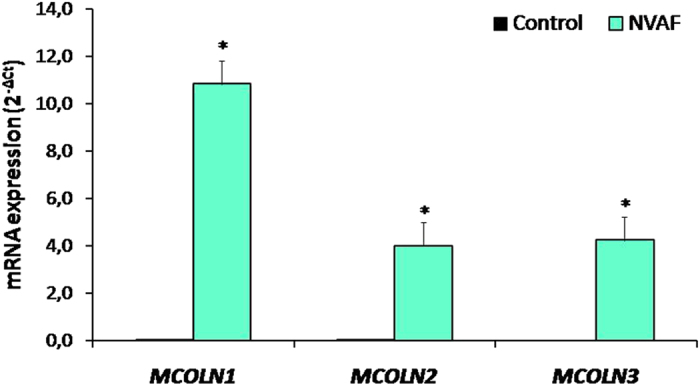
Figure 1
Figure 1
Comparison of the peripheral blood mRNA MCOLN1 (TRPML1), MCOLN2 (TRPML2), and MCOLN3 (TRPML3) expressions in healthy controls (n = 47, solid bars) and in patients with non-valvular atrial fibrillation (NVAF, n = 47, open bars). Values are given as mean ± SEM, *P = 0.0060, P = 0.0217, and P = 0.0001 values were obtained for MCOLN1 (TRPML1), MCOLN2 (TRPML2), and MCOLN3 (TRPML3), respectively.
Figure 2
Figure 2
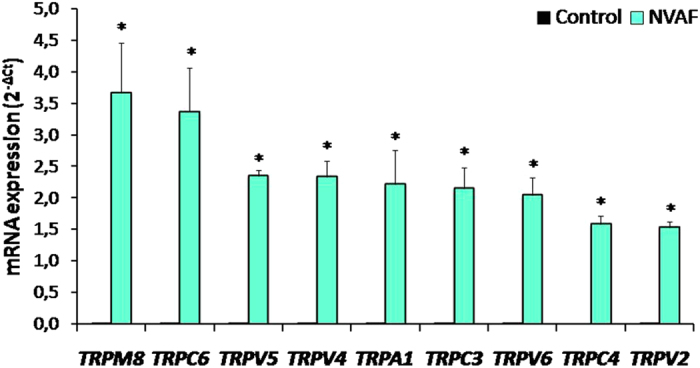
Comparison of the peripheral blood mRNA TRPM8, TRPC6, TRPV5, TRPV4, TRPA1, TRPC3, TRPV6, TRPC4, and TRPV2 expressions in healthy controls (n = 47, solid bars) and in patients with non-valvular atrial fibrillation (NVAF, n = 47, open bars). Values are given as mean ± SEM, *P = 0.0191, P < 0.0001, P < 0.0001, P < 0.0001, P = 0.0147, P < 0.0001, P < 0.0001, P < 0.0001, and P < 0.0001 values were obtained for TRPM8, TRPC6, TRPV5, TRPV4, TRPA1, TRPC3, TRPV6, TRPC4, and TRPV2, respectively.
Figure 3
Figure 3
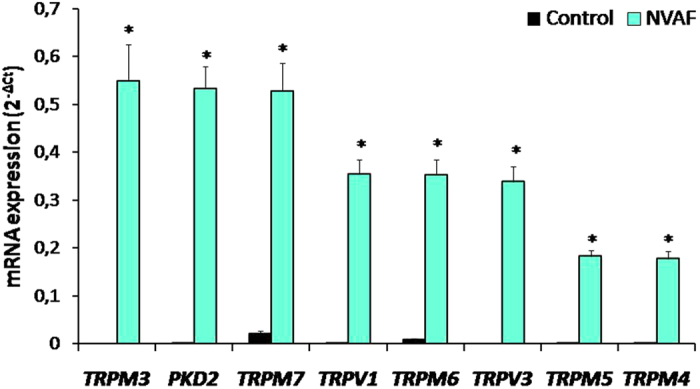
Comparison of the peripheral blood mRNA TRPM3, PKD2 (TRPP2), TRPM7, TRPV1, TRPM6, TRPV3, TRPM5, and TRPM4 expressions in healthy controls (n = 47, solid bars) and in patients with non-valvular atrial fibrillation (NVAF, n = 47, open bars). Values are given as mean ± SEM, *P = 0.0001, P < 0.0001, P < 0.0001, P < 0.0001, P < 0.0001, P < 0.0001, P < 0.0001, and P < 0.0001 values were obtained for TRPM3, PKD2 (TRPP2), TRPM7, TRPV1, TRPM6, TRPV3, TRPM5, and TRPM4, respectively.
Figure 4
Figure 4
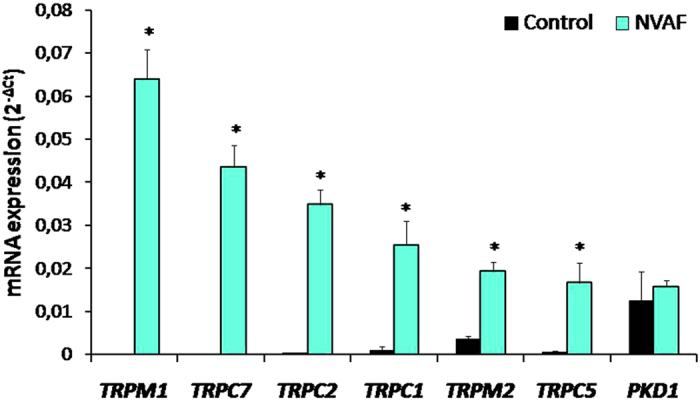
Comparison of the peripheral blood mRNA TRPM1, TRPC7, TRPC2, TRPC1, TRPM2, TRPC5, and PKD1 expressions in healthy controls (n = 47, solid bars) and in patients with non-valvular atrial fibrillation (NVAF, n = 47, open bars). Values are given as mean ± SEM, *P < 0.0001, P < 0.0001, P < 0.0001, P = 0.0040, P = 0.0001, P < 0.0001, and P = 0.3083 values were obtained for TRPM1, TRPC7, TRPC2, TRPC1, TRPM2, TRPC5, and PKD1 respectively.

References

    1. Benjamin EJ, et al. Prevention of atrial fibrillation: report from a national heart, lung, and blood institute workshop. Circulation. 2009;119:606–618. doi: 10.1161/CIRCULATIONAHA.108.825380. - DOI - PMC - PubMed
    1. Rich MW. Epidemiology of atrial fibrillation. J. Interv. Card. Electrophysiol. 2009;25:3–8. doi: 10.1007/s10840-008-9337-8. - DOI - PubMed
    1. Schotten U, Verheule S, Kirchhof P, Goette A. Pathophysiological mechanisms of atrial fibrillation: a translational appraisal. Physiol. Rev. 2011;91:265–325. doi: 10.1152/physrev.00031.2009. - DOI - PubMed
    1. Haissaguerre M, et al. Spontaneous initiation of atrial fibrillation by ectopic beats originating in the pulmonary veins. N. Engl. J. Med. 1998;339:659–666. doi: 10.1056/NEJM199809033391003. - DOI - PubMed
    1. Haissaguerre M, et al. Driver domains in persistent atrial fibrillation. Circulation. 2014;130:530–538. doi: 10.1161/CIRCULATIONAHA.113.005421. - DOI - PubMed

Substances