Burden of irritable bowel syndrome in an increasingly cost-aware National Health Service
- PMID: 28839818
- PMCID: PMC5369587
- DOI: 10.1136/flgastro-2014-100542
Burden of irritable bowel syndrome in an increasingly cost-aware National Health Service
Abstract
Background: The National Health Service (NHS) is faced with increasing cost pressures that make the efficient use of resources paramount. Irritable bowel syndrome (IBS) places a large burden on the NHS as it has been estimated that at least 12% of the UK population is affected. However, poor clinical coding makes accurate assessment of this burden challenging.
Objective: To calculate primary-care prescribing and both hospital outpatient and admission costs associated with the management of IBS in England.
Design and main outcome measures: Hospital Episode Statistics data for 2012-2013 for all clinical commissioning groups in England were analysed to calculate the tariff cost of IBS. Prescribing analysis and cost tabulation (PACT) data for this period were also analysed.
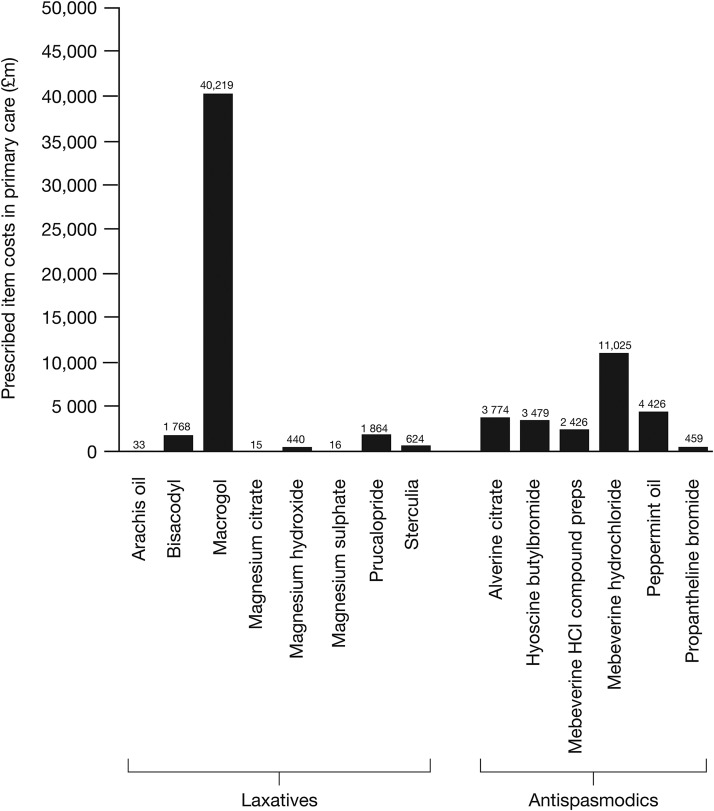
Results: In 2012-2013, there were 1 219 961 outpatient attendances in gastroenterology and colorectal surgery specialties. Despite this, only 1982 patients were recorded with IBS-specific codes, with a total estimated tariff cost of £812 336. In addition, 28 849 patients were recorded with IBS-related symptom codes at a cost of £11 002 874. In 2011-2012, there were 658 698 diagnostic lower gastrointestinal endoscopies at a tariff cost of £16 967 670 4. Of these, 323 752 (49%) had no further follow-up in secondary care over the subsequent 12 months. PACT data indicated that £44 977 959 and £25 582 752, respectively, were spent on selected laxatives and antispasmodics commonly used to treat IBS in primary care.
Conclusions: Better diagnosing, through improved clinical coding and standardisation of diagnostic criteria, is required to more accurately assess the true burden and allow optimal management of IBS.
Keywords: COST-EFFECTIVENESS; HEALTH SERVICE RESEARCH; IRRITABLE BOWEL SYNDROME.
Figures
References
-
- Jones J, Boorman J, Cann P, et al. British Society of Gastroenterology guidelines for the management of the irritable bowel syndrome. Gut 2000;47(Suppl 2):ii1–19. doi:10.1136/gut.47.suppl_2.ii1 - DOI - PMC - PubMed
-
- Longstreth GF, Thompson WG, Chey WD, et al. Functional bowel disorders. Gastroenterology 2006;130:1480–91. doi:10.1053/j.gastro.2005.11.061 - DOI - PubMed
-
- Whitehead WE, Burnett CK, Cook EW III, et al. Impact of irritable bowel syndrome on quality of life. Dig Dis Sci 1996;41:2248–53. doi:10.1007/BF02071408 - DOI - PubMed
-
- Hungin APS, Whorwell PJ, Tack J, et al. The prevalence, patterns and impact of irritable bowel syndrome: an international survey of 40 000 subjects. Aliment Pharmacol Ther 2003;17:643–50. doi:10.1046/j.1365-2036.2003.01456.x - DOI - PubMed
-
- Lovell RM, Ford AC. Global prevalence of and risk factors for irritable bowel syndrome: a meta-analysis. Clin Gastroenterol Hepatol 2012;10:712–21. doi:10.1016/j.cgh.2012.02.029 - DOI - PubMed
LinkOut - more resources
Full Text Sources
Other Literature Sources
Medical
Miscellaneous