


Genetic, epigenetic and exogenetic information in development and evolution
- PMID: 28839922
- PMCID: PMC5566810
- DOI: 10.1098/rsfs.2016.0152
Genetic, epigenetic and exogenetic information in development and evolution
Abstract
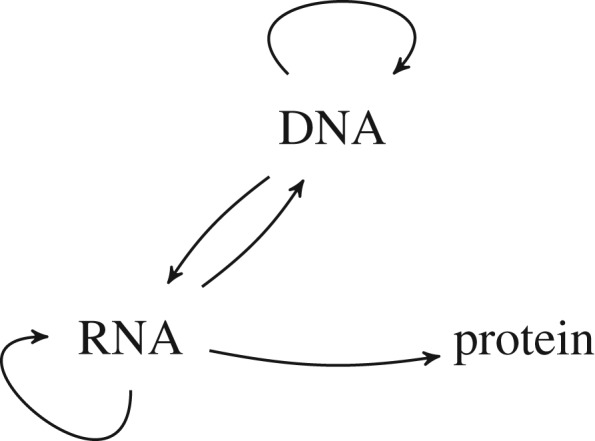
The idea that development is the expression of information accumulated during evolution and that heredity is the transmission of this information is surprisingly hard to cash out in strict, scientific terms. This paper seeks to do so using the sense of information introduced by Francis Crick in his sequence hypothesis and central dogma of molecular biology. It focuses on Crick's idea of precise determination. This is analysed using an information-theoretic measure of causal specificity. This allows us to reconstruct some of Crick's claims about information in transcription and translation. Crick's approach to information has natural extensions to non-coding regions of DNA, to epigenetic marks, and to the genetic or environmental upstream causes of those epigenetic marks. Epigenetic information cannot be reduced to genetic information. The existence of biological information in epigenetic and exogenetic factors is relevant to evolution as well as to development.
Keywords: epigenetics; genetic information; specificity.
Conflict of interest statement
I declare I have no competing interests.
Figures
References
-
- Williams GC. 1992. Natural selection: domains, levels and challenges. New York, NY: Oxford University Press.
-
- Godfrey-Smith P. 2000. On the theoretical role of ‘genetic coding’. Philos. Sci. 67, 26–44. ( 10.1086/392760) - DOI
-
- Sarkar S. 1996. Biological information: a sceptical look at some central dogmas of molecular biology. In The philosophy and history of molecular biology: new perspectives (ed. Sarkar S.). Boston Studies in the Philosophy of Science, vol. 183, pp. 187–232. Dordrecht, The Netherlands: Kluwer Academic Publishers.
LinkOut - more resources
Full Text Sources
Other Literature Sources