


Advances in metabolome information retrieval: turning chemistry into biology. Part I: analytical chemistry of the metabolome
- PMID: 28840392
- PMCID: PMC5959978
- DOI: 10.1007/s10545-017-0074-y
Advances in metabolome information retrieval: turning chemistry into biology. Part I: analytical chemistry of the metabolome
Abstract
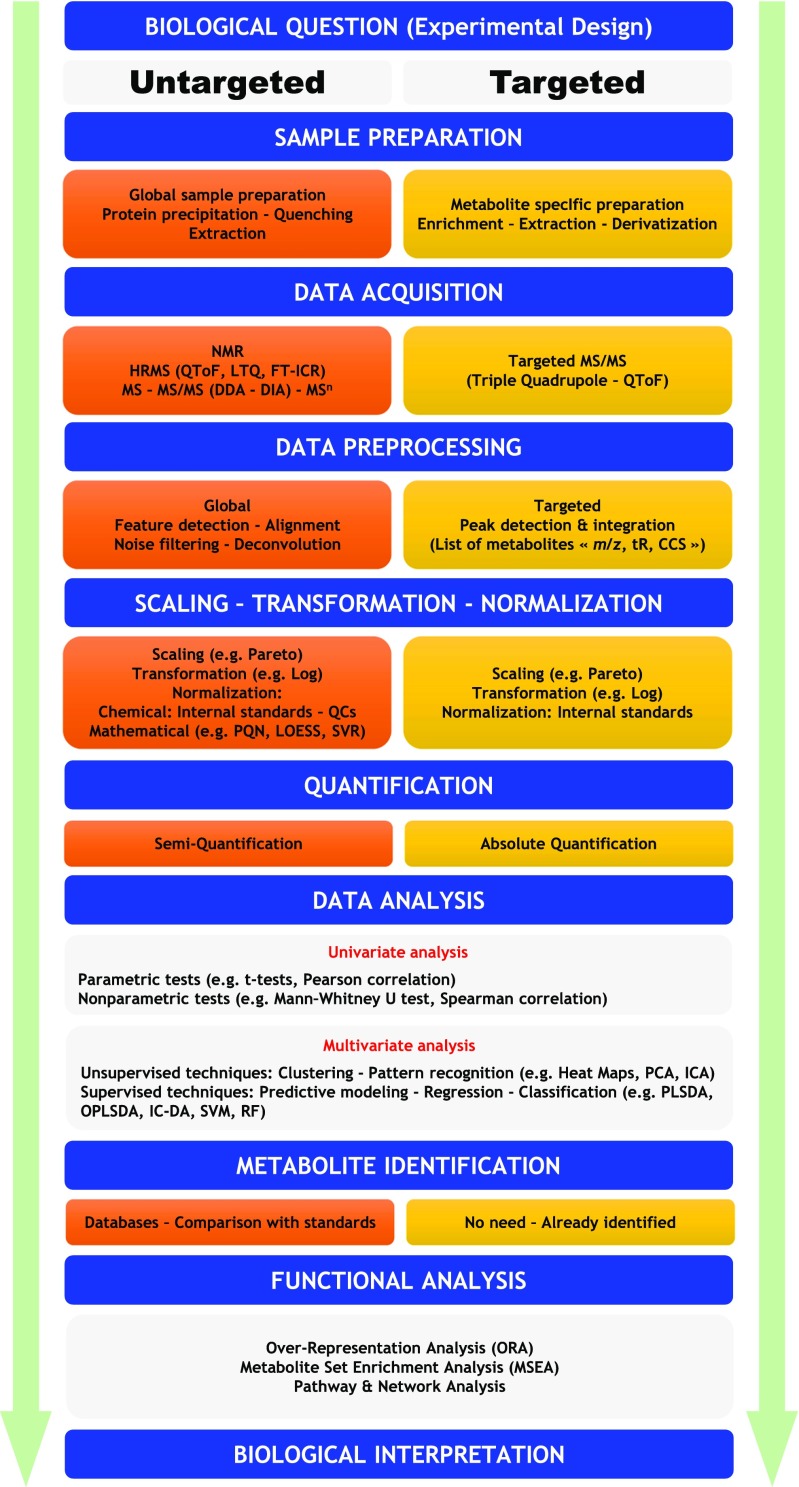
Metabolites are small molecules produced by enzymatic reactions in a given organism. Metabolomics or metabolic phenotyping is a well-established omics aimed at comprehensively assessing metabolites in biological systems. These comprehensive analyses use analytical platforms, mainly nuclear magnetic resonance spectroscopy and mass spectrometry, along with associated separation methods to gather qualitative and quantitative data. Metabolomics holistically evaluates biological systems in an unbiased, data-driven approach that may ultimately support generation of hypotheses. The approach inherently allows the molecular characterization of a biological sample with regard to both internal (genetics) and environmental (exosome, microbiome) influences. Metabolomics workflows are based on whether the investigator knows a priori what kind of metabolites to assess. Thus, a targeted metabolomics approach is defined as a quantitative analysis (absolute concentrations are determined) or a semiquantitative analysis (relative intensities are determined) of a set of metabolites that are possibly linked to common chemical classes or a selected metabolic pathway. An untargeted metabolomics approach is a semiquantitative analysis of the largest possible number of metabolites contained in a biological sample. This is part I of a review intending to give an overview of the state of the art of major metabolic phenotyping technologies. Furthermore, their inherent analytical advantages and limits regarding experimental design, sample handling, standardization and workflow challenges are discussed.
Conflict of interest statement
A. Tebani, C. Afonso and S. Bekri declare that they have no conflict of interest.
This article does not contain any studies with human or animal subjects performed by any of the authors.
Figures
References
-
- Arentz G, Mittal P, Zhang C, et al (2017) aApplications of mass spectrometry imaging to cancer, Chapt. 2 In Richard RD, Liam AM (eds.) Advanced Cancer Research. Academic, pp 27–66 - PubMed
-
- Auray-Blais C, Maranda B, Lavoie P (2014) High-throughput tandem mass spectrometry multiplex analysis for newborn urinary screening of creatine synthesis and transport disorders, triple H syndrome and OTC deficiency. Clin Chim Acta 436:249–255 - PubMed
Publication types
MeSH terms
LinkOut - more resources
Full Text Sources
Other Literature Sources
