


High sensitivity blood-based M-protein detection in sCR patients with multiple myeloma
- PMID: 28841203
- PMCID: PMC5596386
- DOI: 10.1038/bcj.2017.75
High sensitivity blood-based M-protein detection in sCR patients with multiple myeloma
Abstract
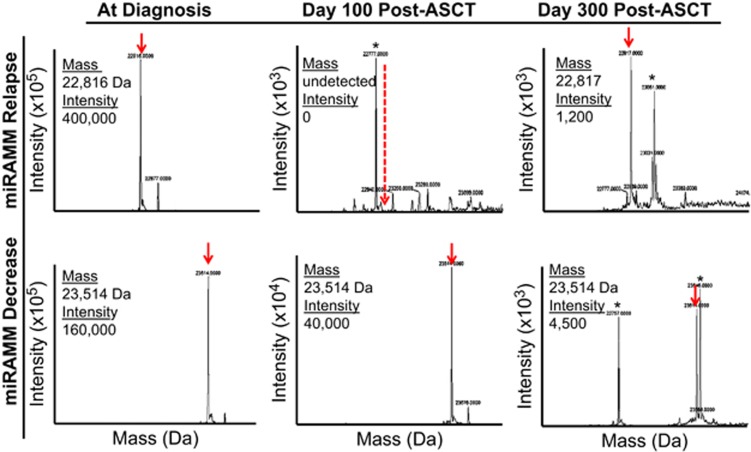
We assessed the ability of a mass spectrometry-based technique, called monoclonal immunoglobulin rapid accurate mass measurement (miRAMM), to extend the analytical range of M-protein detection in serum samples obtained from myeloma patients in stringent complete response (sCR) post-autologous stem cell transplant (ASCT). To aid the M-protein detection post ASCT, the accurate molecular mass of the M-protein light chain at diagnosis was determined in all patients (N=30) and used to positively identify clones in the sCR serum. Day 100 post-ASCT, sCR samples had miRAMM identifiable M-proteins in 81% of patients. Patients who had achieved only a partial remission (PR) pre-ASCT and those with IgG isotypes serum samples had the highest rate of M-protein detection by miRAMM. miRAMM positivity at single time points (day 100, 6 months or 12 months) did not correlate with progression-free survival (PFS). In contrast, sCR patients who did not decrease their miRAMM M-protein intensities in serial measurements had shorter PFS than those whose miRAMM intensities decreased (median 17.9 months vs 51.6 months; P<0.0017). miRAMM M-protein is a more sensitive blood-based test than traditional M-protein tests and could cost effectively aid in serially monitoring complete remission for continue response or biochemical relapse.
Conflict of interest statement
JRM, DRB and DLM have intellectual property rights filed on the method. AD declares no conflict of interest.
Figures
References
-
- Sonneveld P, Goldschmidt H, Rosinol L, Blade J, Lahuerta JJ, Cavo M et al. Bortezomib-based versus nonbortezomib-based induction treatment before autologous stem-cell transplantation in patients with previously untreated multiple myeloma: a meta-analysis of phase III randomized, controlled trials. J Clin Oncol 2013; 31: 3279–3287. - PubMed
-
- Cavo M, Tacchetti P, Patriarca F, Petrucci MT, Pantani L, Galli M et al. Bortezomib with thalidomide plus dexamethasone compared with thalidomide plus dexamethasone as induction therapy before, and consolidation therapy after, double autologous stem-cell transplantation in newly diagnosed multiple myeloma: a randomised phase 3 study. Lancet 2010; 376: 2075–2085. - PubMed
MeSH terms
Substances
Grants and funding
LinkOut - more resources
Full Text Sources
Other Literature Sources
Medical
Research Materials
