


Ipsilateral EEG mu rhythm reflects the excitability of uncrossed pathways projecting to shoulder muscles
- PMID: 28841920
- PMCID: PMC5574148
- DOI: 10.1186/s12984-017-0294-2
Ipsilateral EEG mu rhythm reflects the excitability of uncrossed pathways projecting to shoulder muscles
Abstract
Background: Motor planning, imagery or execution is associated with event-related desynchronization (ERD) of mu rhythm oscillations (8-13 Hz) recordable over sensorimotor areas using electroencephalography (EEG). It was shown that motor imagery involving distal muscles, e.g. finger movements, results in contralateral ERD correlating with increased excitability of the contralateral corticospinal tract (c-CST). Following the rationale that purposefully increasing c-CST excitability might facilitate motor recovery after stroke, ERD recently became an attractive target for brain-computer interface (BCI)-based neurorehabilitation training. It was unclear, however, whether ERD would also reflect excitability of the ipsilateral corticospinal tract (i-CST) that mainly innervates proximal muscles involved in e.g. shoulder movements. Such knowledge would be important to optimize and extend ERD-based BCI neurorehabilitation protocols, e.g. to restore shoulder movements after stroke. Here we used single-pulse transcranial magnetic stimulation (TMS) targeting the ipsilateral primary motor cortex to elicit motor evoked potentials (MEPs) of the trapezius muscle. To assess whether ERD reflects excitability of the i-CST, a correlation analysis between between MEP amplitudes and ipsilateral ERD was performed.
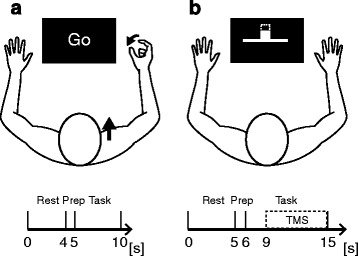
Methods: Experiment 1 consisted of a motor execution task during which 10 healthy volunteers performed elevations of the shoulder girdle or finger pinching while a 128-channel EEG was recorded. Experiment 2 consisted of a motor imagery task during which 16 healthy volunteers imagined shoulder girdle elevations or finger pinching while an EEG was recorded; the participants simultaneously received randomly timed, single-pulse TMS to the ipsilateral primary motor cortex. The spatial pattern and amplitude of ERD and the amplitude of the agonist muscle's TMS-induced MEPs were analyzed.
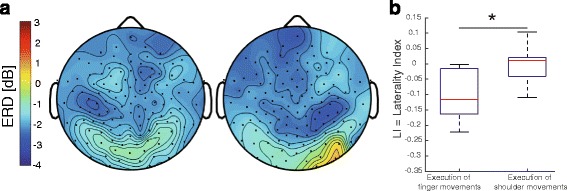
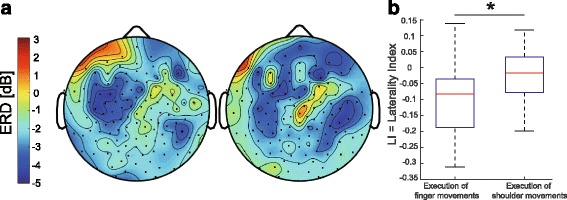
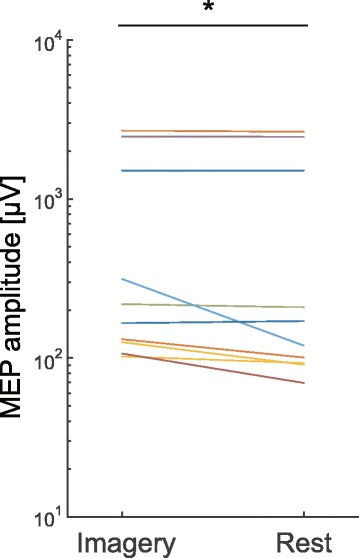
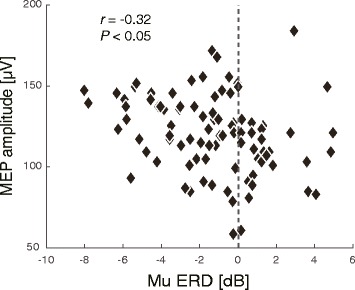
Results: ERDs occurred bilaterally during both execution and imagery of shoulder girdle elevations, but were lateralized to the contralateral hemisphere during finger pinching. We found that trapezius MEPs increased during motor imagery of shoulder elevations and correlated with ipsilateral ERD amplitudes.
Conclusions: Ipsilateral ERD during execution and imagery of shoulder girdle elevations appears to reflect the excitability of uncrossed pathways projecting to the shoulder muscles. As such, ipsilateral ERD could be used for neurofeedback training of shoulder movement, aiming at reanimation of the i-CST.
Keywords: Brain-computer interface; Electroencephalography; Event-related desynchronization; Stroke rehabilitation.
Conflict of interest statement
Ethics approval and consent to participate
This study was conducted according to the Declaration of Helsinki. The experimental procedures were approved by the ethical committee of the Faculty of Science and Technology, Keio University (#25-32). Written, informed consent was obtained from all participants prior to the experiments.
Consent for publication
We obtained written consent to publish data from all participants prior to the experiments.
Competing interests
The authors declare that they have no competing financial interests.
Publisher’s Note
Springer Nature remains neutral with regard to jurisdictional claims in published maps and institutional affiliations.
Figures
References
MeSH terms
LinkOut - more resources
Full Text Sources
Other Literature Sources
Research Materials
