. 2018 Jan 8;11(1):135-148.
doi: 10.1016/j.molp.2017.08.009. Epub 2017 Aug 24.

Two CYP82D Enzymes Function as Flavone Hydroxylases in the Biosynthesis of Root-Specific 4'-Deoxyflavones in Scutellaria baicalensis

Affiliations

Two CYP82D Enzymes Function as Flavone Hydroxylases in the Biosynthesis of Root-Specific 4'-Deoxyflavones in Scutellaria baicalensis

Qing Zhao et al. Mol Plant. .

Abstract

Baicalein, wogonin, and their glycosides are major bioactive compounds found in the medicinal plant Scutellaria baicalensis Georgi. These flavones can induce apoptosis in a variety of cancer cell lines but have no effect on normal cells. Furthermore, they have many additional benefits for human health, such as anti-oxidant, antiviral, and liver-protective properties. Here, we report the isolation and characterization of two CYP450 enzymes, SbCYP82D1.1 and SbCYP82D2, which function as the flavone 6-hydroxylase (F6H) and flavone 8-hydroxylase (F8H), respectively, in S. baicalensis. SbCYP82D1.1 has broad substrate specificity for flavones such as chrysin and apigenin and is responsible for biosynthesis of baicalein and scutellarein in roots and aerial parts of S. baicalensis, respectively. When the expression of SbCYP82D1.1 is knocked down, baicalin and baicalein levels are reduced significantly while chrysin glycosides accumulate in hairy roots. SbCYP82D2 is an F8H with high substrate specificity, accepting only chrysin as its substrate to produce norwogonin, although minor 6-hydroxylation activity can also be detected. Phylogenetic analysis suggested that SbCYP82D2 might have evolved from SbCYP82D1.1 via gene duplication followed by neofunctionalization, whereby the ancestral F6H activity is partially retained in the derived SbCYP82D2.

Keywords: Huangqin; Scutellaria baicalensis; baicalein; flavone 6-hydroxylase; flavone 8-hydroxylase; wogonin.


Figures

Figure 1
Figure 1
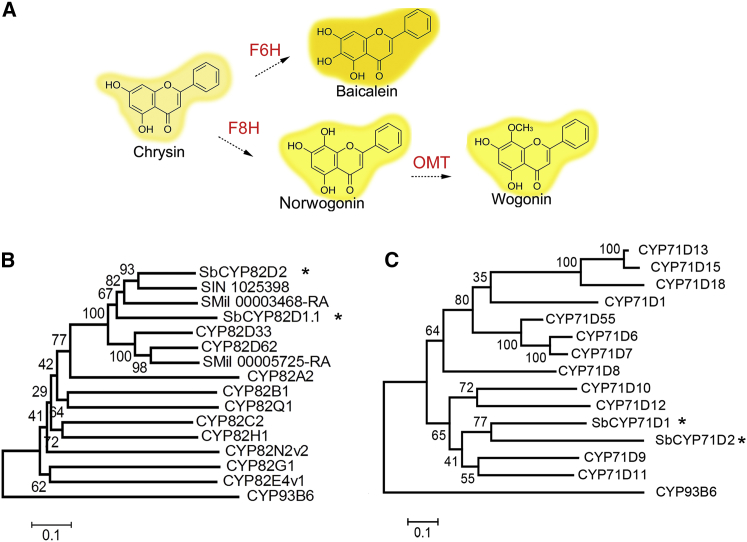
The Proposed Downstream Pathway for 4′-Deoxyflavones and Phylogenetic Analysis of CYP82Ds and CYP71Ds. (A) The proposed biosynthetic pathways for baibalein and wogonin from the flavone, chrysin. (B) Bootstrap consensus tree of CYP82D subfamily. The maximum-likelihood method was used to construct this tree with 1000 replicate bootstrap support. The tree was rooted with CYP93B6. GenBank IDs of the proteins used and their species names: CYP82D33, JX162212, Ocimum basilicum; CYP82D62, JX162214, Mentha piperita; CYP82A2, CAA71515, Glycine max; CYP82B1, AAC39454, Eschscholzia californica; CYP82Q1, ABB20912, Stevia rebaudiana; CYP82C2, O49394, Arabidopsis thaliana; CYP82H1, AAS90126, Ammi majus; CYP82N2v2, BAK20464, Eschscholzia californica; CYP82G1, NP189154, Arabidopsis thaliana; CYP82E4v1, ABA07805, Nicotiana tabacum; CYP93B6, BAB59004.1, Perilla frutescens. SIN1025398, SMil00003468-RA, and Smil00005725-RA are protein locus from Salvia miltiorrhiza genome sequencing database. Proteins from Scutellaria baicalensis studied in this work are marked with asterisks. (C) Bootstrap consensus tree of CYP71D subfamily. The maximum-likelihood method was used to construct this tree with 1000 replicate bootstrap support. The tree was rooted with CYP93B6. GenBank IDs of the proteins used and their species names: CYP71D13, Q9XHE7.1, Mentha piperita; CYP71D15, Q9XHE6.1, Mentha piperita; CYP71D18, Q6WKZ1.1, Mentha piperita; CYP71D1, ACD42776.1, Catharanthus roseus; CYP71D55, A6YIH8.1, Hyoscyamus muticus; CYP71D6, P93530.1, Solanum chacoense; CYP71D7, P93531.1, Solanum chacoense; CYP71D8, O81974.1, Glycine max; CYP71D10, NP_001236165.1, Glycine max; CYP71D12, P98183.1, Catharanthus roseus; CYP71D9, NP_001304582.1, Glycine max; CYP71D11, O22307.1, Lotus japonicus. Proteins from S. baicalensis studied in this work are marked with an asterisk. For amino acid sequence alignments, see Supplemental Figure 10.
Figure 2
Figure 2
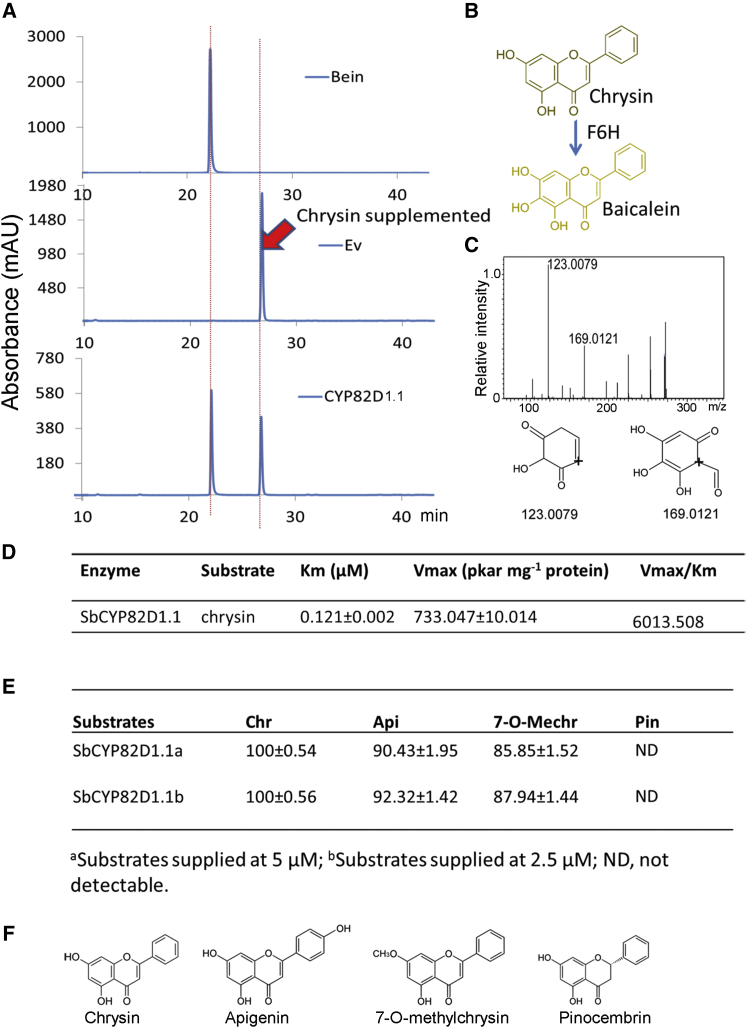
Characterization of SbCYP82D1.1 Enzyme Activity. (A) Assays of activity in yeast in vivo. HPLC analysis of yeast samples incubated with chrysin: top, baicalein standard; middle, yeast with empty vector (Ev); bottom, yeast expressing SbCYP82D1.1, where a new peak with the same retention time as baicalein was found. Bein, baicalein. (B) The proposed reaction catalyzed by SbCYP82D1.1. (C) MS2 and fragmentation patterns of the new compound produced by SbCYP82D1.1 when expressed in yeast, which was identical to baicalein. (D) Kinetic analyses of CYP82D1.1 determined in vitro following expression in yeast; each dataset represents the mean ± SE from triplicate measurements. (E) Relative turnover rate of CYP82D1.1 with apigenin, 7-O-methylchrisin, or pinocembrin used as substrates. Chr, chrysin; Api, apigenin; 7-O-Mechr, 7-O-methylchrysin; Pin, pinocembrin. ND, not detected; each dataset represents the mean ± SE from triplicate measurements, for 5 μM chr, 100% = 707.138 pkat mg1 protein; for 2.5 μM chr, 100% = 702.098 pkat mg1 protein. (F) Structures of the substrates used in the CYP82D1.1 in vitro assays.
Figure 3
Figure 3
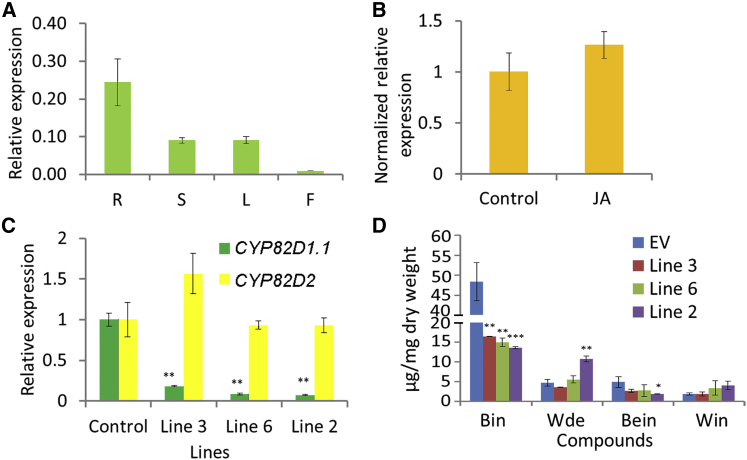
Expression Patterns of SbCYP82D1.1 and the Effects of Silencing SbCYP82D1.1 by RNAi. (A) Relative levels of SbCYP82D1.1 transcripts compared with β-actin were determined by qRT–PCR analyses performed on total RNA extracted from different organs of S. baicalensis. R, roots; S, stems; L, leaves; F, flowers. (B) Relative expression of SbCYP82D1.1 after control and MeJA treatment for 24 h. The expression levels were normalized to corresponding values from mock treatments. (C) Relative transcript levels of SbCYP82D1.1 in different RNAi-silenced hairy root lines measured by qRT–PCR. (D) Measurements of RSFs from the SbCYP82D1.1 selected RNAi lines used for transcript analysis. Bin, baicalin; Wde, wogonoside; Bein, baicalein; Win, wogonin. SEs were calculated from three biological replicates. *P < 0.05, **P < 0.01, and ***P < 0.001 (Student's t-test).
Figure 4
Figure 4
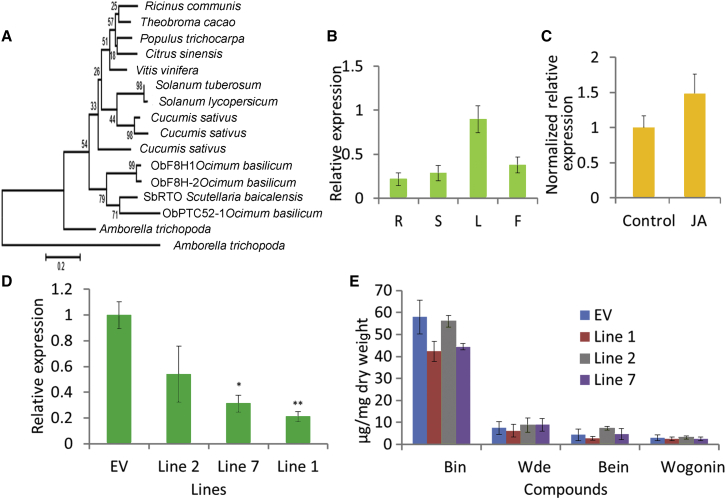
Expression Patterns of SbRTO and the Effects of Silencing SbRTO by RNAi. (A) Bootstrap consensus tree of RTO family. The maximum-likelihood method was used to construct this tree with 1000 replicate bootstrap support. Species names and GenBank IDs for peptide sequences used were: Ricinus communis, EEF2899; Theobroma cacao, EOY32295; Populus trichocarpa, EEE83915; Citrus sinensis, XP006488912; Vitis vinifera, XP002283592; Solanum tuberosum, XP006364436; Solanum lycopersicum, XP004237332; Cucumis sativus, XP004144089, XP004144087, XP004144144; Amborella trichopoda, ERN20453, ERN07127; Ocimum basilicum, AII16849 (ObF8H-1), AII16848 (ObF8H-2), AII16851(ObPTC52-1). For amino acid sequence alignments, see Supplemental Figure 10. (B) Relative levels of SbRTO transcripts compared with β-actin determined by qRT–PCR analyses of cDNA from total RNA extracted from different S. baicalensis organs. R, roots; S, stems; L, leaves; F, flowers. (C) Relative expression of SbRTO following MeJA treatment for 24 h. The expression levels were normalized to corresponding values from mock treatments. (D) Silencing of SbRTO in different RNAi hairy root lines was measured by monitoring relative transcript levels by qRT–PCR. (E) Measurements of RSFs from the SbRTO-RNAi lines used for transcript analyses. Bin, baicalin; Wde, wogonoside; Bein, baicalein; Win, wogonin. SEs were calculated from three biological replicates. *P < 0.05 and **P < 0.01 (Student's t-test).
Figure 5
Figure 5
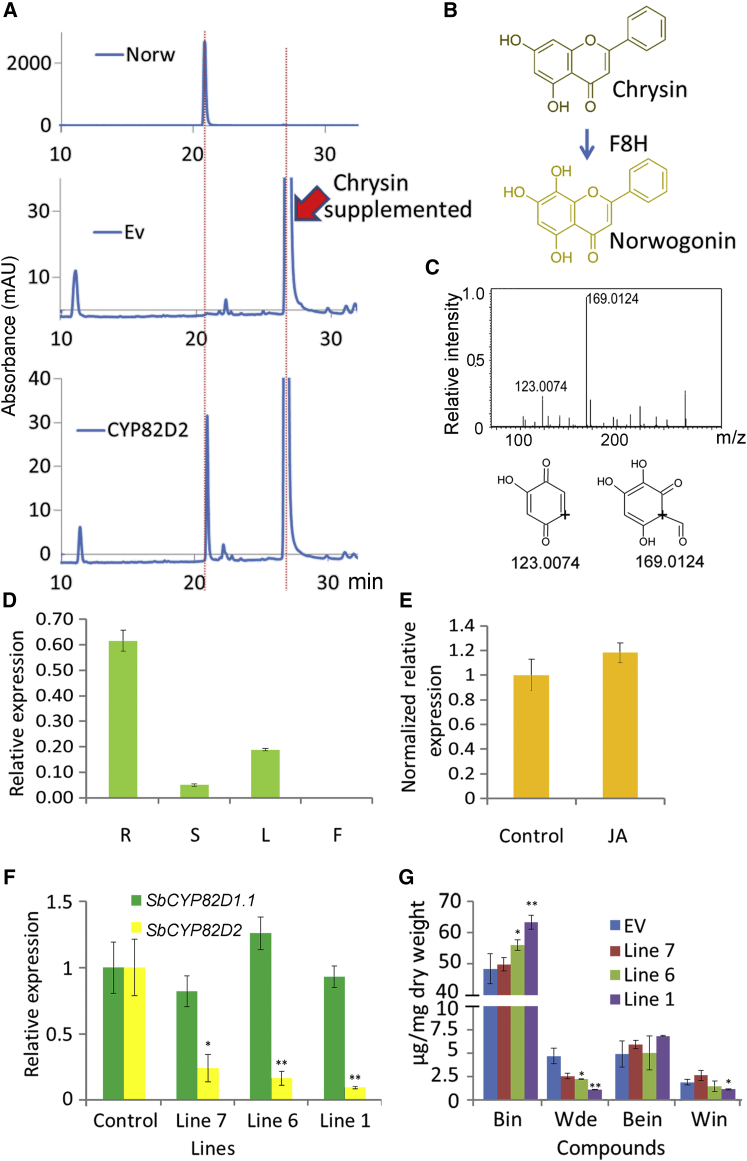
Characterization of SbCYP82D2 Enzyme Activity, Gene Expression Analysis, and RNAi of SbCYP82D2 in Hairy Roots. (A) HPLC analysis of yeast samples incubated with chrysin in vivo. Top, norwogonin standard; middle, yeast carrying empty vector; bottom, yeast expressing SbCYP82D2, where a new peak with the same retention time as norwogonin was found. Norw, norwogonin. (B) The proposed reaction catalyzed by SbCYP82D2. (C) MS2 and fragmentation patterns of the new compound produced by SbCYP82D2 expressed in yeast. The fragmentation patterns were identical to those for norwogonin. (D) Relative levels of SbCYP82D2 transcripts compared with β-actin determined by qRT–PCR analyses performed on cDNA from total RNA extracted from different organs. R, roots; S, stems; L, leaves; F, flowers. (E) Relative expression of SbCYP82D2 following MeJA treatment for 24 h. The expression levels were normalized to corresponding values from mock treatments. (F) Silencing of SbCYP82D2 in RNAi hairy roots was measured by monitoring relative transcript levels by qRT–PCR. (G) Measurements of RSFs from the SbCYP82D2 RNAi lines used for transcript analysis. Bin, baicalin; Wde, wogonoside; Bein, baicalein; Win, wogonin. SEs were calculated from three biological replicates. *P < 0.05 and **P < 0.01 (Student's t-test).
Figure 6
Figure 6
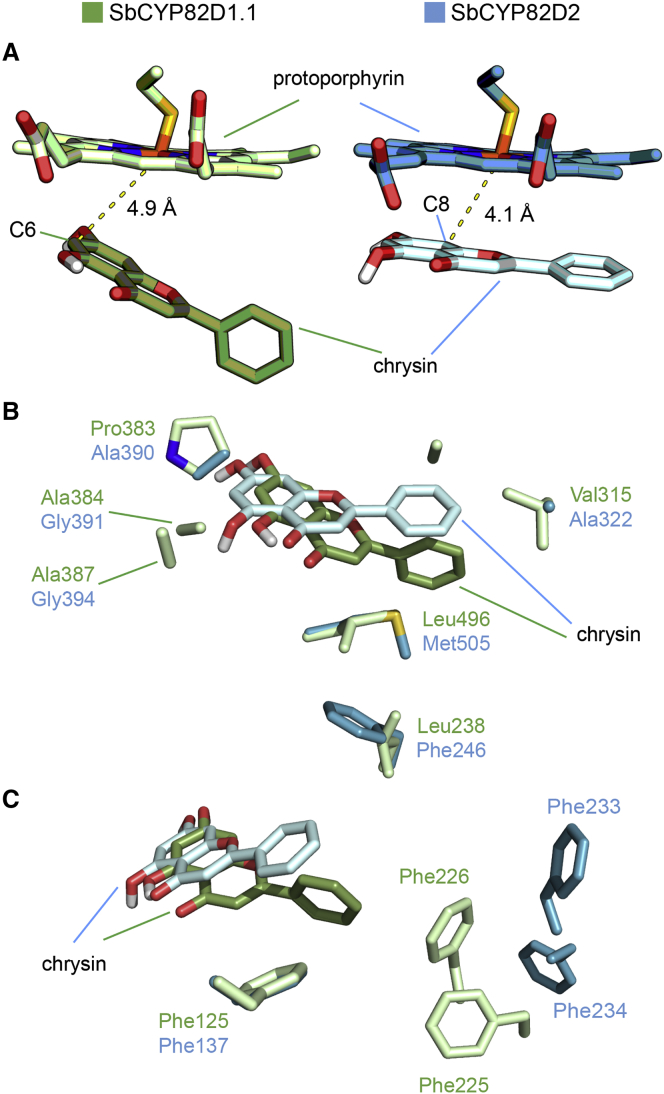
Structural Modeling of Chrysin Binding with SbCYP82D1.1 and SbCYP82D2. (A) Ligand modeling results indicate that chrysin binds in different orientations in the SbCYP82D1.1 (green) and SbCYP82D2 (blue) binding sites. The tilted conformation of chrysin in the SbCYP82D1.1 active site causes the 6-carbon (C6) to be 4.9 Å away from the protoporphyrin iron, whereas the flat conformation in the SbCYP82D2 active site places the 8-carbon (C8) 4.1 Å away from the protoporphyrin iron. (B) Bulky substrate-proximal residues in SbCYP82D1.1 such as Pro383, Ala384, and Ala387 may shift chrysin binding, while additional bulky residues on the opposite end such as Val315, Leu496, and Leu238 may cause the substrate to tilt. (C) Phe125, Phe225, and Phe226 in SbCYP82D1.1 form a nearby hydrophobic pocket that may stabilize the tilted binding of chrysin. The corresponding residues in SbCYP82D2 are located too far away to mediate the same effect.
Figure 7
Figure 7
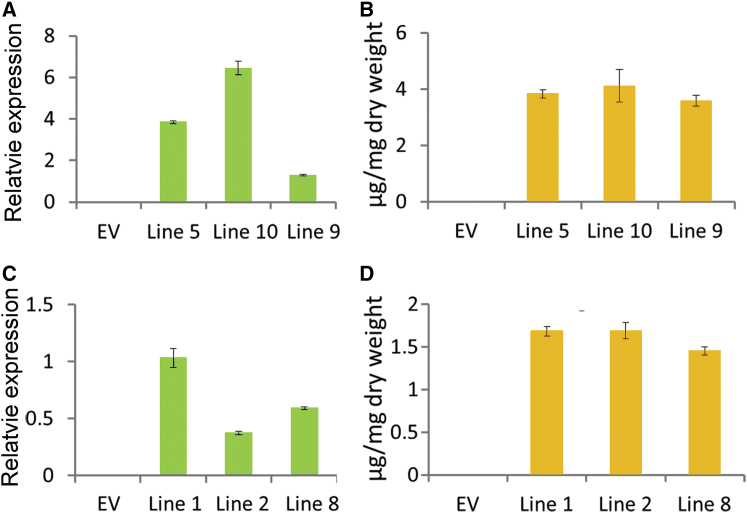
Overexpression of SbCYP82D1.1 and SbCYP82D2 in Arabidopsis. (A) Transcript levels of SbCYP82D1.1 relative to Arabidopsis UBI in an empty vector (EV) control line and three transgenic lines expressing SbCYP82D1.1 under the control of the CaMV35S promoter as determined by qRT–PCR. (B) Measurements of baicalein from EV line and three transgenic lines grown on Murashige–Skoog medium supplemented with chrysin. SEs were calculated from three biological replicates. (C) Transcript levels of SbCYP82D2 relative to Arabidopsis UBI in EV control line and three transgenic lines determined by qRT–PCR. (D) Measurements of norwogonin from empty vector line and three transgenic lines grown on Murashige–Skoog medium supplemented with chrysin. SEs were calculated from three biological replicates for each assay.
Figure 8
Figure 8
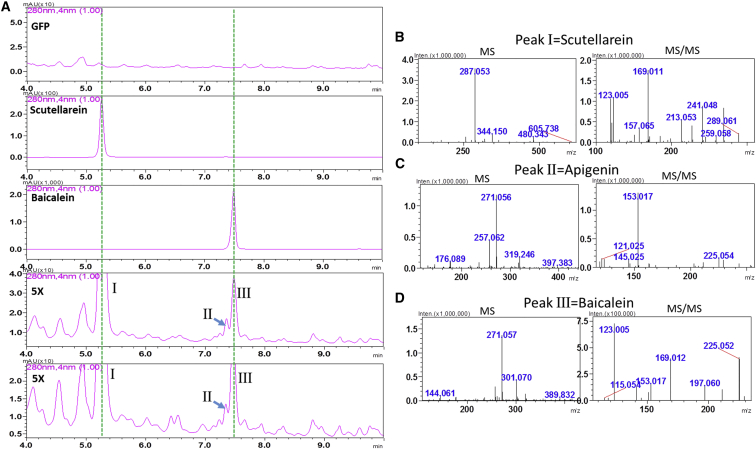
Metabolite Profiles of N. benthamiana Leaves Infiltrated with Agrobacterium tumefaciens Strain (GV3101) Carrying pEAQ Vectors for Expression of Different Genes. (A) Row 1: metabolite profiles of N. benthamiana leaf infiltrated with GFP as a control. Row 2: Profile of scutellarein standard. Row 3: baicalein standard. Rows 4 and 5: N. benthamiana leaves infiltrated with five Agrobacterium strains expressing SbCLL-7, SbCHS-2, CHI, FNSII-2, and CYP82D1 (two replicates). (B) MS and MS/MS of peak I from 6X plants, which was identified as scutellarein. (C) MS and MS/MS of peak II from 6X plants, which was identified as apigenin. (D) MS and MS/MS of peak III from 6X plants, which was identified as baicalein.

References

    1. Anzellotti D., Ibrahim R.K. Novel flavonol 2-oxoglutarate dependent dioxygenase: affinity purification, characterization, and kinetic properties. Arch. Biochem. Biophys. 2000;382:161–172. - PubMed
    1. Anzellotti D., Ibrahim R.K. Molecular characterization and functional expression of flavonol 6-hydroxylase. BMC Plant Biol. 2004;4:20. - PMC - PubMed
    1. Bent A.F. Arabidopsis in planta transformation. Uses, mechanisms, and prospects for transformation of other species. Plant Physiol. 2000;124:1540–1547. - PMC - PubMed
    1. Berim A., Gang D.R. The roles of a flavone-6-hydroxylase and 7-O-demethylation in the flavone biosynthetic network of sweet basil. J. Biol. Chem. 2013;288:1795–1805. - PMC - PubMed
    1. Berim A., Park J.J., Gang D.R. Unexpected roles for ancient proteins: flavone 8-hydroxylase in sweet basil trichomes is a Rieske-type, PAO-family oxygenase. Plant J. 2014;80:385–395. - PubMed

Publication types