No association between dietary sodium intake and the risk of multiple sclerosis
- PMID: 28842447
- PMCID: PMC5649760
- DOI: 10.1212/WNL.0000000000004417
No association between dietary sodium intake and the risk of multiple sclerosis
Abstract
Objective: To prospectively investigate the association between dietary sodium intake and multiple sclerosis (MS) risk.
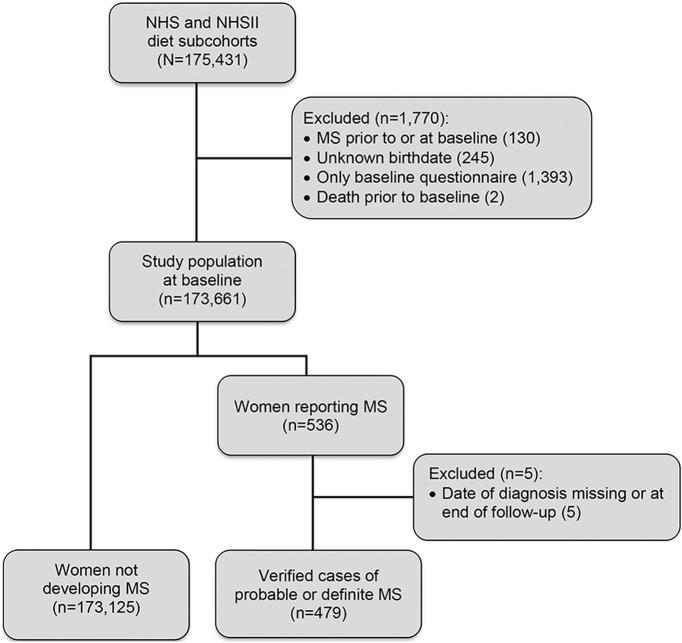
Methods: In this cohort study, we assessed dietary sodium intake by a validated food frequency questionnaire administered every 4 years to 80,920 nurses in the Nurses' Health Study (NHS) (1984-2002) and to 94,511 in the Nurses' Health Study II (NHSII) (1991-2007), and calibrated it using data from a validation study. There were 479 new MS cases during follow-up. We used Cox proportional hazards models to estimate hazard ratios (HR) and 95% confidence intervals (CI) for the effect of energy-adjusted dietary sodium on MS risk, adjusting also for age, latitude of residence at age 15, ancestry, body mass index at age 18, supplemental vitamin D intake, cigarette smoking, and total energy intake in each cohort. The results in both cohorts were pooled using fixed effects models.
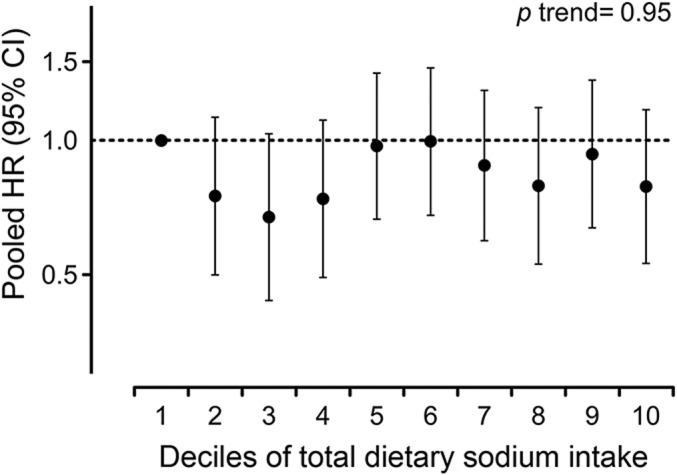
Results: Total dietary intake of sodium at baseline was not associated with MS risk (highest [medians: 3.2 g/d NHS; 3.5 g/d NHSII] vs lowest [medians: 2.5 g/d NHS; 2.8 g/d NHSII] quintile: HRpooled 0.98, 95% CI 0.74-1.30, p for trend = 0.75). Cumulative average sodium intake during follow-up was also not associated with MS risk (highest [medians: 3.3 g/d NHS; 3.4 g/d NHSII] vs lowest [medians: 2.7 g/d NHS; 2.8 g/d NHSII] quintile: HRpooled 1.02, 95% CI 0.76-1.37, p for trend = 0.76). Comparing more extreme sodium intake in deciles yielded similar results (p for trend = 0.95).
Conclusions: Our findings suggest that higher dietary sodium intake does not increase the risk of developing MS.
© 2017 American Academy of Neurology.
Figures
Comment in
-
Dietary sodium intake: An etiologic dead end in multiple sclerosis.Neurology. 2017 Sep 26;89(13):1314-1315. doi: 10.1212/WNL.0000000000004426. Epub 2017 Aug 25. Neurology. 2017. PMID: 28842448 No abstract available.
References
-
- Munger KL, Levin LI, Hollis BW, Howard NS, Ascherio A. Serum 25-hydroxyvitamin D levels and risk of multiple sclerosis. JAMA 2006;296:2832–2838. - PubMed
-
- Hernan MA, Olek MJ, Ascherio A. Cigarette smoking and incidence of multiple sclerosis. Am J Epidemiol 2001;154:69–74. - PubMed
-
- Hucke S, Wiendl H, Klotz L. Implications of dietary salt intake for multiple sclerosis pathogenesis. Mult Scler 2016;22:133–139. - PubMed
MeSH terms
Substances
Grants and funding
LinkOut - more resources
Full Text Sources
Other Literature Sources
Medical