


Germline Mutations in DNA Repair Genes in Lung Adenocarcinoma
- PMID: 28843361
- PMCID: PMC5659909
- DOI: 10.1016/j.jtho.2017.08.011
Germline Mutations in DNA Repair Genes in Lung Adenocarcinoma
Abstract
Introduction: Although lung cancer is generally thought to be environmentally provoked, anecdotal familial clustering has been reported, suggesting that there may be genetic susceptibility factors. We systematically tested whether germline mutations in eight candidate genes may be risk factors for lung adenocarcinoma.
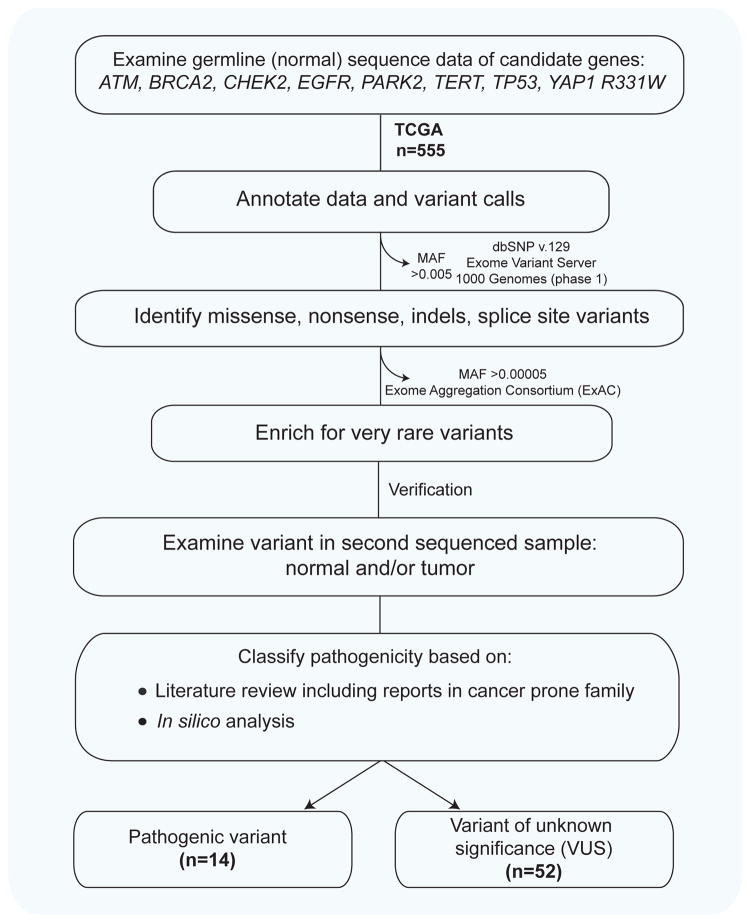
Methods: We studied lung adenocarcinoma cases for which germline sequence data had been generated as part of The Cancer Genome Atlas project but had not been previously analyzed. We selected eight genes, ATM serine/threonine kinase gene (ATM), BRCA2, DNA repair associated gene (BRCA2), checkpoint kinase 2 gene (CHEK2), EGFR, parkin RBR E3 ubiquitin protein ligase gene (PARK2), telomerase reverse transcriptase gene (TERT), tumor protein p53 gene (TP53), and Yes associated protein 1 gene (YAP1), on the basis of prior anecdotal association with lung cancer or genome-wide association studies.
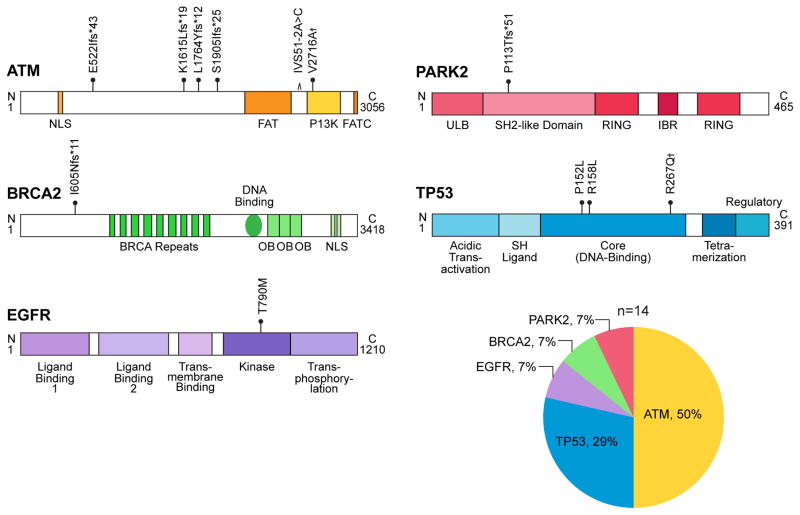
Results: Among 555 lung adenocarcinoma cases, we detected 14 pathogenic mutations in five genes; they occurred at a frequency of 2.5% and represented an OR of 66 (95% confidence interval: 33-125, p < 0.0001 [chi-square test]). The mutations fell most commonly in ATM (50%), followed by TP53, BRCA2, EGFR, and PARK2. Most (86%) of these variants had been reported in other familial cancer syndromes. Another 12 cases (2%) carried ultrarare variants that were predicted to be deleterious by three protein prediction programs; these most frequently involved ATM and BRCA2.
Conclusions: A subset of patients with lung adenocarcinoma, at least 2.5% to 4.5%, carry germline variants that have been linked to cancer risk in Mendelian syndromes. The genes fall most frequently in DNA repair pathways. Our data indicate that patients with lung adenocarcinoma, similar to other solid tumors, include a subset of patients with inherited susceptibility.
Keywords: Ataxia Telengiectasia; Li-Fraumeni syndrome; lung adenocarcinoma; poly ADP ribose inhibitors.
Copyright © 2017 International Association for the Study of Lung Cancer. Published by Elsevier Inc. All rights reserved.
Conflict of interest statement
Disclosures: The authors declare no relevant conflicts of interest.
Figures
References
-
- Bell DW, Gore I, Okimoto RA, et al. Inherited susceptibility to lung cancer may be associated with the T790M drug resistance mutation in EGFR. Nat Genet. 2005;37:1315–1316. - PubMed
-
- Chen HY, Yu SL, Ho BC, et al. R331W Missense Mutation of Oncogene YAP1 Is a Germline Risk Allele for Lung Adenocarcinoma With Medical Actionability. J Clin Oncol. 2015;33:2303–2310. - PubMed
MeSH terms
Grants and funding
LinkOut - more resources
Full Text Sources
Other Literature Sources
Medical
Research Materials
Miscellaneous
