Review
. 2017 Oct:46:76-83.
doi: 10.1016/j.conb.2017.08.002. Epub 2017 Aug 24.

Parsing learning in networks using brain-machine interfaces

Affiliations
Review

Parsing learning in networks using brain-machine interfaces

Amy L Orsborn et al. Curr Opin Neurobiol. 2017 Oct.

Abstract

Brain-machine interfaces (BMIs) define new ways to interact with our environment and hold great promise for clinical therapies. Motor BMIs, for instance, re-route neural activity to control movements of a new effector and could restore movement to people with paralysis. Increasing experience shows that interfacing with the brain inevitably changes the brain. BMIs engage and depend on a wide array of innate learning mechanisms to produce meaningful behavior. BMIs precisely define the information streams into and out of the brain, but engage wide-spread learning. We take a network perspective and review existing observations of learning in motor BMIs to show that BMIs engage multiple learning mechanisms distributed across neural networks. Recent studies demonstrate the advantages of BMI for parsing this learning and its underlying neural mechanisms. BMIs therefore provide a powerful tool for studying the neural mechanisms of learning that highlights the critical role of learning in engineered neural therapies.


Figures

Figure 1
Figure 1
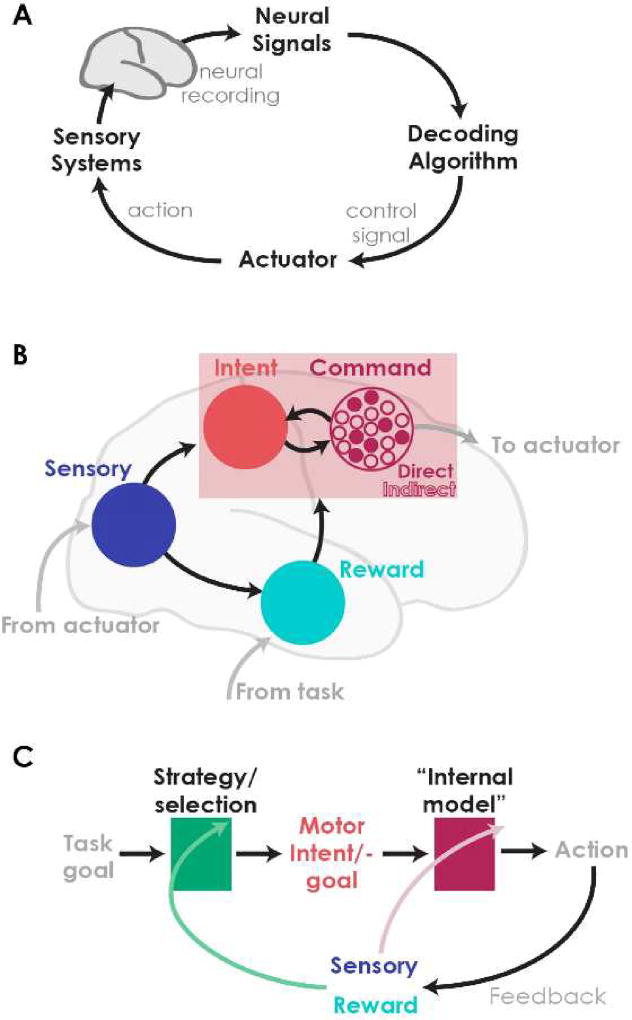
(a) Motor brain-machine interfaces (BMIs) map neural activity into a command signal to move an actuator via a “decoder”. Feedback, such as vision of the device movement closes the control loop and facilitates learning. (b) Controlling a motor BMI requires processing feedback (sensory information about movement and reward information from task context) and using this information to guide formation of a motor output (pink box). Motor output is generated through the formation of an intended action and a command. BMIs specify which nodes within this network form the command sent to the actuator (direct versus indirect nodes). (c) Learning in BMI can occur in multiple sites within this network. Existing studies provide evidence for learning specifically changing activity of the command nodes (shifting the mapping from sensory inputs to action outcome; red) and shifts in the selection of motor plans (green).
Figure 2
Figure 2
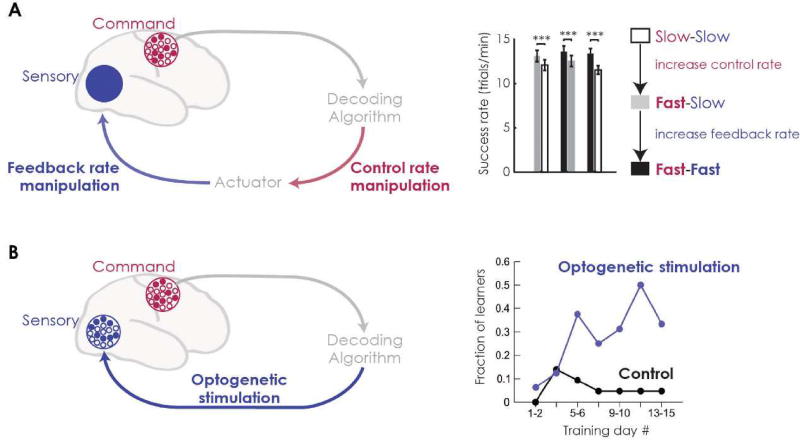
Recent BMI studies probe learning and control by manipulating the information streams in BMI. (a) Shanechi et al. [36]** used BMIs to manipulate the rates of the sensory-motor loop (left). BMIs allowed them to independently manipulate both the rate at which motor commands moved the actuator (“control rate”, red) and the rate of feedback (blue). They showed that BMI performance depends on both rates separately (right). Performance improved with faster control rates, even when subjects received slower feedback. Increasing the feedback rate then further improved performance. These results suggest that BMI may involve multiple control strategies—both predictive feed-forward control and feedback-based control. (b) Prsa et al. [25]** developed a BMI where decoder output drove optogenetic stimulation (channelrhodopsin, ChR2). This creates a system where both the command and feedback nodes can be precisely defined (left). They show that, with training, mice can learn to modulate command node activity to achieve rewards with optogenetic stimulation as their only form of sensory feedback (right). Control mice lacking ChR2 were unable to learn the task, demonstrating the necessity of this sensory feedback for learning the BMI task.

References

    1. Shenoy K, Carmena J. Combining decoder design and neural adaptation in brain-machine interfaces. Neuron. 2014;84:665–680. - PubMed
    1. Fetz EE. Volitional control of neural activity: implications for brain-computer interfaces. J. Physiol. 2007;579:571–579. - PMC - PubMed
    1. Green AM, Kalaska JF. Learning to move machines with the mind. Trends Neurosci. 2011;34:61–75. - PubMed
    1. Jackson A, Fetz EE. Interfacing with the computational brain. IEEE Trans. Neural Syst. Rehabil. Eng. 2011;19:534–541. - PMC - PubMed
    1. Orsborn AL, Carmena JM. Creating new functional circuits for action via brain-machine interfaces. Front. Comput. Neurosci. 2013 doi: 10.3389/fncom.2013.00157. - DOI - PMC - PubMed

Publication types

LinkOut - more resources