Comparative Study
. 2017 Dec;72(6):899-907.
doi: 10.1016/j.eururo.2017.07.018. Epub 2017 Aug 23.

Active Surveillance Versus Watchful Waiting for Localized Prostate Cancer: A Model to Inform Decisions

Affiliations
Comparative Study

Active Surveillance Versus Watchful Waiting for Localized Prostate Cancer: A Model to Inform Decisions

Stacy Loeb et al. Eur Urol. 2017 Dec.

Abstract

Background: An increasing proportion of prostate cancer is being managed conservatively. However, there are no randomized trials or consensus regarding the optimal follow-up strategy.

Objective: To compare life expectancy and quality of life between watchful waiting (WW) versus different strategies of active surveillance (AS).

Design, setting, and participants: A Markov model was created for US men starting at age 50, diagnosed with localized prostate cancer who chose conservative management by WW or AS using different testing protocols (prostate-specific antigen every 3-6 mo, biopsy every 1-5 yr, or magnetic resonance imaging based). Transition probabilities and utilities were obtained from the literature.

Outcome measurements and statistical analysis: Primary outcomes were life years and quality-adjusted life years (QALYs). Secondary outcomes include radical treatment, metastasis, and prostate cancer death.

Results and limitations: All AS strategies yielded more life years compared with WW. Lifetime risks of prostate cancer death and metastasis were, respectively, 5.42% and 6.40% with AS versus 8.72% and 10.30% with WW. AS yielded more QALYs than WW except in cohorts age >65 yr at diagnosis, or when treatment-related complications were long term. The preferred follow-up strategy was also sensitive to whether people value short-term over long-term benefits (time preference). Depending on the AS protocol, 30-41% underwent radical treatment within 10 yr. Extending the surveillance biopsy interval from 1 to 5 yr reduced life years slightly, with a 0.26 difference in QALYs.

Conclusions: AS extends life more than WW, particularly for men with higher-risk features, but this is partly offset by the decrement in quality of life since many men eventually receive treatment.

Patient summary: More intensive active surveillance protocols extend life more than watchful waiting, but this is partly offset by decrements in quality of life from subsequent treatment.

Keywords: Active surveillance; Conservative management; Markov model; Prostate cancer; Watchful waiting.


Conflict of interest statement

Financial disclosures: Stacy Loeb certifies that all conflicts of interest, including specific financial interests and relationships and affiliations relevant to the subject matter or materials discussed in the manuscript (eg, employment/affiliation, grants or funding, consultancies, honoraria, stock ownership or options, expert testimony, royalties, or patents filed, received, or pending), are the following: Stacy Loeb received honoraria for lectures from MDxHealth and Boehringer Ingelheim, travel reimbursement from Minomic and Boehringer Ingelheim, and consulting for Lilly (unrelated to the current manuscript).

Figures

Fig. 1
Fig. 1
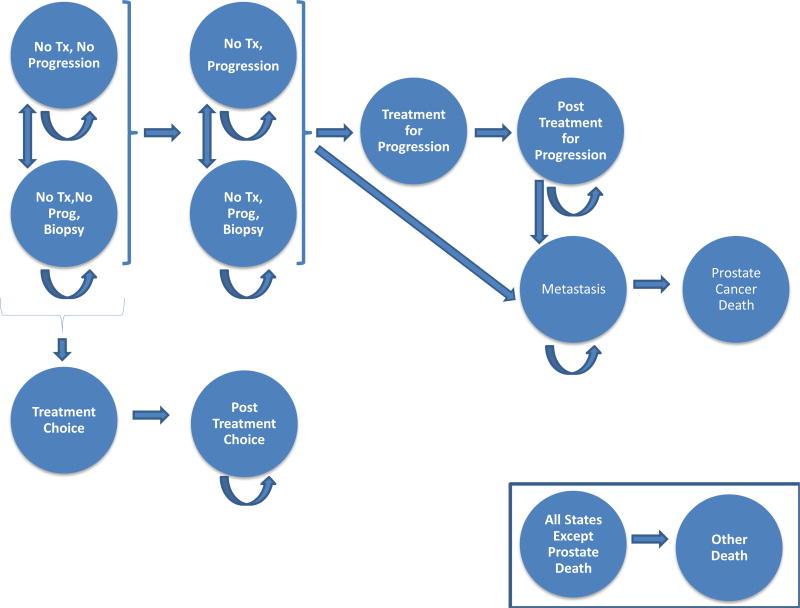
Schematic diagram of the state-transition Markov model for men undergoing conservative management of prostate cancer showing all the possible states that men in the model can be in and all the possible transitions between states. At the start, men have been diagnosed with PCa and have chosen conservative management. Some were classified accurately with Gleason 6 (grade group 1), while others were misclassified and have undetected higher-grade disease. During each model cycle, individuals can remain on conservative management, undergo treatment for reclassification (then into a post-treatment state), develop metastases, or die. PCa = prostate cancer; Prog = progression; Tx = treatment. Biopsy, treatment and post-treatment states are silent during watchful waiting. In the efficacy analysis shown in this paper, patients only undergo treatment for evidence of reclassification.
Fig. 2
Fig. 2
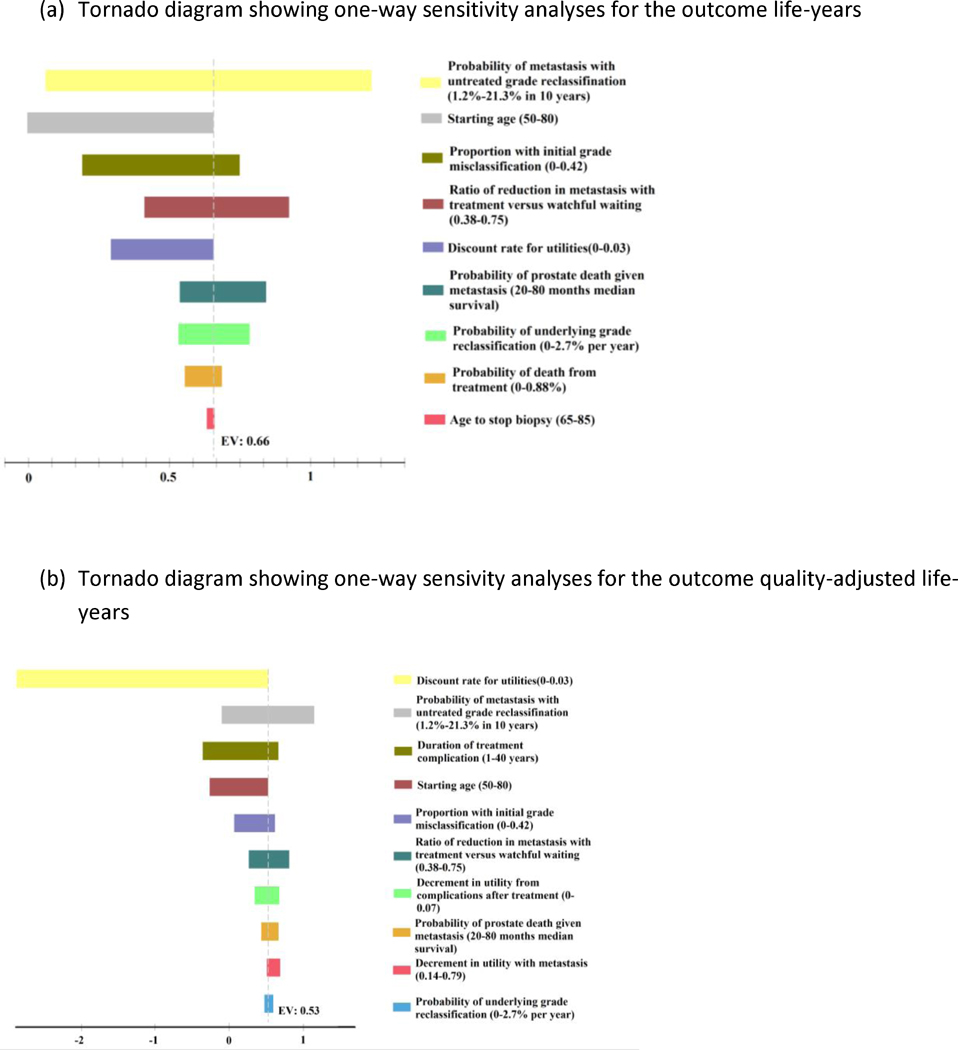
Tornado diagram showing a series of one-way sensitivity analyses of key variables for the outcome of (A) LYs and (B) QALYs comparing AS (Johns Hopkins) with WW. The tornado diagram for incremental LYs (or QALYs) shows how the difference in LYs (or QALYs) between AS and WW changes when the value of a parameter varies. The X-axis shows the difference in LYs (or QALYs) between AS and WW. The dotted line shows the difference in LYs (or QALYs) for the base case analysis, where AS has 0.66 more LYs (or 0.53 more QALYs) than WW. Each bar shows how much the difference in LYs (or QALYs) changes when we change a specific parameter within its range. If a bar crosses “0” in X-axis, it means that AS has less LYs (or QALYs) than WW and therefore the decision is reversed. AS = active surveillance; LY = life year; QALY = quality-adjusted life year; WW = watchful waiting.
Fig. 3
Fig. 3
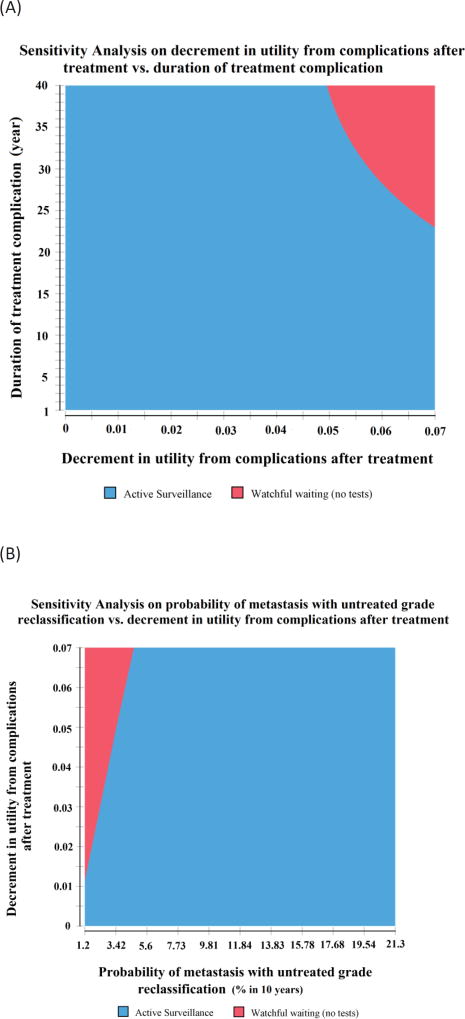
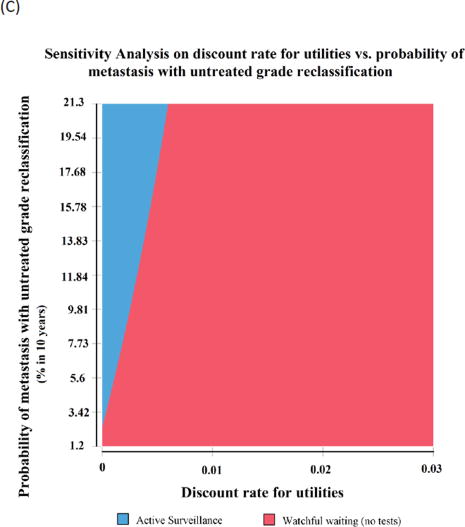
Two-way sensitivity analyses for the (A) decrement in utility from treatment complications and the duration of treatment-related complications, (B) probability of metastasis for untreated grade reclassification and decrement in utility from treatment-related complications, and (C) discount rate and probability of metastasis with untreated grade reclassification. Active surveillance (Hopkins) is preferred with a shorter duration and less utility decrement from treatment complications, and with an increasing probability of metastasis for untreated grade reclassification, whereas watchful waiting has more QALYs with a large decrement in utility and long duration of treatment-related complications, and with a higher discount rate. QALY = quality-adjusted life year.
Fig. 3
Fig. 3
Two-way sensitivity analyses for the (A) decrement in utility from treatment complications and the duration of treatment-related complications, (B) probability of metastasis for untreated grade reclassification and decrement in utility from treatment-related complications, and (C) discount rate and probability of metastasis with untreated grade reclassification. Active surveillance (Hopkins) is preferred with a shorter duration and less utility decrement from treatment complications, and with an increasing probability of metastasis for untreated grade reclassification, whereas watchful waiting has more QALYs with a large decrement in utility and long duration of treatment-related complications, and with a higher discount rate. QALY = quality-adjusted life year.

Comment in

References

    1. Schroder FH, Hugosson J, Roobol MJ, et al. Prostate-cancer mortality at 11 years of follow-up. N Engl J Med. 2012;366:981–90. - PMC - PubMed
    1. Etzioni R, Tsodikov A, Mariotto A, et al. Quantifying the role of PSA screening in the US prostate cancer mortality decline. Cancer Causes Control. 2008;19:175–81. - PMC - PubMed
    1. Barry MJ. Screening for prostate cancer--the controversy that refuses to die. N Engl J Med. 2009;360:1351–4. - PubMed
    1. Etzioni R, Penson DF, Legler JM, et al. Overdiagnosis due to prostate-specific antigen screening: lessons from U.S. prostate cancer incidence trends. J Natl Cancer Inst. 2002;94:981–90. - PubMed
    1. Gulati R, Wever EM, Tsodikov A, et al. What if I don't treat my PSA-detected prostate cancer? Answers from three natural history models. Cancer Epidemiol Biomarkers Prev. 2011;20:740–50. - PMC - PubMed

Publication types

MeSH terms

Substances