


Serologic Testing for Syphilis: Benefits and Challenges of a Reverse Algorithm
- PMID: 28845073
- PMCID: PMC5568569
- DOI: 10.1016/j.clinmicnews.2014.12.001
Serologic Testing for Syphilis: Benefits and Challenges of a Reverse Algorithm
Abstract
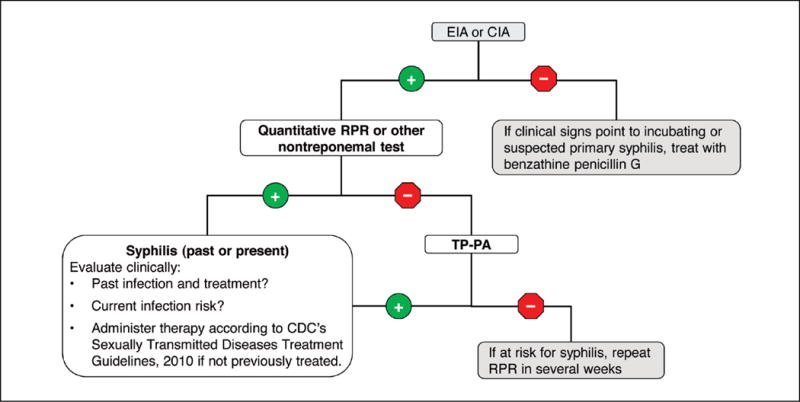
Syphilis is a human infection of global importance. Its diagnosis can be challenging, requiring construction of a serologic profile based on the results of at least two types of antibody tests: treponemal and nontreponemal. The traditional approach to the serodiagnosis of syphilis has been the use of a nontreponemal screening assay followed by the performance of a treponemal confirmatory test if the initial nontreponemal screening test was reactive. With the increasing availability of automated, easier-to-perform, and rapid treponemal assays, an increasing number of laboratory testing sites are adopting reverse sequence screening for the serodiagnosis of syphilis: screening with a treponemal assay first, then confirmation with a nontreponemal assay and, when necessary, discrepant resolution using another treponemal test. In addition to offering automation and increased throughput, a reverse algorithm can increase disease detection, especially in late latent and early primary stages of infection when the nontreponemal antibody test may be nonreactive. However, a disadvantage to this approach is that there can be an increase in false-positive test results. This article reviews the clinical and workflow benefits and limitations of a reverse testing algorithm and discusses current guidance available from the Centers for Disease Control and Prevention.
Figures
References
-
- Centers for Disease Control and Prevention, National Center for HIV/AIDS, Viral Hepatitis, STD, and TB Prevention, Division of STD Prevention. Self-study STD modules for clinicians— syphilis. 2013 (Accessed January 2014.) http://www2a.cdc.gov/stdtraining/self-study/syphilis/default.htm.
-
- Centers for Disease Control and Prevention. Syphilis CDC fact sheet. 2012 (Accessed January 2014.) http://www.cdc.gov/std/syphilis/STDFact-Syphilis-detailed.htm.
-
- Anonymous. HIV prevention through early detection and treatment of other sexually transmitted diseases—United States. Recommendations of the Advisory Committee for HIV and STD prevention. MMWR Recomm Rep. 1998;47(RR-12):1–24. - PubMed
Grants and funding
LinkOut - more resources
Full Text Sources
Other Literature Sources