


Association between statin use, the vaginal microbiome, and Gardnerella vaginalis vaginolysin-mediated cytotoxicity
- PMID: 28846702
- PMCID: PMC5573284
- DOI: 10.1371/journal.pone.0183765
Association between statin use, the vaginal microbiome, and Gardnerella vaginalis vaginolysin-mediated cytotoxicity
Abstract
Background: Bacterial vaginosis (BV) is the leading dysbiosis of the vaginal microbiome. The pathways leading towards the development of BV are not well understood. Gardnerella vaginalis is frequently associated with BV. G. vaginalis produces the cholesterol-dependent cytolysin (CDC), vaginolysin, which can lyse a variety of human cells and is thought to play a role in pathogenesis. Because membrane cholesterol is required for vaginolysin to function, and because HMG-CoA reductase inhibitors (statins) affect not only serum levels of cholesterol but membrane levels as well, we hypothesized that statins might affect the vaginal microbiome.
Methods: To investigate the relationship between use of the statins and the vaginal microbiome, we analyzed 16S rRNA gene taxonomic surveys performed on vaginal samples from 133 women who participated in the Vaginal Human Microbiome Project and who were taking statins at the time of sampling, 152 women who reported high cholesterol levels but were not taking statins, and 316 women who did not report high cholesterol. To examine the effect of statins on the cytolytic effect of vaginolysin, the cholesterol-dependent cytolysin (CDC) produced by Gardnerella vaginalis, we assessed the effect of simvastatin pretreatment of VK2E6/E7 vaginal epithelial cells on vaginolysin-mediated cytotoxicity.
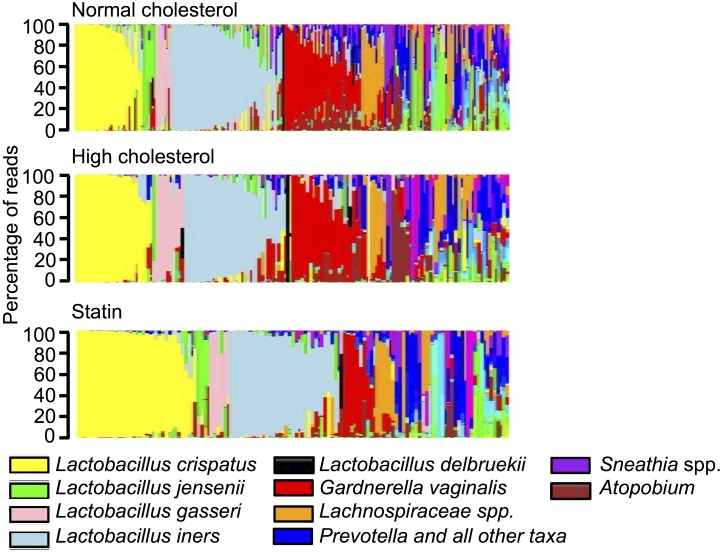
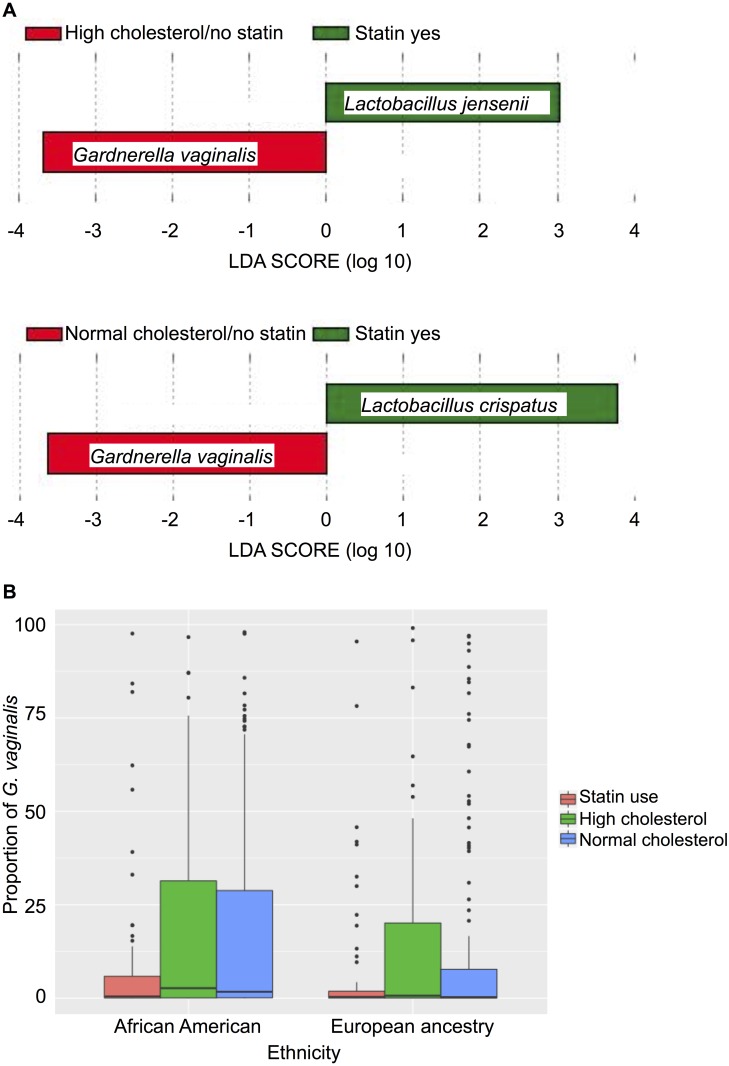
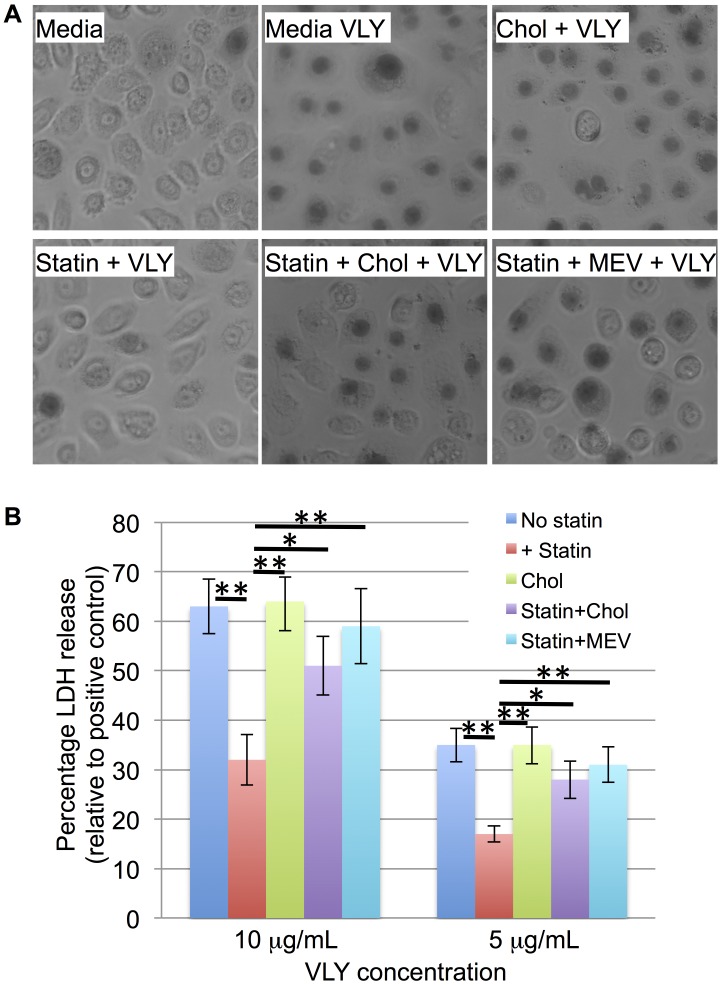
Results: The mean proportion of G. vaginalis among women taking statins was significantly lower relative to women not using statins. Women using statins had higher mean proportions of Lactobacillus crispatus relative to women with normal cholesterol levels, and higher levels of Lactobacillus jensenii relative to women with high cholesterol but not taking statins. In vitro, vaginal epithelial cells pretreated with simvastatin were relatively resistant to vaginolysin and this effect was inhibited by cholesterol.
Conclusions: In this cross-sectional study, statin use was associated with reduced proportions of G. vaginalis and greater proportions of beneficial lactobacilli within the vaginal microbiome. The negative association between statin use and G. vaginalis may be related to inhibition of vaginolysin function.
Conflict of interest statement
Figures
References
-
- Mendling W. Vaginal Microbiota. Adv Exp Med Biol. 2016;902: 83–93. doi: 10.1007/978-3-319-31248-4_6 - DOI - PubMed
-
- Hillier SL, Krohn MA, Rabe LK, Klebanoff SJ, Eschenbach DA. The normal vaginal flora, H2O2-producing lactobacilli, and bacterial vaginosis in pregnant women. Clin Infect Dis Off Publ Infect Dis Soc Am. 1993;16 Suppl 4: S273–281. - PubMed
-
- O’Hanlon DE, Moench TR, Cone RA. In vaginal fluid, bacteria associated with bacterial vaginosis can be suppressed with lactic acid but not hydrogen peroxide. BMC Infect Dis. 2011;11: 200 doi: 10.1186/1471-2334-11-200 - DOI - PMC - PubMed
-
- Verstraelen H, Verhelst R, Claeys G, De Backer E, Temmerman M, Vaneechoutte M. Longitudinal analysis of the vaginal microflora in pregnancy suggests that L. crispatus promotes the stability of the normal vaginal microflora and that L. gasseri and/or L. iners are more conducive to the occurrence of abnormal vaginal microflora. BMC Microbiol. 2009;9: 116 doi: 10.1186/1471-2180-9-116 - DOI - PMC - PubMed
-
- Hütt P, Lapp E, Štšepetova J, Smidt I, Taelma H, Borovkova N, et al. Characterisation of probiotic properties in human vaginal lactobacilli strains. Microb Ecol Health Dis. 2016;27: 30484 doi: 10.3402/mehd.v27.30484 - DOI - PMC - PubMed
MeSH terms
Substances
Grants and funding
LinkOut - more resources
Full Text Sources
Other Literature Sources
Medical
