Review
. 2017 Oct 5;372(1731):20160287.
doi: 10.1098/rstb.2016.0287.

DNA replication through a chromatin environment

Affiliations
Review

DNA replication through a chromatin environment

James M Bellush et al. Philos Trans R Soc Lond B Biol Sci. .

Abstract

Compaction of the genome into the nuclear space is achieved by wrapping DNA around octameric assemblies of histone proteins to form nucleosomes, the fundamental repeating unit of chromatin. Aside from providing a means by which to fit larger genomes into the cell, chromatinization of DNA is a crucial means by which the cell regulates access to the genome. While the complex role that chromatin plays in gene transcription has been appreciated for a long time, it is now also apparent that crucial aspects of DNA replication are linked to the biology of chromatin. This review will focus on recent advances in our understanding of how the chromatin environment influences key aspects of DNA replication.This article is part of the themed issue 'Chromatin modifiers and remodellers in DNA repair and signalling'.

Keywords: DNA replication; chromatin; nucleosome.


Conflict of interest statement

We declare we have no competing interests.

Figures
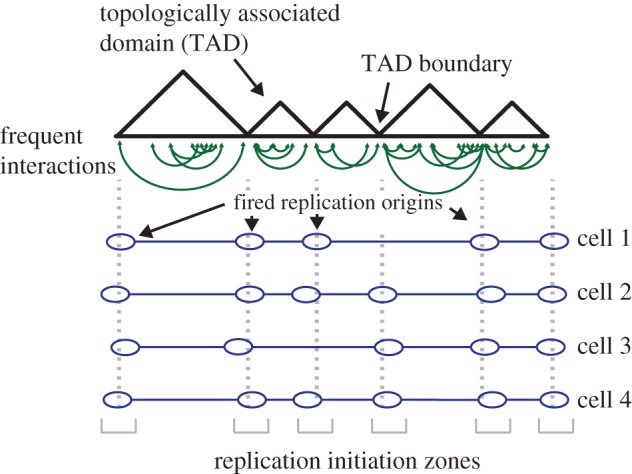
Figure 1.
Figure 1.
Topologically associated domain (TAD) structure and relation to replication origins. Representation of a region of a chromosome containing TADs. TADs contain elements of chromatin, such as gene promoters and enhancers that make frequent interactions with each other (depicted as green lines). TADs are separated by TAD boundaries; chromatin within one TAD seldom interacts with chromatin from another. Replication origins are enriched at TAD boundaries (marked as blue ovals), but the precise sites of initiation varies from cell to cell within a population; this gives rise to replication initiation zones, which are depicted at the bottom in grey.
Figure 2.
Figure 2.
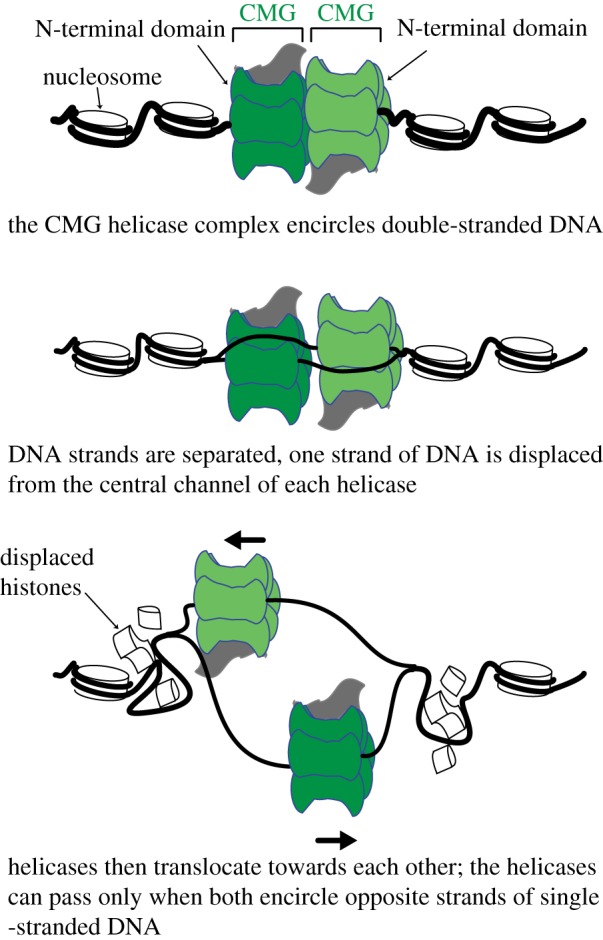
A model for helicase activation and separation. See main text for details.
Figure 3.
Figure 3.
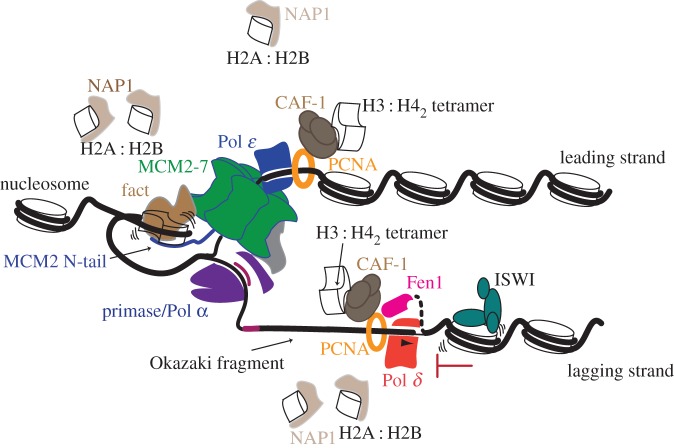
Dynamics at the replication fork. Representation of the replication fork progressing through chromatin. For simplicity, several proteins are omitted and only proteins discussed in the text are included. See text for details.

References

    1. Jacob F, Brenner S, Cuzin F (eds). 1963. On the regulation of DNA replication in bacteria. Cold Spring Harbor symposia on quantitative biology. Cold Spring Harbor, NY: Cold Spring Harbor Laboratory Press.
    1. O'Donnell M, Langston L, Stillman B. 2013. Principles and concepts of DNA replication in bacteria, Archaea, and Eukarya. Cold Spring Harb. Perspect. Biol. 5, a010108 (10.1101/cshperspect.a010108) - DOI - PMC - PubMed
    1. Hyrien O. 2015. Peaks cloaked in the mist: the landscape of mammalian replication origins. J. Cell Biol. 208, 147–160. (10.1083/jcb.201407004) - DOI - PMC - PubMed
    1. Huberman JA, Spotila LD, Nawotka KA, el-Assouli SM, Davis LR. 1987. The in vivo replication origin of the yeast 2 microns plasmid. Cell 51, 473–481. (10.1016/0092-8674(87)90643-X) - DOI - PubMed
    1. Remus D, Beuron F, Tolun G, Griffith JD, Morris EP, Diffley JF. 2009. Concerted loading of Mcm2-7 double hexamers around DNA during DNA replication origin licensing. Cell 139, 719–730. (10.1016/j.cell.2009.10.015) - DOI - PMC - PubMed

LinkOut - more resources