


Biochemical Screening for Nonadherence Is Associated With Blood Pressure Reduction and Improvement in Adherence
- PMID: 28847892
- PMCID: PMC5642335
- DOI: 10.1161/HYPERTENSIONAHA.117.09631
Biochemical Screening for Nonadherence Is Associated With Blood Pressure Reduction and Improvement in Adherence
Abstract
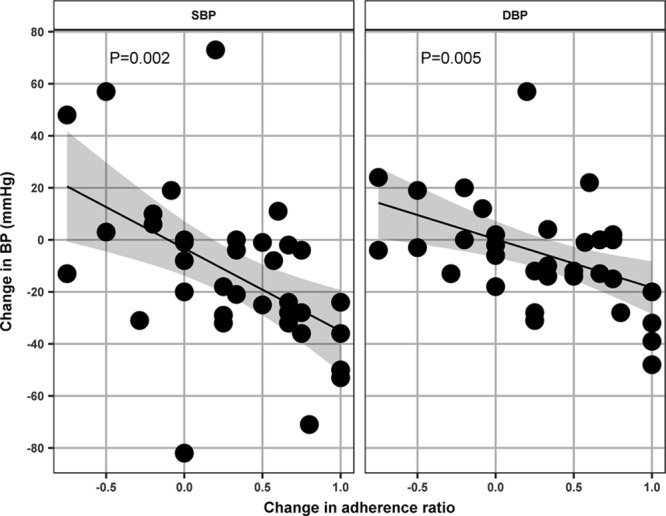
We hypothesized that screening for nonadherence to antihypertensive treatment using liquid chromatography-tandem mass spectrometry-based biochemical analysis of urine/serum has therapeutic applications in nonadherent hypertensive patients. A retrospective analysis of hypertensive patients attending specialist tertiary care centers was conducted in 2 European countries (United Kingdom and Czech Republic). Nonadherence to antihypertensive treatment was diagnosed using biochemical analysis of urine (United Kingdom) or serum (Czech Republic). These results were subsequently discussed with each patient, and data on follow-up clinic blood pressure (BP) measurements were collected from clinical files. Of 238 UK patients who underwent biochemical urine analysis, 73 were nonadherent to antihypertensive treatment. Their initial urinary adherence ratio (the ratio of detected to prescribed antihypertensive medications) increased from 0.33 (0-0.67) to 1 (0.67-1) between the first and the last clinic appointments. The observed increase in the urinary adherence ratio in initially nonadherent UK patients was associated with the improved BP control; by the last clinic appointment, systolic and diastolic BPs were ≈19.5 and 7.5 mm Hg lower than at baseline (P=0.001 and 0.009, respectively). These findings were further corroborated in 93 nonadherent hypertensive patients from Czech Republic-their average systolic and diastolic BPs dropped by ≈32.6 and 17.4 mm Hg, respectively (P<0.001), on appointments after the biochemical analysis. Our data show that nonadherent hypertensive patients respond to liquid chromatography-tandem mass spectrometry-based biochemical analysis with improved adherence and significant BP drop. Such repeated biochemical analyses should be considered as a therapeutic approach in nonadherent hypertensive patients.
Keywords: adherence; antihypertensive agents; blood pressure; chromatography, liquid; hypertension.
© 2017 The Authors.
Figures
References
-
- WHO. A global brief on hypertension. who.int/cardiovascular_diseases/publications/global_brief_hypertension. Accessed January 16, 2017.
-
- Neal B, MacMahon S, Chapman N Blood Pressure Lowering Treatment Trialists’ Collaboration. Effects of ACE inhibitors, calcium antagonists, and other blood-pressure-lowering drugs: results of prospectively designed overviews of randomised trials. Blood Pressure Lowering Treatment Trialists’ Collaboration. Lancet. 2000;356:1955–1964. - PubMed
-
- Chobanian AV, Bakris GL, Black HR, Cushman WC, Green LA, Izzo JL, Jr, Jones DW, Materson BJ, Oparil S, Wright JT, Jr, Roccella EJ National Heart, Lung, and Blood Institute Joint National Committee on Prevention, Detection, Evaluation, and Treatment of High Blood Pressure; National High Blood Pressure Education Program Coordinating Committee. The Seventh Report of the Joint National Committee on Prevention, Detection, Evaluation, and Treatment of High Blood Pressure: the JNC 7 report. JAMA. 2003;289:2560–2572. doi: 10.1001/jama.289.19.2560. - PubMed
-
- Kotseva K, Wood D, De Bacquer D, et al. EUROASPIRE Investigators. EUROASPIRE IV: a European Society of Cardiology survey on the lifestyle, risk factor and therapeutic management of coronary patients from 24 European countries. Eur J Prev Cardiol. 2016;23:636–648. doi: 10.1177/2047487315569401. - PubMed
MeSH terms
Substances
Grants and funding
LinkOut - more resources
Full Text Sources
Other Literature Sources
Medical
