


Hand grip strength in patients with chronic obstructive pulmonary disease
- PMID: 28848339
- PMCID: PMC5557109
- DOI: 10.2147/COPD.S140915
Hand grip strength in patients with chronic obstructive pulmonary disease
Abstract
Purpose: Hand grip strength (HGS) is a simple way of predicting the risk of cardiovascular disease and all-cause mortality in the general population. However, the practical significance of grip strength in patients with COPD is uncertain. The aim of this study was to compare HGS between subjects with and without COPD and to evaluate its clinical relevance in patients with COPD by using a national survey.
Methods: Data were collected from the Korean National Health and Nutrition Examination Survey. The study included 421 adults with COPD and 2,542 controls who completed questionnaires, spirometry, and a HGS test. HGS was compared between subjects with and without COPD, and the association between grip strength, lung function, and quality of life (QoL) was evaluated.
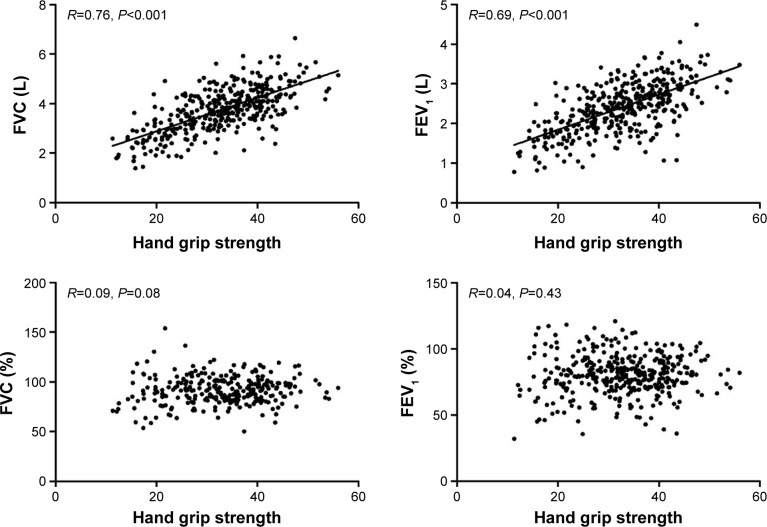
Results: The mean HGS was 33.3±9.1 kg in the COPD group and 29.9±9.5 kg in the non-COPD group; adjusted HGS was 30.9±0.33 kg and 30.9±0.11 kg, respectively (P=0.99). HGS was not related to forced vital capacity (β=0.04, P=0.70) or forced expiratory volume in 1 second (β=0.11, P=0.24) in multivariable analysis. HGS was independently associated with the EQ-5D index, but the relationship was stronger in the COPD group (β=0.30, P<0.001) than in the non-COPD group (β=0.21, P<0.001). The results were similar for each component of the EQ-5D, including mobility (β=-0.25, P<0.001), daily activity (β=-0.19, P=0.01), pain/discomfort (β=-0.32, P<0.001), and anxiety/depression (β=-0.16, P=0.01).
Conclusion: HGS was not different between subjects with and without COPD, but was associated with QoL - including mobility, daily activity, pain/discomfort, and anxiety/depression - in patients with COPD. The HGS test could be used as a marker of QoL in patients with COPD and could assist risk stratification in clinical practice.
Keywords: biomarker; chronic obstructive; hand strength; pulmonary disease; quality of life; respiratory function tests.
Conflict of interest statement
Disclosure The authors report no conflicts of interest in this work.
Figures
References
-
- Global Initiative for Chronic Obstructive Lung Disease (GOLD) Global Strategy for the Diagnosis, Management and Prevention of COPD. [Accessed March 1, 2017]. http://goldcopd.org/download/326/
-
- Gosselink R, Troosters T, Decramer M. Distribution of muscle weakness in patients with stable chronic obstructive pulmonary disease. J Cardiopulm Rehabil. 2000;20(6):353–360. - PubMed
-
- Felipe C, Bartolome C, Miguel D, Victor PP. Longitudinal changes in handgrip strength, hyperinflation, and 6-minute walk distance in patients with COPD and a control group. Chest. 2015;148(4):986–994. - PubMed
-
- Leong DP, Teo KK, Rangarajan S, et al. Prospective Urban Rural Epidemiology (PURE) Study investigators Prognostic value of grip strength: findings from the Prospective Urban Rural Epidemiology (PURE) study. Lancet. 2015;386(9990):266–273. - PubMed
MeSH terms
LinkOut - more resources
Full Text Sources
Other Literature Sources
Medical
