. 2017 Aug 8:11:146.
doi: 10.3389/fnbeh.2017.00146. eCollection 2017.

Behavioral and Immunohistochemical Study of the Effects of Subchronic and Chronic Exposure to Glyphosate in Mice

Affiliations

Behavioral and Immunohistochemical Study of the Effects of Subchronic and Chronic Exposure to Glyphosate in Mice

Yassine Ait Bali et al. Front Behav Neurosci. .

Abstract

Many epidemiological studies have described an adolescent-related psychiatric illness and sensorimotor deficits after Glyphosate based herbicide (GBH) exposure. GBH exposure in animal models of various ages suggests that it may be neurotoxic and could impact brain development and subsequently, behavior in adulthood. However, its neurotoxic effects on adolescent brain remain unclear and the results are limited. The present study was conducted to evaluate the neurobehavioral effects of GBH following acute, subchronic (6 weeks) and chronic (12 weeks) exposure (250 or 500 mg/kg/day) in mice treated from juvenile age until adulthood. Mice were subjected to behavioral testing with the open field (OF), the elevated plus maze, the tail suspension and Splash tests (STs). Their behaviors related to exploratory activity, anxiety and depression-like were recorded. After completion of the behavioral testing, adult mice were sacrificed and the expression of tyrosine hydroxylase (TH) in the substantia nigra pars compacta (SNc) and serotonin (5-HT) in the dorsal raphe nucleus (DRN), the basolateral amygdala (BLA) and the ventral medial prefrontal cortex (mPFC) was evaluated using immunohistochemical procedure. Our results indicate that unlike acute exposure, both subchronic and chronic exposure to GBH induced a decrease in body weight gain and locomotor activity, and an increase of anxiety and depression-like behavior levels. In addition, the immunohistochemical findings showed that only the chronic treatment induced a reduction of TH-immunoreactivity. However, both subchronic and chronic exposure produced a reduction of 5-HT-immunoreactivity in the DRN, BLA and ventral mPFC. Taken together, our data suggest that exposure to GBH from juvenile age through adulthood in mice leads to neurobehavioral changes that stem from the impairment of neuronal developmental processes.

Keywords: anxiety; basolateral amygdala; depression; glyphosate; locomotor activity; medial prefrontal cortex; serotonin; tyrosine-hydroxylase.


Figures
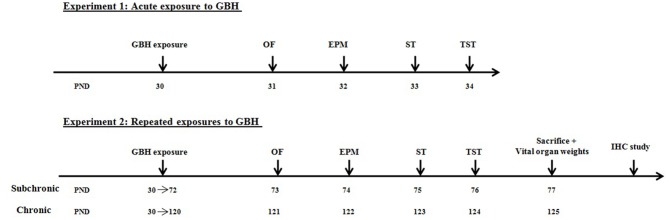
Figure 1
Figure 1
Experimental design of the acute and repeated exposures to glyphosate based herbicide (GBH) in male mice.
Figure 2
Figure 2
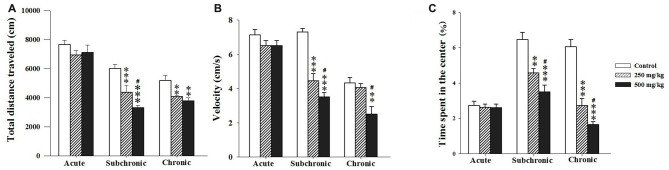
Effect of the acute and repeated exposures to GBH on locomotor activity. (A) Total distance traveled. (B) The moving velocity. (C) The time spent in the center. Results are presented as mean ± standard error of the mean (SEM). **P < 0.01; ***P < 0.001. The *** refers to the control vs. 250 mg/kg and 500 mg/kg group comparison and the “#” refers to the 250 mg/kg vs. 500 mg/kg group comparison. #P < 0.05: the post hoc analysis.
Figure 3
Figure 3
Effect of the acute and repeated exposures to GBH on anxiety-like behavior. (A) The ratio of time spent in open arm. (B) The ratio of open arm entries. (C) The anxiety index. Ratio = time spent in each arm/(time spent in open arm + time spent in closed arm). Results are presented as mean ± SEM. *P < 0.05; ***P < 0.001. The *** refers to the control vs. 250 mg/kg and 500 mg/kg group comparison and the “#” refers to the 250 mg/kg vs. 500 mg/kg group comparison. #P < 0.05: the post hoc analysis.
Figure 4
Figure 4
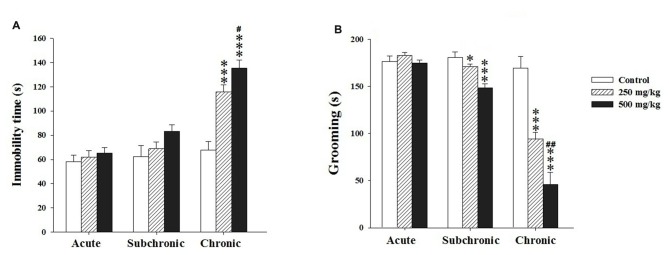
Effect of the acute and repeated exposures to GBH on depression-like behavior. (A) The immobility time in the tail suspension test (TST). (B) The grooming time in the splash test (ST). Results are presented as mean ± SEM. *P < 0.05; ***P < 0.001. The *** refers to the control vs. 250 mg/kg and 500 mg/kg group comparison and the “#” refers to the 250 mg/kg vs. 500 mg/kg group comparison. #P < 0.05, ##P < 0.01: the post hoc analysis.
Figure 5
Figure 5
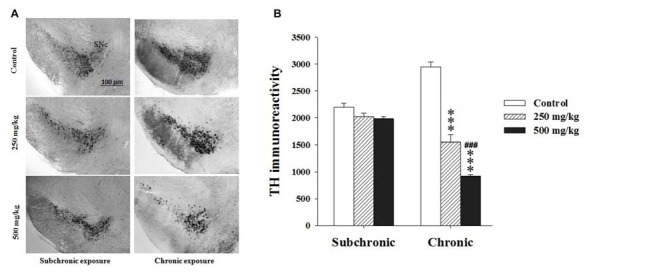
Effect of subchronic and chronic exposure to GBH on dopaminergic neurons. (A) Photomicrographs of mice brain cross sections showing the tyrosine hydroxylase (TH)-immunoreactive neurons at the SNc. (B) The intensity of TH Immunoreactivity at the SNc in control and treated mice. SNc, substantia nigra pars compacta. Results are presented as mean ± SEM. ***P < 0.001. The *** refers to the control vs. 250 mg/kg and 500 mg/kg group comparison and the “#” refers to the 250 mg/kg vs. 500 mg/kg group comparison. ###P < 0.001: the post hoc analysis.
Figure 6
Figure 6
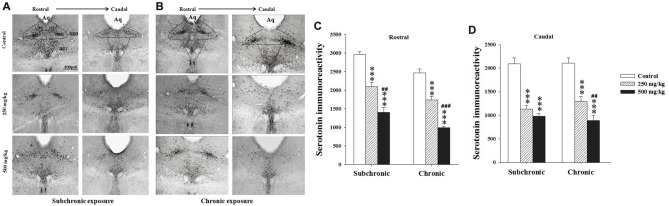
Effect of subchronic and chronic exposure to GBH on serotoninergic neurons. (A) Photomicrographs of mice brain cross sections showing the serotonin (5-HT)-immunoreactive neurons across the rostral to the caudal extent of the dorsal raphe nucleus (DRN) after subchronic exposure. (B) The intensity of 5-HT immunoreactivity at the DRN in control and treated mice following chronic exposure. (C,D) The intensity of 5-HT immunoreactivity at the DRN in control and treated mice. Aq, Cerebral aqueduct. DRD, dorsal raphe dorsal (dorsomedial), DRV, dorsal raphe ventral (ventromedial). Results are presented as mean ± SEM. ***P < 0.001. The *** refers to the control vs. 250 mg/kg and 500 mg/kg group comparison and the “#” refers to the 250 mg/kg vs. 500 mg/kg group comparison. ##P < 0.01, ###P < 0.001: the post hoc analysis.
Figure 7
Figure 7
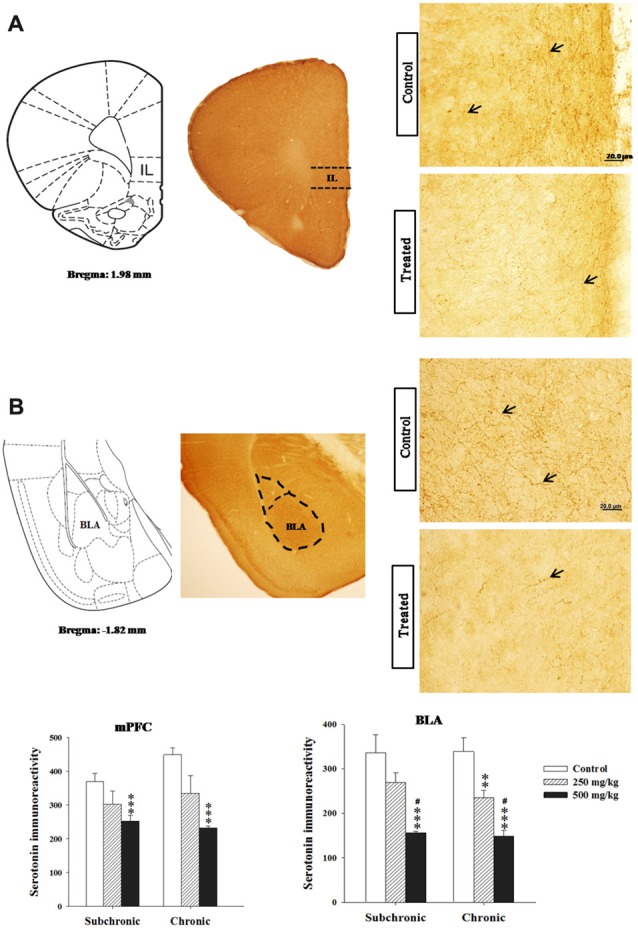
Effect of subchronic and chronic exposure to GBH on serotoninergic fibers. (A) Photomicrographs of mice brain cross sections showing the 5-HT-immunoreactive fibers and the intensity of 5-HT immunoreactivity in the mPFC. (B) Photomicrographs of mice brain cross sections showing the 5-HT-immunoreactive fibers and the intensity of 5-HT immunoreactivity in the basolateral nucleus of the amygdala. mPFC, ventral medial prefrontal cortex; BLA, basolateral nucleus of amygdale; IL, the infralimbic cortex corresponding to the ventral mPFC. The arrows refer to 5-HT fibers. Results are presented as mean ± SEM. **P < 0.01; ***P < 0.00. The *** refers to the control vs. 250 mg/kg and 500 mg/kg group comparison and the “#” refers to the 250 mg/kg vs. 500 mg/kg group comparison. #P < 0.05: the post hoc analysis.

References

    1. Aldridge J. E., Seidler F. J., Slotkin T. E. (2004). Developmental exposure to chlorpyrifos elicits sex selective alterations of serotoninergic synaptic function in adulthood: critical periods and regional selectivity for effects on the serotonin transporter, receptor subtypes, and cell signaling. Environ. Health Perspect. 112, 148–155. 10.1289/ehp.6713 - DOI - PMC - PubMed
    1. Amiri S., Haj-Mirzaian A., Rahimi-Balaei M., Razmi A., Kordjazy N., Shirzadian A., et al. . (2015). Co-occurrence of anxiety and depressive-like behaviors following adolescent social isolation in male mice; possible role of nitrergic system. Physiol. Behav. 145, 38–44. 10.1016/j.physbeh.2015.03.032 - DOI - PubMed
    1. Anadón A., Del Pino J., Martínez M. A., Caballero V., Ares I., Nieto I., et al. (2008). “Neurotoxicological effects of the herbicide glyphosate,” in Comunication 45th Congress of the European Societies of Toxicology (EUROTOX 2008) Toxicol. Lett. (Rhodes, Greece), S164–S180.
    1. Ansorge M. S., Morelli E., Gingrich J. A. (2008). Inhibition of serotonin but not norepinephrine transport during development produces delayed, persistent perturbations of emotional behaviors in mice. J. Neurosci. 28, 199–207. 10.1523/JNEUROSCI.3973-07.2008 - DOI - PMC - PubMed
    1. Astiz M., de Alaniz M. J., Marra C. A. (2009). Effect of pesticides on cell survival in liver and brain rat tissues. Ecotoxicol. Environ. Saf. 72, 2025–2032. 10.1016/j.ecoenv.2009.05.001 - DOI - PubMed