


Lost in Transition: A Systematic Review of Neonatal Electroencephalography in the Delivery Room-Are We Forgetting an Important Biomarker for Newborn Brain Health?
- PMID: 28848727
- PMCID: PMC5554119
- DOI: 10.3389/fped.2017.00173
Lost in Transition: A Systematic Review of Neonatal Electroencephalography in the Delivery Room-Are We Forgetting an Important Biomarker for Newborn Brain Health?
Abstract
Background: Electroencephalography (EEG) monitoring is routine in neonatal intensive care units (NICUs) for detection of seizures, neurological monitoring of infants following perinatal asphyxia, and increasingly, following preterm delivery. EEG monitoring is not routinely commenced in the delivery room (DR).
Objectives: To determine the feasibility of recording neonatal EEG in the DR, and to assess its usefulness as a marker of neurological well-being during immediate newborn transition.
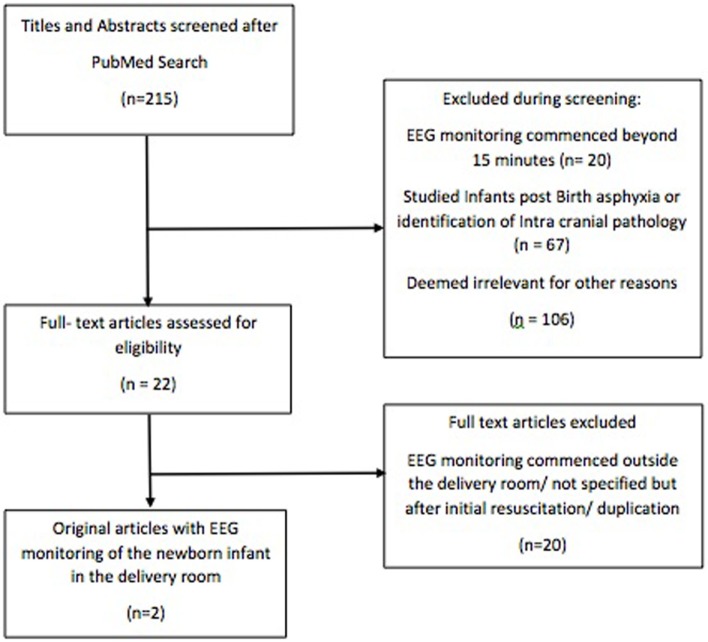
Methods: We performed a systematic stepwise search of PubMed using the following terms: infant, newborns, neonate, DR, afterbirth, transition, and EEG. Only human studies describing EEG monitoring in the first 15 min following delivery were included. Infants of all gestational ages were included.
Results: Two original studies were identified that described EEG monitoring of newborn infants within the DR. Both prospective observational studies used amplitude-integrated EEG (aEEG) monitoring and found it feasible in infants >34 weeks' gestation; however, technical challenges made it difficult to obtain continuous reliable data. Different EEG patterns were identified in uncompromised newborns and those requiring resuscitation.
Conclusion: EEG monitoring is possible in the DR and may provide an objective baseline measure of neurological function. Further feasibility studies are required to overcome technical challenges in the DR, but these challenges are not insurmountable with modern technology.
Keywords: delivery room; electroencephalography; hypoxic–ischemic encephalopathy; neuro-monitoring; newborn; prematurity.
References
-
- Weeke LC, Boylan GB, Pressler RM, Hallberg B, Blennow M, Toet MC, et al. Role of EEG background activity, seizure burden and MRI in predicting neurodevelopmental outcome in full-term infants with hypoxic-ischaemic encephalopathy in the era of therapeutic hypothermia. Eur J Paediatr Neurol (2016) 20(6):855–64. 10.1016/j.ejpn.2016.06.003 - DOI - PubMed
Publication types
LinkOut - more resources
Full Text Sources
Other Literature Sources
