Comorbidity Distribution, Clinical Expression and Survival in COPD Patients with Different Body Mass Index
- PMID: 28848824
- PMCID: PMC5556867
- DOI: 10.15326/jcopdf.1.2.2014.0117
Comorbidity Distribution, Clinical Expression and Survival in COPD Patients with Different Body Mass Index
Abstract
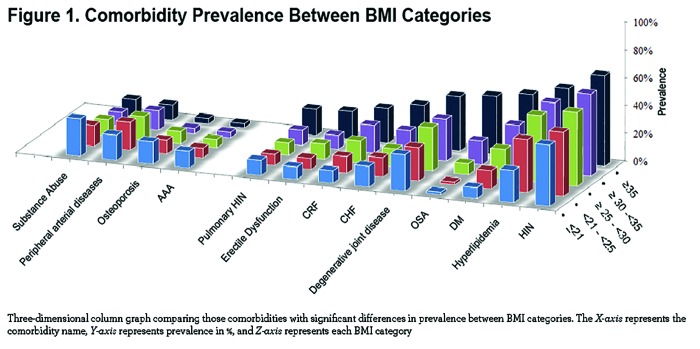
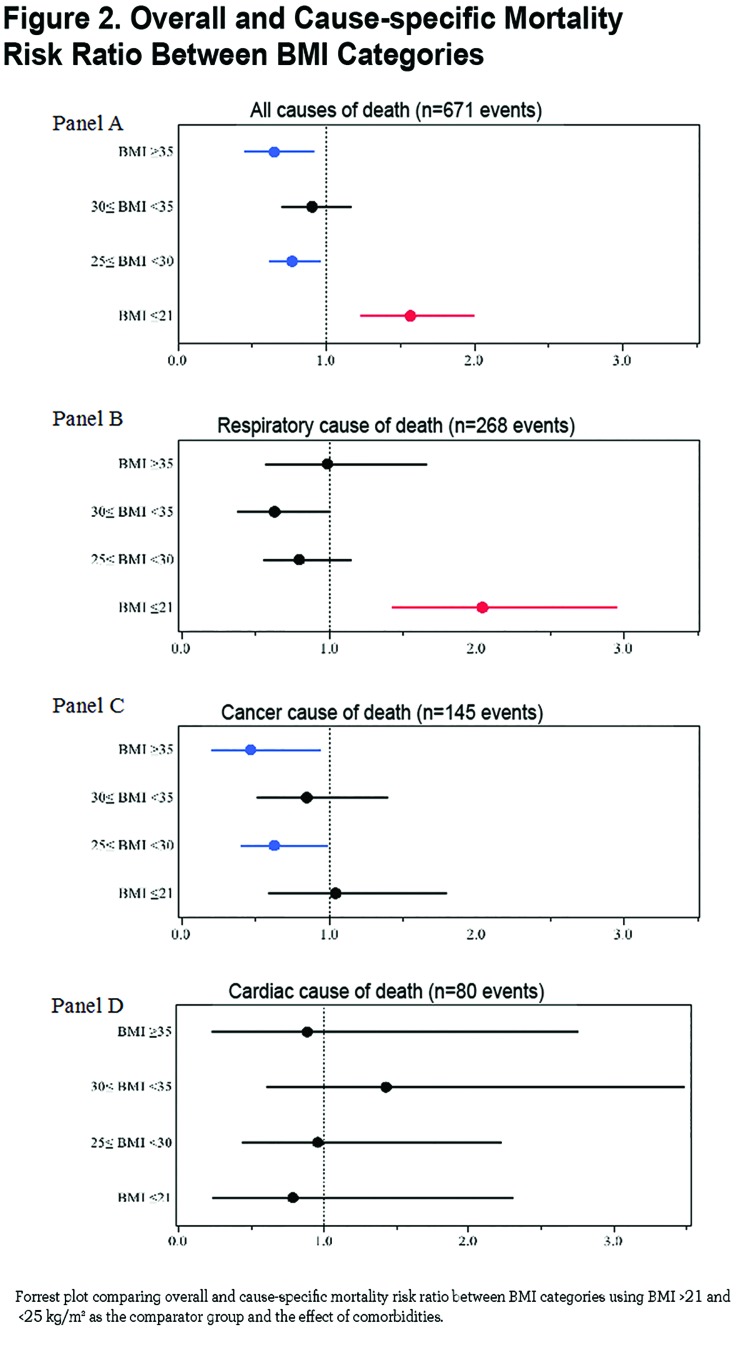
Rationale: Contrary to the general population, in patients with chronic obstructive pulmonary disease (COPD) a low body mass index (BMI) is associated with excess mortality, while obesity appears protective (obesity paradox). We hypothesized that BMI is associated with a distinct number and expression of comorbidities in patients with COPD. The type of comorbidity may relate to mortality variability. Objectives and Methods: We followed 1659 COPD patients for a median of 51 months [IQR 27-77] with detailed comorbidity records and tracking pulmonary function, exercise capacity, dyspnea, health status, and cause of death. The cohort was categorized into the 5 National Heart Lung and Blood Institute (NHLBI) BMI groups with determination made about each group's relationship to specific comorbidities, clinical parameters and risk for death. Results: Whereas osteoporosis, substance abuse, abdominal aortic aneurism and peripheral arterial disease were more prevalent in patients with low BMI, metabolic and cardiac problems were more frequent in those with high BMI. The BMI was inversely related to the ratio of forced expiratory volume in 1 second (FEV1) to forced vital capacity (FVC)(FEV1 %), BODE (Body mass index, airway Obstruction, Dyspnea, Exercise capacity) index and hyperinflation, had a "U" shape with dyspnea and the St. George's Respiratory Questionaire (SGRQ) score and an inverse "U" with exercise capacity. The crude mortality rate was 60%, 43%, 37%, 36% and 28% from the lowest to highest BMI groups (p<.0001). More respiratory deaths were observed in the lowest BMI group even though they had a lower number of comorbidities. Conclusions: Different BMI categories are associated with distinct clinical expressions of COPD and comorbidity patterns. The relationship between BMI and mortality in patients with COPD remains an unresolved paradox.
Keywords: BMI; body mass index; chronic obstructive pulmonary disease; comorbidity; copd; mortality; obesity paradox.
Conflict of interest statement
There is no direct or perceived conflict of interest in either the support, analysis and content of the manuscript by any of the authors. The authors of the manuscript are solely responsible for the data collection, analysis and crafting of the manuscript. There is no direct or indirect relationship with tobacco industry.
Comment in
-
New insights in chronic obstructive pulmonary disease and comorbidity.Am J Respir Crit Care Med. 2015 May 1;191(9):1081-2. doi: 10.1164/rccm.201412-2296RR. Am J Respir Crit Care Med. 2015. PMID: 25932764 No abstract available.
References
-
- Celli BR,Cote CG,Marin JM,et al. The body-mass index, airflow obstruction, dyspnea, and exercise capacity index in chronic obstructive pulmonary disease. N Engl J Med. 2004;350(10):1005-1012. doi: http://dx.doi.org/10.1056/NEJMoa021322 - PubMed
-
- Vestbo J,Hurd SS,Agustí AG,et al. Global strategy for the diagnosis, management, and prevention of chronic obstructive pulmonary disease. Am J Respir Crit Care Med. 2013;187(4):347-365. doi: http://dx.doi.org/10.1164/rccm.201204-0596PP - PubMed
-
- Casanova C,Aguirre-Jaime A,de Torres J,et al. Longitudinal assessment in COPD patients: multidimensional variability and outcomes. Eur Respir J. 2014;44:324-331. - PubMed
-
- Marin JM,Alfageme I,Almagro P,et al. Multicomponent indices to predict survival in COPD: the COCOMICS study. Eur Respir J. 2013;42(2):323-332. doi: http://dx.doi.org/10.1183/09031936.00121012 - PubMed
-
- Pischon T,Boeing H,Hoffmann K,et al. General and abdominal adiposity and risk of death in Europe. N Engl J Med. 2008;359(20):2105-2120. doi: http://dx.doi.org/10.1056/NEJMoa0801891 - PubMed
LinkOut - more resources
Full Text Sources
Other Literature Sources