Responder Analyses for Treatment Effects in COPD Using the St George's Respiratory Questionnaire
- PMID: 28848921
- PMCID: PMC5559111
- DOI: 10.15326/jcopdf.4.2.2017.0130
Responder Analyses for Treatment Effects in COPD Using the St George's Respiratory Questionnaire
Abstract
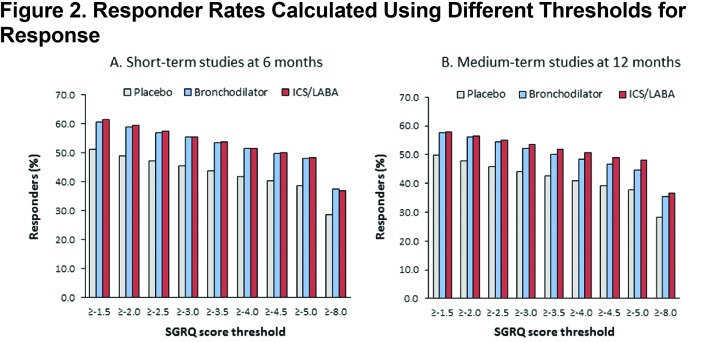
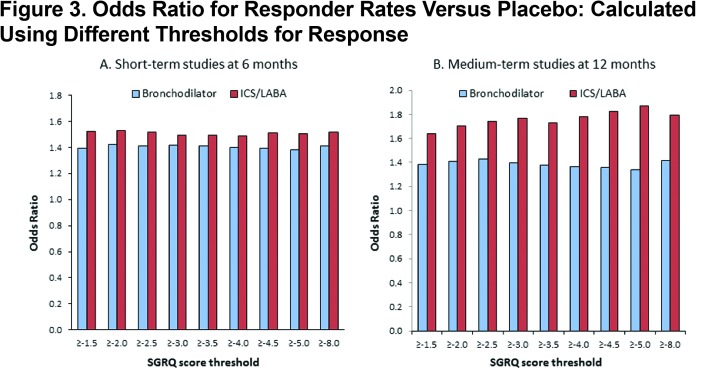
Background: Patient-reported outcomes data in clinical trials are usually reported as mean values, interpreted in comparison to a minimum clinically important difference (MCID) and ignoring the possibility of a sizable proportion of patients experiencing a worthwhile benefit when the majority did not. This analysis tested the reliability of calculated responder rates (from chronic obstructive pulmonary disease [COPD] patients) with the St George's Respiratory Questionnaire (SGRQ) using a range of responder cut-points above and below the MCID (4 units). Methods: Individual patient data (i.e., data from long-acting bronchodilator [LAB] and inhaled corticosteroids [ICS]/long-acting beta2-agonist [LABA] randomized clinical studies) in the COPD Biomarker Qualification Consortium database were used: short-term (≤1-year duration; 14,814 patients,) and medium-term (2-4 years; 12,043 patients). Responder rates versus placebo across SGRQ score change thresholds ranging from -1.5 to -8.0 were tested; differences were expressed as the odds ratio (OR) of a patient exceeding the threshold versus no change or deterioration. Results: The ORs measuring benefit of active treatment were similar across thresholds in short-term studies (LAB, ORs 1.40-1.42; LABA/ICS, 1.50-1.56) and medium-term LAB studies (ORs 1.34-1.43), whereas ORs in medium-term studies with LABA/ICS intervention showed a trend for higher response rates at higher values of threshold cut-points (1.64-1.79). In short-term studies, different thresholds had little effect on the OR between active drugs versus a trend for lower ORs with lower thresholds in medium-term studies. Conclusions: The OR for a treatment effect compared with placebo appears consistent across a range of responder cut-points. In medium-term trials, the treatment difference between active drugs suggests that use of a lower threshold would not increase the odds of observing a measured treatment difference.
Keywords: CBQC; COPD Biomarkers Qualification Consortium; SGRQ; SGRQ threshold; St George’s Respiratory Questionnaire; forced expiratory volume in 1 second; responder rates.
Conflict of interest statement
PWJ, NK, SM, HM, SIR, RTS and MT are employees of the pharma companies who funded this analysis. KR is a former employee of Pfizer. HG and HW participated in this project as employees of Evidera, a company which performs work for hire for multiple pharmaceutical and device companies in outcomes research. DM has nothing to declare.


References
-
- Global Initiative for Chronic Obstructive Lung Disease (GOLD) Global Strategy for the Diagnosis, Management and Prevention of COPD 2016. GOLD website. http://www.goldcopd.org/ Published 2016 Accessed February 2017.
-
- Jones PW,Agusti AGN. Outcomes and markers in the assessment of chronic obstructive pulmonary disease. Eur Respir J. 2006;27:822-832. doi: https://doi.org/10.1183/09031936.06.00145104 - PubMed
-
- Jones P,Miravitlles M,van der Molen T,Kulich K. Beyond FEV1 in COPD: a review of patient-reported outcomes and their measurement. Int J Chron Obstruct Pulmon Dis. 2012;7:697-709. doi: https://doi.org/10.2147/COPD.S32675 - PMC - PubMed
-
- Cazzola M,Hanania NA,MacNee W,Rüdell K,Hackford C,Tamimi N. A review of the most common patient-reported outcomes in COPD – revisiting current knowledge and estimating future challenges. Int J Chron Obstruct Pulmon Dis. 2015;10(1):725-738. doi: https://doi.org/10.2147/COPD.S77368 - PMC - PubMed
-
- Food and Drug Administration (FDA) Chronic obstructive pulmonary disease: Developing drugs for treatment. Guidance for industry. FDA website. http://www.fda.gov/downloads/drugs/guidancecomplianceregulatoryinformati... Published May 2016 Accessed February 2017.
LinkOut - more resources
Full Text Sources
Other Literature Sources
Medical
Miscellaneous