Socioeconomic Status as a Determinant of Health Status Treatment Response in COPD Trials
- PMID: 28848924
- PMCID: PMC5559114
- DOI: 10.15326/jcopdf.4.2.2017.0132
Socioeconomic Status as a Determinant of Health Status Treatment Response in COPD Trials
Abstract
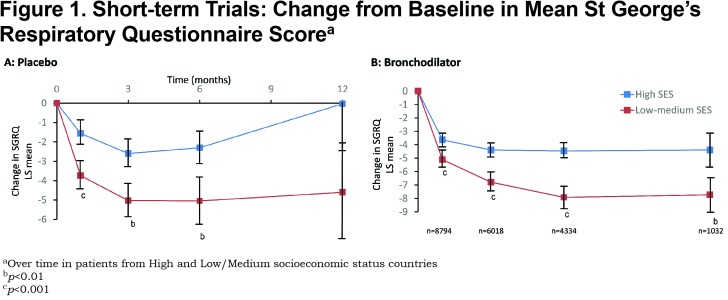
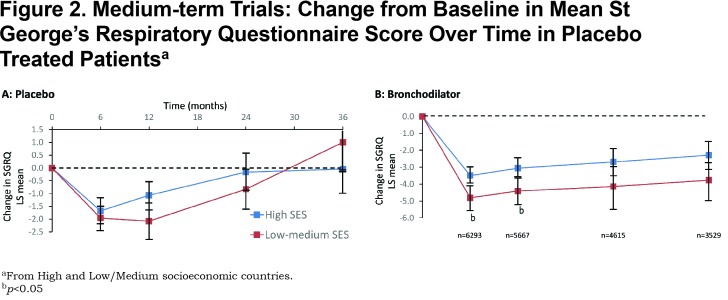
Background: Randomized controlled trials (RCTs) often recruit patients from low and high socioeconomic status (SES) countries, but little is known about the effect of SES on clinical outcomes, particularly patient-centered measures of symptomatic benefit. Methods: Combined individual chronic obstructive pulmonary disease (COPD) patient data from the placebo and long-acting bronchodilator arms of 17 RCTs (from the COPD Biomarkers Qualification Consortium database) were analyzed. Health status was measured using the St George's Respiratory Questionnaire (SGRQ) (minimum clinically important difference [MCID]: 4 units). Trials were grouped into short-term (≤12 months) and medium-term (>12 months to 48 months). A participant's country of residence was categorized into Low/Medium or High SES using World Health Organization criteria. Results: Data from 19765 individuals (6109 Low/Medium SES) were available. Patients in Low/Medium SES countries had more severe disease at baseline. Improvement in SGRQ score with placebo was ≈2 units greater in Low/Medium than in High SES countries; at its greatest, the improvement from baseline exceeded the MCID in Low/Medium countries. This difference was maintained for at least 1 year. Improvement with bronchodilator was also greater in Low/Medium versus High SES countries; overall there was no evidence that the treatment effect versus placebo was different between countries of different SES status. Conclusions: Participants in Low/Medium SES countries experienced significantly larger treatment effects, irrespective of treatment group (placebo and bronchodilator). Despite this, COPD patients in Low/Medium SES countries experienced a health status gain from long-acting bronchodilator treatment that is similar to that seen in High SES countries.
Keywords: SGRQ; St George’s Respiratory Questionnaire; chronic obstructive pulmonary disease; copd; health status; socioeconomic status.
Conflict of interest statement
HM, VSB, MT, RTS, PWJ, NK, SM and SIR are employees of the pharma companies who funded this analysis. SIR is an employee of the University of Nebraska Medical Center. HG and HW participated in this project as employees of Evidera, a company which performs work for hire for multiple pharmaceutical and device companies in outcomes research, and were funded by the CBQC consortium. DM has nothing to declare.
References
-
- Lang T,Siribaddana S. Clinical trials have gone global: Is this a good thing? . PLoS Med. 2012;9(6):e1001228. doi: https://doi.org/10.1371/journal.pmed.1001228 - PMC - PubMed
-
- Thiers FA,Sinskey AJ,Berndt ER. Trends in the globalization of clinical trials. Nat Rev Drug Discov. 2008;7:13-14. doi: https://doi.org/10.1038/nrd2441
-
- Gershon AS,Dolmage TE,Stephenson A,Jackson B. Chronic obstructive pulmonary disease and socioeconomic status: A systematic review. COPD. 2012;9(3):216-226. doi: https://doi.org/10.3109/15412555.2011.648030 - PubMed
-
- Zheng J-P,Yang L,Wu YM,et al. The efficacy and safety of combination salmeterol (50 µg)/fluticasone propionate (500 µg) inhalation twice daily via Accuhaler in Chinese patients with COPD. Chest. 2007;132(6):1756-1763. doi: https://doi.org/10.1378/chest.06-3009 - PubMed
-
- Jones PW,Quirk FH,Baveystock CM,Littlejohns P. A self-complete measure of health status for chronic airflow limitation: The St. George's Respiratory Questionnaire. Am Rev Respir Dis. 1992;145(6):1321-1327. doi: https://doi.org/10.1164/ajrccm/145.6.1321 - PubMed
LinkOut - more resources
Full Text Sources
Other Literature Sources