


Development of Multivariable Models to Predict and Benchmark Transfusion in Elective Surgery Supporting Patient Blood Management
- PMID: 28850152
- PMCID: PMC6241749
- DOI: 10.4338/ACI-2016-11-RA-0195
Development of Multivariable Models to Predict and Benchmark Transfusion in Elective Surgery Supporting Patient Blood Management
Abstract
Background: Blood transfusion is a highly prevalent procedure in hospitalized patients and in some clinical scenarios it has lifesaving potential. However, in most cases transfusion is administered to hemodynamically stable patients with no benefit, but increased odds of adverse patient outcomes and substantial direct and indirect cost. Therefore, the concept of Patient Blood Management has increasingly gained importance to pre-empt and reduce transfusion and to identify the optimal transfusion volume for an individual patient when transfusion is indicated.
Objectives: It was our aim to describe, how predictive modeling and machine learning tools applied on pre-operative data can be used to predict the amount of red blood cells to be transfused during surgery and to prospectively optimize blood ordering schedules. In addition, the data derived from the predictive models should be used to benchmark different hospitals concerning their blood transfusion patterns.
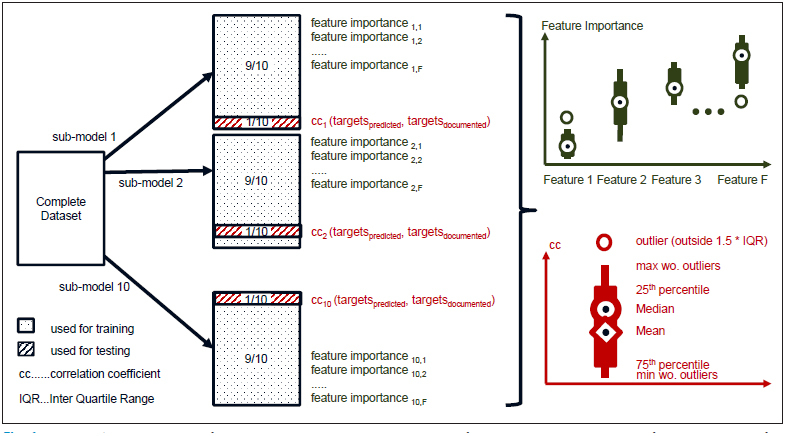
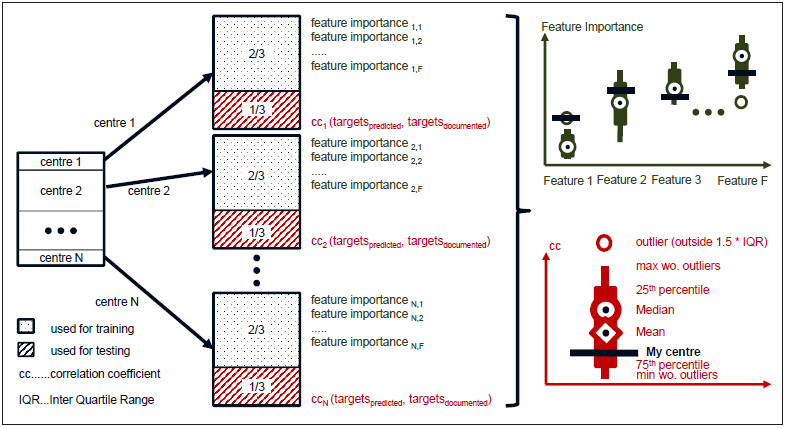
Methods: 6,530 case records obtained for elective surgeries from 16 centers taking part in two studies conducted in 2004-2005 and 2009-2010 were analyzed. Transfused red blood cell volume was predicted using random forests. Separate models were trained for overall data, for each center and for each of the two studies. Important characteristics of different models were compared with one another.
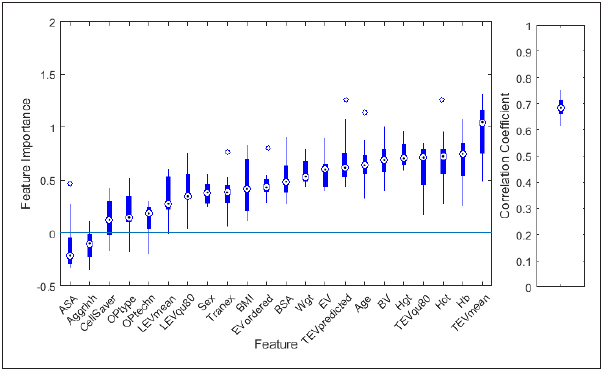
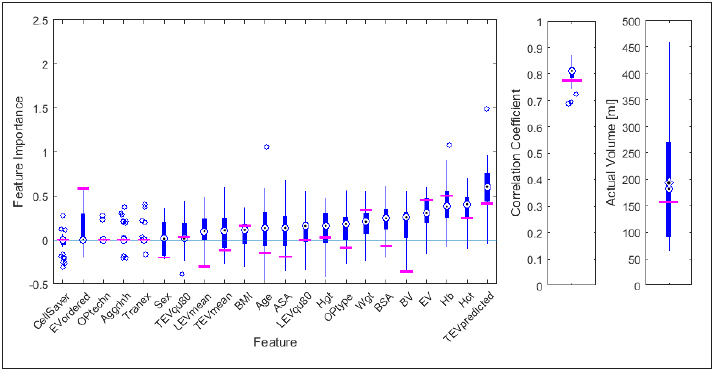
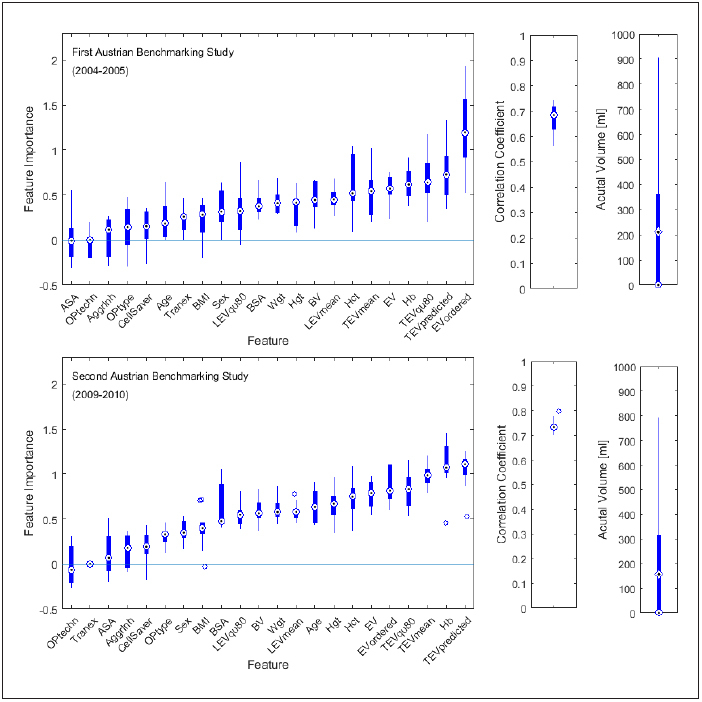
Results: Our results indicate that predictive modeling applied prior surgery can predict the transfused volume of red blood cells more accurately (correlation coefficient cc = 0.61) than state of the art algorithms (cc = 0.39). We found significantly different patterns of feature importance a) in different hospitals and b) between study 1 and study 2.
Conclusion: We conclude that predictive modeling can be used to benchmark the importance of different features on the models derived with data from different hospitals. This might help to optimize crucial processes in a specific hospital, even in other scenarios beyond Patient Blood Management.
Keywords: Predictive modelling; benchmarking; blood transfusion; machine learning; patient blood management; random forests.
Conflict of interest statement
Figures
References
-
- Anthes E.Evidence-based medicine: Save blood, save lives Nature 2015520754524–26. - PubMed
-
- Gombotz H, Zacharowski K, Spahn DR. Georg Thieme Verlag; 2013. Patient Blood Management –Individuelles Behandlungskonzept zur Reduktion und Vermeidung von Anämie und Blutverlust sowie zum rationalen Einsatz von Blutprodukten; p. 214.
-
- Gombotz H, Rehak PH, Shander A, Hofmann A. Blood use in elective surgery: the Austrian benchmark study. Transfusion. 2007;47(08):1468–1480. - PubMed
-
- Leahy MF, Hofmann A, Towler S, Trentino KM, Burrows SA, Swain SG, Hamdorf J, Gallagher T, Koay A, Geelhoed GC, Farmer SL.Improved outcomes and reduced costs associated with a health-system-wide patient blood management program: a retrospective observational study in four major adult tertiary-care hospitals. Transfusion 2017. Epub 2017/02/02. doi: 10.1111/trf.14006. - PubMed
-
- Gombotz H, Rehak PH, Shander A, Hofmann A.The second Austrian benchmark study for blood use in elective surgery: results and practice change Transfusion 20145410 Pt 22646–2657.Epub 2014/05/09. doi: 10.1111/trf.12687. - PubMed
Publication types
MeSH terms
LinkOut - more resources
Full Text Sources
Other Literature Sources
Medical
