. 2017 Aug 29;15(1):181.
doi: 10.1186/s12967-017-1284-7.

Glucocorticoid attenuates acute lung injury through induction of type 2 macrophage

Affiliations

Glucocorticoid attenuates acute lung injury through induction of type 2 macrophage

Guo-Wei Tu et al. J Transl Med. .

Abstract

Background: Acute lung injury (ALI) and acute respiratory distress syndrome (ARDS) are severe inflammatory lung diseases. Methylprednisolone (MP) is a common drug against inflammation in clinic. In this study, we aim to investigate the protective effect of MP on ALI and potential mechanisms.

Methods: Male BABL/c mice were injected through tail vein using lipopolysaccharide (LPS, 5 mg/kg) with or without 5 mg/kg MP. Lung mechanics, tissue injury and inflammation were examined. Macrophage subsets in the lung were identified by flow cytometry. Macrophages were cultured from bone marrow of mice with or without MP. Then, we analyzed and isolated the subsets of macrophages. These isolated macrophages were then co-cultured with CD4+ T cells, and the percentage of regulatory T cells (Tregs) was examined. The expression of IL-10 and TGF-β in the supernatant was measured. The Tregs immunosuppression function was examined by T cell proliferation assay. To disclose the mechanism of the induction of Tregs by M2c, we blocked IL-10 or/and TGF-β using neutralizing antibody.

Results: Respiratory physiologic function was significantly improved by MP treatment. Tissue injury and inflammation were ameliorated in the MP-treated group. After MP treatment, the number of M1 decreased and M2 increased in the lung. In in vitro experiment, MP promoted M2 polarization rather than M1. We then induced M1, M2a and M2c from bone marrow cells. M1 induced more Th17 while M2 induced more CD4+CD25+Fxop3+ Tregs. Compared with M2a, M2c induced more Tregs, and this effect could be blocked by anti-IL-10 and anti-TGF-β antibodies. However, M2a and M2c have no impact on Tregs immunosuppression function.

Conclusion: In conclusion, MP ameliorated ALI by promoting M2 polarization. M2, especially M2c, induced Tregs without any influence on Tregs immunosuppression function.

Keywords: Acute lung injury; Acute respiratory distress syndrome; Glucocorticoid; Macrophage; Methylprednisolone; Regulatory T cell.


Figures
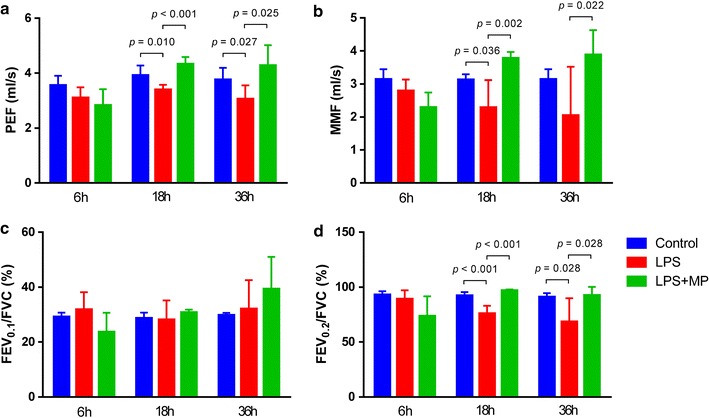
Fig. 1
Fig. 1
Lung function and ameliorated tissue injury. After the tracheostomy, we detected lung function at 6, 18 and 36 h in ALI model. Compared to the LPS group, a MP significantly increased the peak expiratory flow (PEF), b maximal mid-expiratory flow (MMF) and d forced expiratory volume 0.2 (FEV0.2)/forced vital capacity (FVC) at 18 and 36 h. c No significant difference was observed in forced expiratory volume 0.1 (FEV0.1)/forced vital capacity (FVC) among these groups. Data were shown as mean ± S.D.; n = 5 mice per group
Fig. 2
Fig. 2
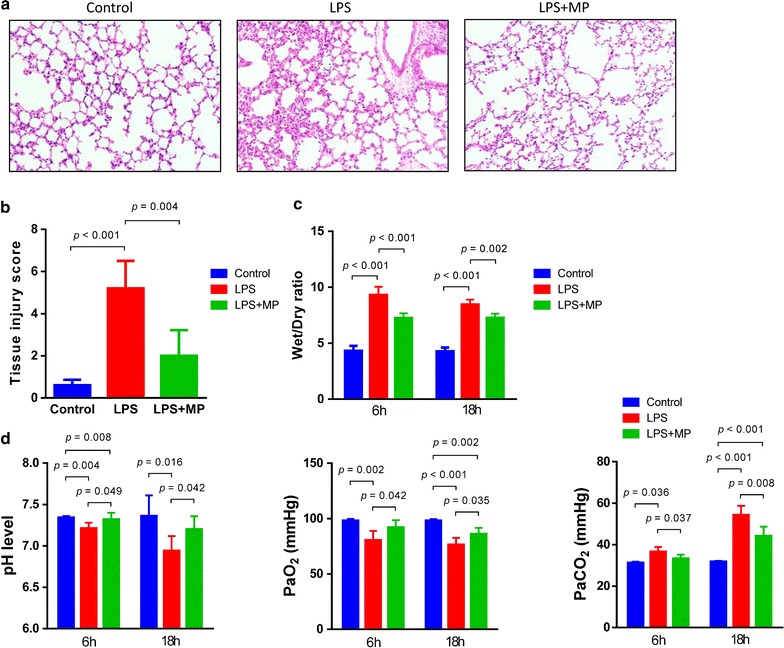
Tissue injury, lung weight/dry and arterial blood gas analysis. a At the 18 h after ALI, the lung was harvest and histologic damage was assessed in H&E-stained sections. b The semi-quantitative analysis of tissue injury indicated that MP treatment significantly attenuated tissue injury in the lung. c The severity of pulmonary edema was assessed by the wet to dry ratio (W/D ratio). MP treatment significantly reduced the W/D compared to that in the LPS group at 6 and 18 h. d Arterial blood gas analysis showed MP treatment significantly improved acid–base disturbance, increased PaO2 and reduced PaCO2. Data were shown as mean ± S.D.; n = 5 mice per group
Fig. 3
Fig. 3
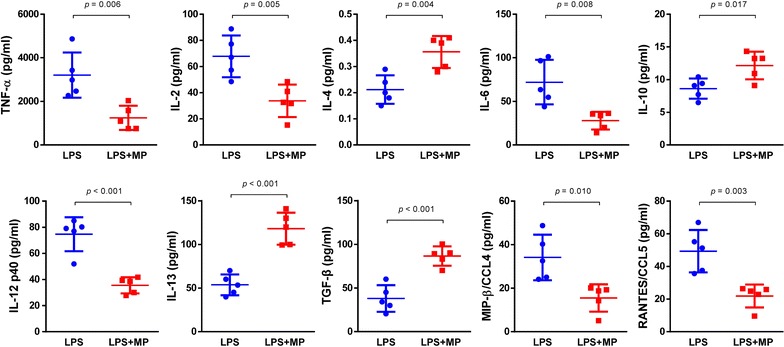
Cytokines and chemokines in (Bronchoalveolar lavage fluid) BAFL. The BALF supernatant was collected after centrifugation at 18 h after ALI. The expression of TNF-α, IL-2, IL-4, IL-6, IL-10, IL-12p40, IL-13, TGF-β, CCL4 and CCL5 in BAFL was measured by ELISA. The expression of TNF-α, IL-2, IL-6, IL-12p40, CCL4 and CCL5 decreased in the MP-treated group. However, MP treatment increased the level of IL-4, IL-10, IL-13 and TGF-β. Data were shown as mean ± S.D.; n = 5 mice per group. ELISA enzyme-linked immuno sorbent assay
Fig. 4
Fig. 4
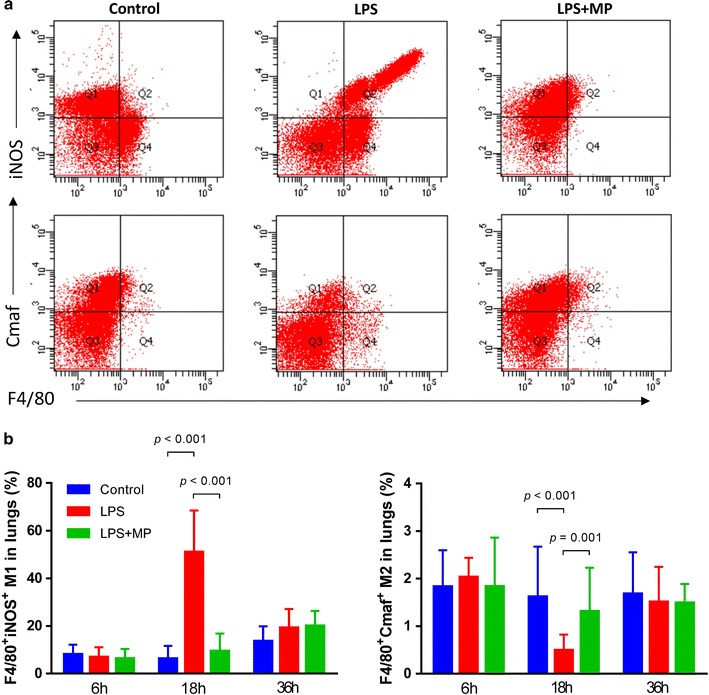
Macrophage subsets in vivo. After separating single cell in lung, flow cytometry was performed. a The percentage of F4/80+iNOS+ M1 and F4/80+Cmaf+ M2 were detected by flow cytometry of in the lung. b Semi-quantitative analysis showed F4/80+Cmaf+ M2 was decreased in the LPS group. MP treatment reduced M1 and increased M2 in the lung. No difference was observed between the control and MP treatment groups at 6 and 36 h. Data were shown as mean ± S.D.; n = 5 mice per group
Fig. 5
Fig. 5
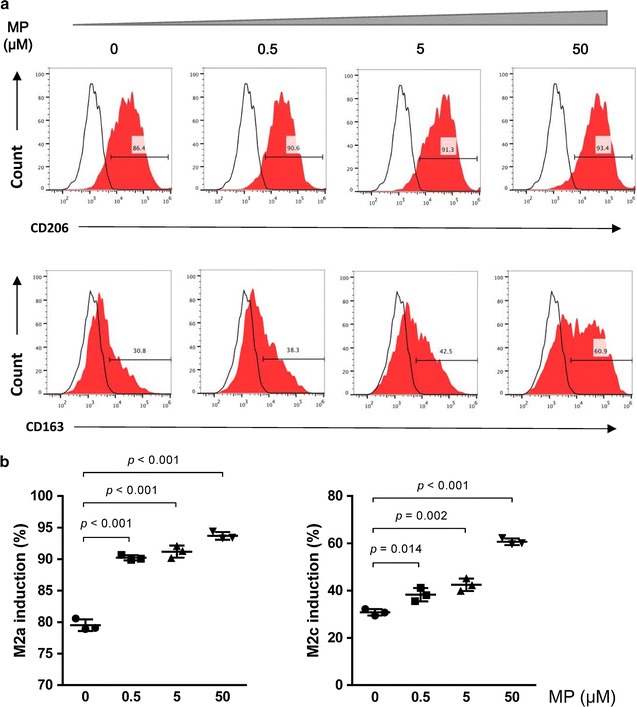
M2a and M2c differentiation in vitro. a Different dose of MP was added during M2a and M2c induction culture. The flow cytometry showed the percentage of CD206+ M2a and CD163+ M2c. b MP increased the CD206+ M2a and CD163+ M2c percentage in a dose-dependent way
Fig. 6
Fig. 6
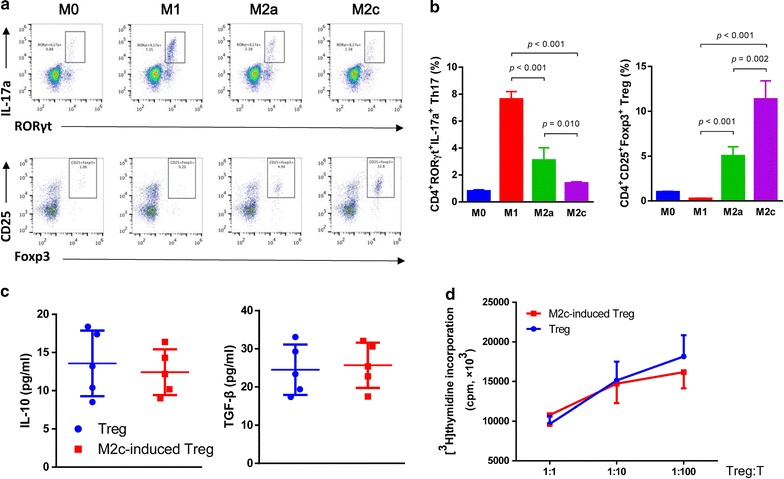
Influence on Tregs differentiation and function by macrophages. a Induced-M2a and M2c were isolated by flow cytometry and co-cultured with CD4+ naïve T cells, as well as M0 and M1, under Tregs induction environment. CD4+CD25+Foxp3+ Tregs and CD4+IL-17a+RORγt+ Th17 were detected. b Semi-quantitative analysis of Th17 and Tregs percentage showed M1 induced much more percentage of Th17. Compared to M0 and M1, both M2a and M2c significantly induced Tregs and inhibited Th17. Intriguingly, M2c induced more Tregs than M2a. c These M2c-induced Tregs were isolated. Compared to the normal Tregs, the expression of IL-10 and TGF-β in supernatant has no difference in M2c-induced Tregs. d Mix lymphocyte reaction was performed to compare the immunosuppression function between the two groups of Tregs. The immune suppressive function between normal Tregs and M2c-induced Tregs showed no significant difference
Fig. 7
Fig. 7
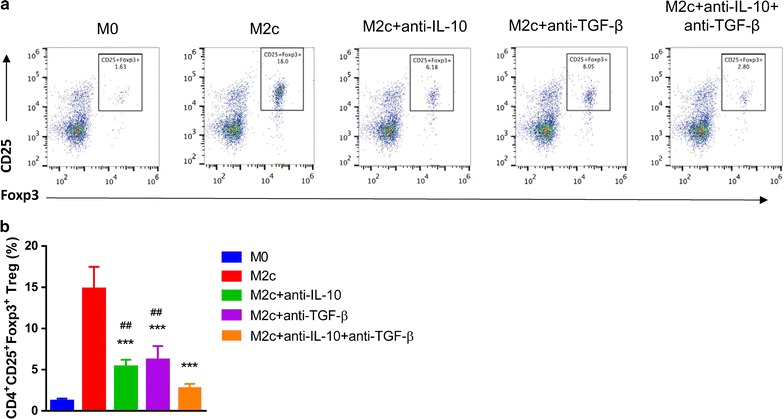
M2c induced Tregs through IL-10 and TGF-β secretion. a Anti-IL-10 and/or anti-TGF-β antibodies were added in the co-culture system. b Either anti-IL-10 or anti-TGF-β antibody significantly reversed Tregs induction by MP. In the mixed antibodies group, the number of Tregs is the lowest
Fig. 8
Fig. 8
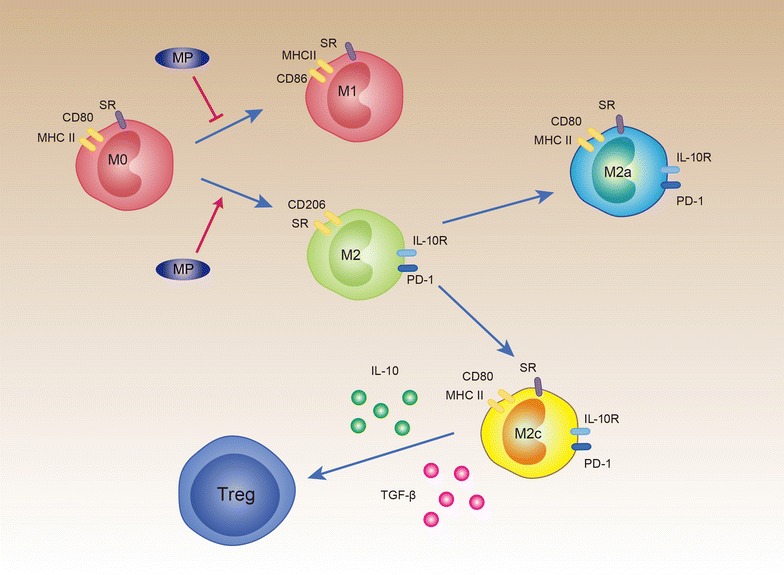
Schematic picture of the mechanism. In ALI model, MP treatment restores the balance between M1 and M2. MP promotes M2 differentiation in terms of M2a and M2c. Compared to M2a, MP-induced M2c induces more Tregs. Regulation innate and adaptive immune response by MP might be a mechanism of ameliorating ALI

References

    1. Gibbison B, Lopez-Lopez JA, Higgins JP, Miller T, Angelini GD, Lightman SL, Annane D. Corticosteroids in septic shock: a systematic review and network meta-analysis. Crit Care. 2017;21:78. doi: 10.1186/s13054-017-1659-4. - DOI - PMC - PubMed
    1. Ozturk O, Tezcan AH, Adali Y, Yildirim CH, Aksoy O, Yagmurdur H, Bilge A. Effect of ozone and methylprednisolone treatment following crush type sciatic nerve injury. Acta Cir Bras. 2016;31:730–735. doi: 10.1590/s0102-865020160110000005. - DOI - PubMed
    1. Cheng S, Gao W, Xu X, Fan H, Wu Y, Li F, Zhang J, Zhu X, Zhang Y. Methylprednisolone sodium succinate reduces BBB disruption and inflammation in a model mouse of intracranial haemorrhage. Brain Res Bull. 2016;127:226–233. doi: 10.1016/j.brainresbull.2016.10.007. - DOI - PubMed
    1. Royse CF, Saager L, Whitlock R, Ou-Young J, Royse A, Vincent J, Devereaux PJ, Kurz A, Awais A, Panjasawatwong K, Sessler DI. Impact of methylprednisolone on postoperative quality of recovery and delirium in the steroids in cardiac surgery trial: a randomized, double-blind, placebo-controlled substudy. Anesthesiology. 2017;126:223–233. doi: 10.1097/ALN.0000000000001433. - DOI - PubMed
    1. Marik PE, Meduri GU, Rocco PR, Annane D. Glucocorticoid treatment in acute lung injury and acute respiratory distress syndrome. Crit Care Clin. 2011;27:589–607. doi: 10.1016/j.ccc.2011.05.007. - DOI - PubMed

Publication types

MeSH terms