


A system approach to improving maternal and child health care delivery in Kenya: innovations at the community and primary care facilities (a protocol)
- PMID: 28851383
- PMCID: PMC5576377
- DOI: 10.1186/s12978-017-0358-6
A system approach to improving maternal and child health care delivery in Kenya: innovations at the community and primary care facilities (a protocol)
Abstract
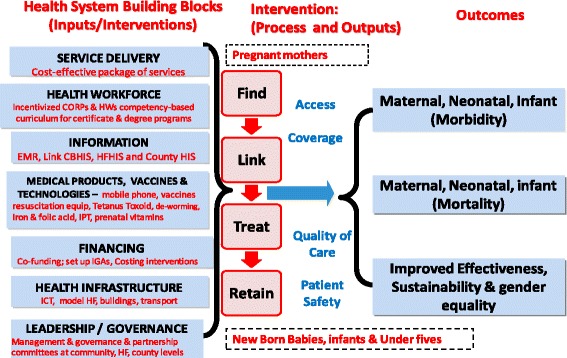
Background: Maternal, fetal and neonatal mortality are higher in low-income compared to high-income countries due to weak health systems including poor access and utilization of health services. Despite enormous recent improvements in maternal, neonatal and under 5 health indicators, more rapid progress is needed to meet the targets including the Development Goal 3(SDG). In Kenya these indicators are still high and comprehensive systems are needed to attain the targets of the SDG 3 by 2030. We describe the structure and methods of a study to assess the impact of an innovative system approach on maternal, neonatal and under-five children outcomes. This will be implemented in two clusters in the Counties of Busia and Bungoma in Kenya. There will be 4 control clusters in Kakamega, UasinGishu, Trans Nzoia and Elgeyo Marakwet Counties in Kenya. The study population will be pregnant women, newborns and under-five children identified over the study period. The objective of the study is to improve access, utilization and quality of Maternal and Child Health care through a predesigned Enhanced Health Care System (EHC) that embodies six WHO pillars of the health system and community owned initiatives including Community Based Organisations and Income Generating Activities.
Methods/design: A five year quasi-experimental design will be used to compare the outcomes of the implementation of the EHC using the Find Link Treat and retain (FLTR) strategy in one cluster, community owned initiatives in one cluster and four control clusters at baseline and at the end of the study. A Baseline survey will be conducted in year one and an endline in the fifth year in which maternal, neonatal and underfive childhood outcomes will be compared.
Discussion: The expected findings from the study include showing trends in improvement in the intervention clusters for morbidity, mortality, health service utilization and access indicators. Use of the health systems approach in health care provision is expected to provide a holistic improvement in the quality of care in the study populations in the intervention clusters that will lead to improved health indicators including morbidity and mortality. It is expected that the findings will inform health policy of the national and county governments in Kenya and worldwide.
Keywords: Enhanced health care; Find link treat and retain; Health systems; Maternal; Neonatal.
Conflict of interest statement
Ethics approval and consent to participate
The proposal was approved by the Research and Ethics committee of Moi university
Consent for publication
The authors have all approved the publication of the proposal.
Competing interests
The authors declare that they have no competing interests.
Publisher’s Note
Springer Nature remains neutral with regard to jurisdictional claims in published maps and institutional affiliations.
Figures
References
-
- WHO, Everybody’s Business: Strengthening Health Systems to Improve Health Outcomes—WHO’s Framework for Action. Geneva; 2007.
-
- UNICEF. Committing to child survival: A Promise Renewed. Progress report 2013, 9.09.2013. http://www.unicef.org/publications/files/APR_Progress_ Report_20139_Sept_2013.pdf (accessed 04.10.2013).
-
- Gilson L, Health Policy and System Researc h: A Methodology Reader. 2012. http://www.who.int/alliance-hpsr/resources/alliancehpsr_reader.pdf?ua=1.
MeSH terms
LinkOut - more resources
Full Text Sources
Other Literature Sources
Medical
