


Effectiveness of an online social support intervention for caregivers of people with dementia: the study protocol of a randomised controlled trial
- PMID: 28851406
- PMCID: PMC5575867
- DOI: 10.1186/s13063-017-2097-y
Effectiveness of an online social support intervention for caregivers of people with dementia: the study protocol of a randomised controlled trial
Abstract
Background: Caregivers of people with dementia (PwD) face burden, feelings of loneliness, and social isolation. Previous studies have shown promising effects of online e-health interventions. Using social media may facilitate support for dementia caregiver networks. In an iterative step-wise approach, a social support tool entitled "Inlife" was developed. This paper describes the design of a study evaluating the effects of Inlife and its process characteristics.
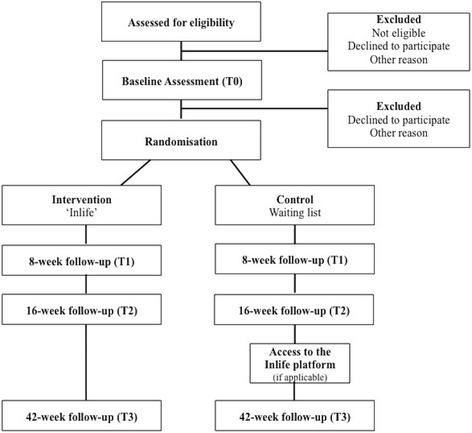
Methods: A mixed-method, randomised controlled trial with 122 caregivers of PwD will be conducted. Participants will be assigned to either the Inlife social support intervention or a waiting-list control group. After 16 weeks, the control group will obtain access to the Inlife environment. Data will be collected at baseline (T0) and at 8-week (T1), 16-week (T2) and 42-week follow up (T3). The 16-week follow-up assessment (T2) is the primary endpoint to evaluate the results on the primary and secondary outcomes, measured by self-reported questionnaires. The primary outcomes include feelings of caregiver competence and perceived social support. The secondary outcomes include received support, feelings of loneliness, psychological complaints (e.g., anxiety, stress), and quality of life. A process evaluation, including semi-structured interviews, will be conducted to examine the internal and external validity of the intervention.
Discussion: Using a mixed-method design, our study will provide valuable insights into the usability, effectiveness, and factors related to implementation of the Inlife intervention. Our study results will indicate whether Inlife could be a valuable social support resource in future routine dementia care.
Trial registration: Dutch trial register, NTR6131 . Registered on 20 October 2016.
Keywords: Dementia; Informal caregiving; Online intervention; RCT; Social media; Web-based.
Conflict of interest statement
Consent for publication
Not applicable.
Competing interests
The authors declare that they have no competing interests.
Publisher’s Note
Springer Nature remains neutral with regard to jurisdictional claims in published maps and institutional affiliations.
Figures
References
-
- Alzheimer's Disease International; 2014. World Alzheimer's Report 2014: Dementia and Risk Reduction: An analysis of protective and modifiable factors. [https://www.alz.co.uk/research/WorldAlzheimerReport2014.pdf]. Accessed 15 Feb 2017.
-
- Droes RM, Chattat R, Diaz A, Gove D, Graff M, Murphy K, Verbeek H, Vernooij-Dassen M, Clare L, Johannessen A, et al. Social health and dementia: a European consensus on the operationalization of the concept and directions for research and practice. Aging Ment Health 2016:1–14. doi: 10.1080/13607863.2016.1254596. - PubMed
-
- Clement S, Schauman O, Graham T, Maggioni F, Evans-Lacko S, Bezborodovs N, Morgan C, Rusch N, Brown JS, Thornicroft G. What is the impact of mental health-related stigma on help-seeking? A systematic review of quantitative and qualitative studies. Psychol Med. 2015;45:11–27. doi: 10.1017/S0033291714000129. - DOI - PubMed
Publication types
MeSH terms
Associated data
LinkOut - more resources
Full Text Sources
Other Literature Sources
Medical
