


Postmenopausal mild hirsutism and hyperandrogenemia due to granulosa cell tumor of the ovary: a case report
- PMID: 28851436
- PMCID: PMC5576087
- DOI: 10.1186/s13256-017-1411-3
Postmenopausal mild hirsutism and hyperandrogenemia due to granulosa cell tumor of the ovary: a case report
Abstract
Background: Among classes of ovarian tumor, granulosa cell tumors are the least common. In approximately 10% of cases of granulosa cell tumor, androgen will be secreted which will present with hirsutism and hyperandrogenemia. We describe a woman with ovarian granulosa cell tumor who presented with hirsutism.
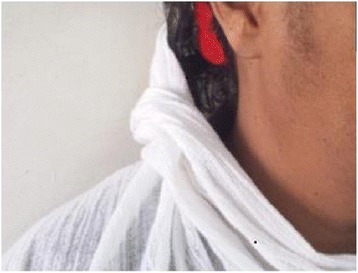
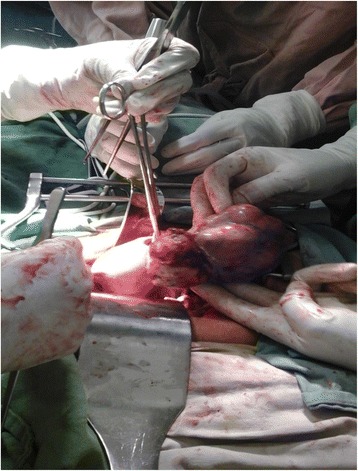
Case presentation: A 50-year-old woman of Amhara ethnicity, para III, abortion I (induced), presented with excessive hair on her face and lower abdomen of 4 years' duration which affected her quality of life. Her menopause started 7 years ago. Her body mass index was 29.8 kg/m2. She had hair on her upper lip, chin, and lower abdomen; she had a Ferriman-Gallwey score of 10. A pelvic examination revealed that her uterus was of normal size and there was no adnexal mass. Ultrasound finding: her right ovary measured 5 × 4 cm. Her serum testosterone was 254 ng/dl; she was counseled to undergo an exploratory laparotomy but she declined. She presented to our out-patient department 10 months later with a complaint of excessive vaginal bleeding of 18 days' duration. A sonographic evaluation showed a 12 by 15 cm right adnexal cystic mass. With preoperative diagnosis of testosterone-producing sex cord-stromal tumor of the ovary, an exploratory laparotomy was performed. The laparotomy revealed a 20 by 30 cm right ovarian mass with pathology result of adult granulosa cell tumor.
Conclusion: In postmenopausal women with new hirsutism that is severe or rapidly progressive, the possibility of an androgen-secreting tumor must be suspected and a thorough evaluation is needed before initiating treatment for idiopathic hirsutism.
Keywords: Granulosa cell tumor; Hirsutism; Hyperandrogenemia; Virilization.
Conflict of interest statement
Ethics approval and consent to participate
Not applicable.
Consent for publication
Written informed consent was obtained from the patient for publication of this case report and any accompanying images. A copy of the written consent is available for review by the Editor-in-Chief of this journal.
Competing interests
The authors declare that they have no competing interests.
Publisher’s Note
Springer Nature remains neutral with regard to jurisdictional claims in published maps and institutional affiliations.
Figures
References
-
- González-Díaz E, et al. Tumor de células de la granulosa tipo adulto de ovario. Progresos de Obstetricia y Ginecología. 2008;51(10):593–604. doi: 10.1016/S0304-5013(08)73321-1. - DOI
-
- Sehouli J, et al. Granulosa cell tumor of the ovary: 10 years follow-up data of 65 patients. Anticancer Res. 2004;24(2C):1223–30. - PubMed
Publication types
MeSH terms
Substances
Supplementary concepts
LinkOut - more resources
Full Text Sources
Other Literature Sources
Medical
