Review
. 2017 Aug 29;5(1):63.
doi: 10.1186/s40478-017-0468-y.

RNA biology of disease-associated microsatellite repeat expansions

Affiliations
Review

RNA biology of disease-associated microsatellite repeat expansions

Kushal J Rohilla et al. Acta Neuropathol Commun. .

Abstract

Microsatellites, or simple tandem repeat sequences, occur naturally in the human genome and have important roles in genome evolution and function. However, the expansion of microsatellites is associated with over two dozen neurological diseases. A common denominator among the majority of these disorders is the expression of expanded tandem repeat-containing RNA, referred to as xtrRNA in this review, which can mediate molecular disease pathology in multiple ways. This review focuses on the potential impact that simple tandem repeat expansions can have on the biology and metabolism of RNA that contain them and underscores important gaps in understanding. Merging the molecular biology of repeat expansion disorders with the current understanding of RNA biology, including splicing, transcription, transport, turnover and translation, will help clarify mechanisms of disease and improve therapeutic development.

Keywords: Amyotrophic lateral sclerosis; C9FTD/ALS; C9ORF72; DM1; DM2; Export; FXTAS; Fragile X; HD; Huntington's disease; Mechanism; Microsatellite; Myotonic dystrophy; RNA; Repeat expansion disease; SBMA; SCA; Spinocerebellar ataxia; Splicing; Tandem repeats; Therapeutics; Transcription; Translation; Transport; Turnover.


Conflict of interest statement

Competing interests

The authors declare that they have no competing interests.

Publisher’s Note

Springer Nature remains neutral with regard to jurisdictional claims in published maps and institutional affiliations.

Figures
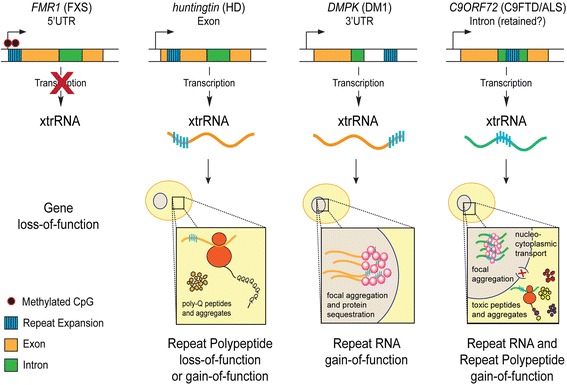
Fig. 1
Fig. 1
Distinct loss-of-function and gain-of-function mechanisms of disease for various repeat expansion disorders. Repeat expansions can occur in 5’ or 3’ UTRs, exons, or introns. Expanded tandem repeat-containing RNA (xtrRNA) may not be transcribed due to epigenetic silencing, thereby causing loss of gene function. If transcribed, xtrRNA may become trapped in the cell nucleus where it can form focal aggregates and functionally deplete important RNA binding proteins. The xtrRNA may also be exported to the cytoplasm where it can undergo translation to produce repeat-containing polypeptides that disrupt cellular processes. In some cases, xtrRNA can form focal nuclear aggregates and also be translated into repeat-containing polypeptides. Repeat-containing polypeptides can be toxic in multiple ways, including insoluble aggregation, blocking normal host protein function, inhibiting nucleocytoplasmic transport, and disrupting other critical cellular functions
Fig. 2
Fig. 2
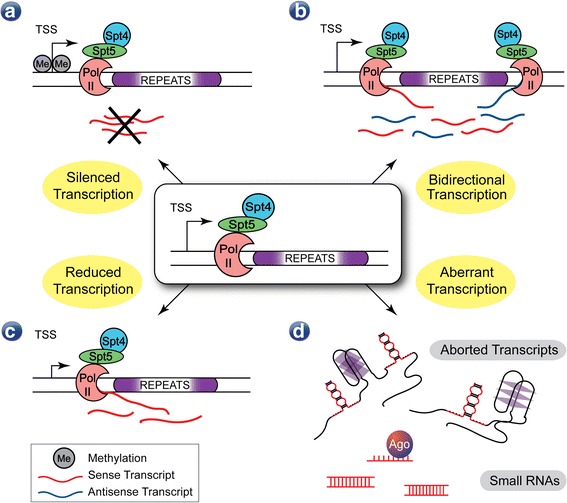
Effects of repeat expansion sequence on transcription. Repeat expansion sequences can perturb transcription by a epigenetic silencing, b inducing or facilitating bidirectional transcription, c reduced transcription kinetics, or d generating transcripts that can potentially be processed into small RNAs that could guide degradation or silencing of various complementary RNAs, including the xtrRNA itself
Fig. 3
Fig. 3
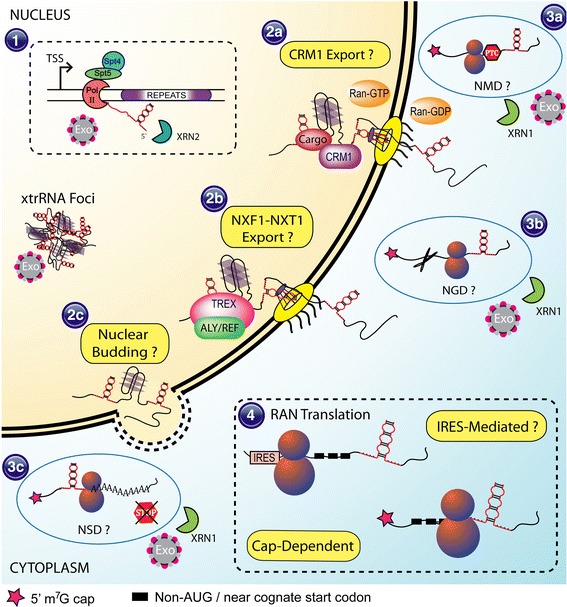
Possible mechanisms of nuclear and cytoplasmic RNA surveillance, nuclear export, and translation of xtrRNA. RNA containing large repeat expansion sequences may be subject to nuclear RNA surveillance mechanisms, including degradation by the nuclear exosome (1) or the XRN2 5'-3' exoribonuclease (1). Export of xtrRNA likely involves bulk mRNA transport via NXF1 (2b), but may also include alternative mechanisms like CRM1-mediated export (2a) or possibly nuclear envelope budding (2c). Cytoplasmic RNA surveillance mechanisms that may control xtrRNA levels and translation include nonsense-mediated decay (NMD) (3a), no-go decay (NGD) (3b), or nonstop decay (NSD) (3c). Translation of xtrRNA is likely to follow canonical cap-dependent translation (4), especially when repeat expansions are embedded in normal coding regions of an mRNA, but may potentially involve internal ribosome entry site (IRES)-like mechanisms (4). RAN translation has been shown to be cap-dependent for some repeat expansions, but complete mechanistic details remain to be determined

References

    1. Abecasis GR, Auton A, Brooks LD, DePristo MA, Durbin RM, Handsaker RE, Kang HM, Marth GT, McVean GA. An integrated map of genetic variation from 1,092 human genomes. Nature. 2012;491:56–65. doi: 10.1038/nature11632. - DOI - PMC - PubMed
    1. Adihe Lokanga R, Zhao XN, Entezam A, Usdin K. X inactivation plays a major role in the gender bias in somatic expansion in a mouse model of the fragile X-related disorders: implications for the mechanism of repeat expansion. Hum Mol Genet. 2014;23:4985–4994. doi: 10.1093/hmg/ddu213. - DOI - PMC - PubMed
    1. Akiyama BM, Eiler D, Kieft JS. Structured RNAs that evade or confound exonucleases: function follows form. Curr Opin Struct Biol. 2016;36:40–47. doi: 10.1016/j.sbi.2015.12.006. - DOI - PMC - PubMed
    1. Amrani N, Ganesan R, Kervestin S, Mangus DA, Ghosh S, Jacobson A. A faux 3'-UTR promotes aberrant termination and triggers nonsense-mediated mRNA decay. Nature. 2004;432:112–118. doi: 10.1038/nature03060. - DOI - PubMed
    1. Anderson JS, Parker RP. The 3' to 5' degradation of yeast mRNAs is a general mechanism for mRNA turnover that requires the SKI2 DEVH box protein and 3' to 5' exonucleases of the exosome complex. EMBO J. 1998;17:1497–1506. doi: 10.1093/emboj/17.5.1497. - DOI - PMC - PubMed

Publication types