. 2017 Aug 29;7(1):9627.
doi: 10.1038/s41598-017-09878-8.

Nosocomial transmission of Clostridium difficile Genotype ST81 in a General Teaching Hospital in China traced by whole genome sequencing

Affiliations

Nosocomial transmission of Clostridium difficile Genotype ST81 in a General Teaching Hospital in China traced by whole genome sequencing

Juanxiu Qin et al. Sci Rep. .

Abstract

Clostridium difficile infection (CDI) is increasingly recognized globally as a cause of significant morbidity and mortality. This study aimed to provide insight into the various dynamics of C. difficile transmission and infection in the hospital. We monitored the toxin and resistance profiles as well as evolutionary relationships of C. difficile strains to determine the epidemiology over time in a teaching hospital in Shanghai, China between May 2014 and August 2015. The CDI incidence of inpatients and outpatients were 67.7 cases and 0.3 cases per 100,000 patient-days, with a nosocomial patient-environment-patient transmission in May and June 2015. C. difficile genotype ST81, a clone with tcdA-negative and tcdB-positive, was not only the most common strain (30.8%, 28/91) but also had much higher resistance rates to clindamycin and moxifloxacin compared with non-ST81 genotypes. Hospitalized patients infected with ST81 genotypes were over 65 years of age and had more comorbidities, however patients infected with ST81 presented with less clinical symptoms than non-ST81 infected patients. This study provides initial epidemiological evidence that C. difficile ST81 is a successful epidemic genotype that deserves continuous surveillance in China.


Conflict of interest statement

The authors declare that they have no competing interests.

Figures

Figure 1
Figure 1
eBURST analysis of C. difficile using all STs available in the MLST database as of January 2016. ST nodes: blue: primary founder; yellow: sub-group founder; purple: STs identified in this research; green: newly identified STs in this research; red: >5 STs in this research; Cyan: clonal complex groups (CC).
Figure 2
Figure 2
Distribution of genotypes over time by hospital departments. (A) Distribution of genotype according to admission departments. GD: Gastroenterology department; ED: Emergency department; MO: Medical oncology; ND: Nephrology department; OP: Outpatient; HSD: Hepatobiliary surgery department CD: Cardiology department. (B) Monthly distribution of C. difficile isolates.
Figure 3
Figure 3
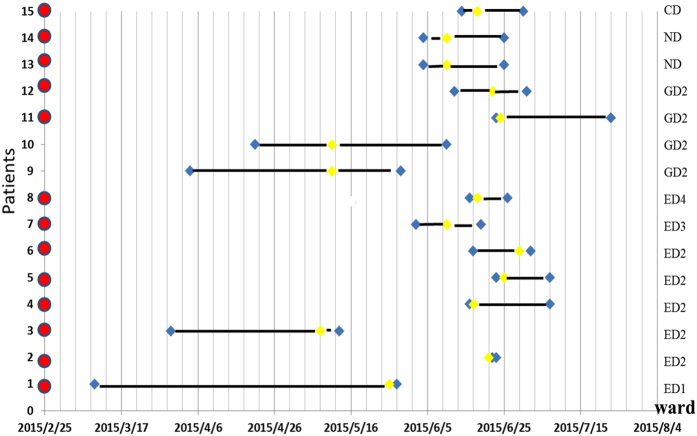
Temporal graph of 15 isolates of ST81 isolated from 15 patients (1–15). Red: The patient had undergone emergency medical treatment in the department observation room (ED0); Yellow: detection time; Blue: admission time and discharge time; Bold black line: period of hospitalization; ED1,ED2,ED3, and ED4: Emergency department wards; GD2: Gastroenterology department ward; ND: Nephrology department.
Figure 4
Figure 4
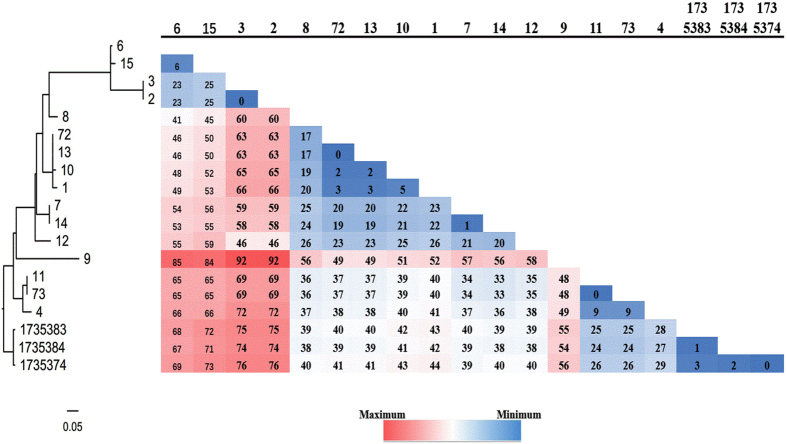
Analysis of phylogenetic tree and SNPs within C. difficile genotype ST81 in May and June 2015. Isolates 73 and 74 were separated from the ED0 environment in early June; SRR 1735383, SRR 1735384 and SRR1735374 were three annotated ST81.
Figure 5
Figure 5
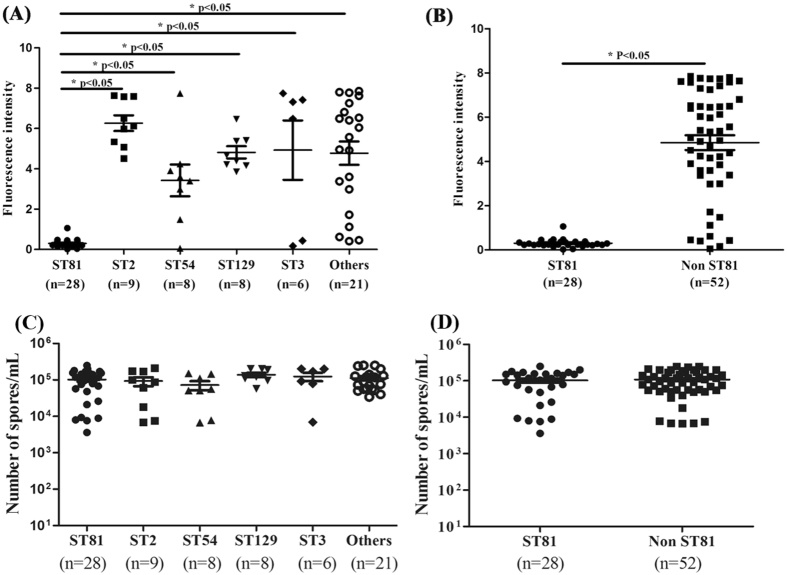
Comparison of toxin production and Sporulation determination by clinical toxigenic C. difficile genotypes. The toxin production and sporulation determination data are shown as the means ± SEM. The genotypes with significant differences were marked with *P < 0.05. (A) A comparison of toxin production among isolates with different genotypes: ST81, ST2, ST54, ST129, ST3, and others. (B) A comparison of the toxin production of the isolates with ST81 genotype and non ST81 genotypes. (C) Comparison of the sporulation determination of the isolates with different genotypes: ST81, ST2, ST54, ST129, ST3, and others. (D) Comparison of Sporulation determination of the isolates with ST81 genotype and non ST81 genotypes.

References

    1. Keel MK, Songer JG. The comparative pathology of Clostridium difficile-associated disease. Veterinary pathology. 2006;43:225–240. doi: 10.1354/vp.43-3-225. - DOI - PubMed
    1. Ananthakrishnan AN. Clostridium difficile infection: epidemiology, risk factors and management. Nature reviews. Gastroenterology & hepatology. 2011;8:17–26. - PubMed
    1. Dubberke ER, Wertheimer AI. Review of current literature on the economic burden of Clostridium difficile infection. Infection control and hospital epidemiology. 2009;30:57–66. doi: 10.1086/592981. - DOI - PubMed
    1. Jones AM, Kuijper EJ, Wilcox MH. Clostridium difficile: a European perspective. The Journal of infection. 2013;66:115–128. doi: 10.1016/j.jinf.2012.10.019. - DOI - PubMed
    1. Rupnik M, Wilcox MH, Gerding DN. Clostridium difficile infection: new developments in epidemiology and pathogenesis. Nature reviews. Microbiology. 2009;7:526–536. doi: 10.1038/nrmicro2164. - DOI - PubMed

Publication types

MeSH terms

Substances

LinkOut - more resources