


High-density lipoprotein particle pattern and overall lipid responses to a short-term moderate-intensity aerobic exercise training intervention in patients with chronic kidney disease
- PMID: 28852492
- PMCID: PMC5570090
- DOI: 10.1093/ckj/sfx006
High-density lipoprotein particle pattern and overall lipid responses to a short-term moderate-intensity aerobic exercise training intervention in patients with chronic kidney disease
Abstract
Background: Chronic kidney disease (CKD) is associated with abnormal lipid profiles and altered high-density lipoprotein (HDL) particle size patterns. Lower levels of the larger, cardioprotective HDL particles found in CKD may play a role in the increased risk for cardiovascular disease in these patients. The current study was designed to assess the effects of short-term moderate-intensity aerobic exercise training on the HDL particle pattern and overall lipid profiles in stage 3 CKD patients.
Methods: Forty-six men and women with stage 3 CKD were randomized to either exercise (EX, n = 25) or control (CON, n = 21). Those in the EX group completed 16 weeks of supervised moderate-intensity aerobic exercise three times per week. Serum total cholesterol, HDL cholesterol (HDL-C), triglycerides (TGs), low-density lipoprotein cholesterol (LDL-C), HDL particle size, estimated glomerular filtration rate (eGFR), body composition and peak oxygen uptake (VO2peak) were assessed at baseline and week 16.
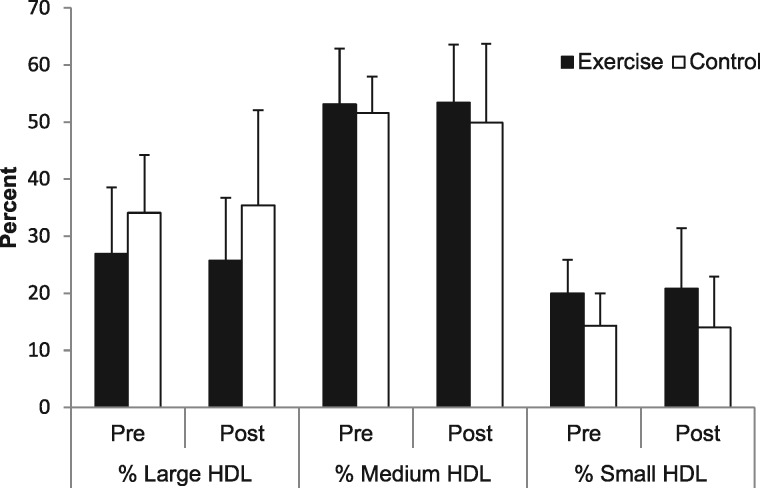
Results: The rate of compliance in the EX group was 97 ± 7.2%. No change was observed in eGFR over time in either group. There was an 8.2% improvement in VO2peak in the EX group (P = 0.05), while VO2peak decreased in the CON group. HDL-C, TGs, HDL particle size and body composition remained unchanged in both groups. A trend was found for lower total cholesterol (TC) (P = 0.051) and LDL-C (P = 0.07) in the CON group.
Conclusion: Our findings indicate that a short-term aerobic exercise training intervention in stage 3 CKD patients does not induce changes in HDL particle size or favorable lipid profile modifications.
Keywords: HDL particles; aerobic exercise; chronic kidney disease; lipids.
Figures
References
-
- Levey AS, Eckardt K, Tsukamoto Y. et al. Definition and classification of chronic kidney disease: a position statement from Kidney Disease: Improving Global Outcomes (KDIGO). Kidney Int 2005; 67: 2089–2100 - PubMed
-
- National Kidney Foundation. K/DOQI clinical practice guidelines for chronic kidney disease: evaluation, classification and stratification. Am J Kidney Dis 2002; 39(Suppl 1): S1–S266 - PubMed
-
- Sarnak MJ, Levey AS, Schoolwerth AC. et al. Kidney disease as a risk factor for development of cardiovascular disease: a statement from the American Heart Association councils on kidney in cardiovascular disease, high blood pressure research, clinical cardiology, and epidemiology and prevention. Circulation 2003; 108: 2154–2169 - PubMed
-
- 2013 USRDS annual data report: atlas of chronic kidney disease and end-stage renal disease in the United States. National Institutes of Health, National Institute of Diabetes and Digestive and Kidney Diseases, Bethesda, MD. 2014; 63: e1–e478
-
- Shulman NB, Ford CE, Hall WD. et al. Prognostic value of serum creatinine and effect of treatment of hypertension on renal function. Results from the hypertension detection and follow-up program. The Hypertension Detection and Follow-up Program Cooperative Group. Hypertension 1989; 13(5 Suppl): I80–I93 - PubMed
Grants and funding
LinkOut - more resources
Full Text Sources
Other Literature Sources
Research Materials
Miscellaneous
