


IN VIVO AND IN VITRO IMMUNOMODULATORY AND ANTI-INFLAMMATORY EFFECTS OF TOTAL FLAVONOIDS OF ASTRAGALUS
- PMID: 28852721
- PMCID: PMC5566160
- DOI: 10.21010/ajtcam.v13i4.10
IN VIVO AND IN VITRO IMMUNOMODULATORY AND ANTI-INFLAMMATORY EFFECTS OF TOTAL FLAVONOIDS OF ASTRAGALUS
Abstract
Background: Astragali Radix has long been used to improve immune function in traditional Chinese medicine. However, its main active components and potential immunomodulatory or anti-inflammatory activities have not been elucidated. In the present study, the immunomodulatory and anti-inflammatory activities of total flavonoids of Astragalus (TFA) isolated from Astragali Radix were evaluated by using in vivo animal models and in vitro cell models.
Materials and methods: The in vivo Immunomodulatory and anti-inflammatory activities of TFA were assessed by measuring macrophage phagocytic index, delayed type hypersensitivity, serum hemolysin level and immune organ index in mice, ear edema test in mice, paw edema test in rats, vascular permeability test in mice and granuloma test in rats. The in vitro Immunomodulatory and anti-inflammatory activities of TFA were assessed by examining its effect on cytokine and mediator production in un-stimulated and LPS-stimulated murine RAW 264.7 macrophages.
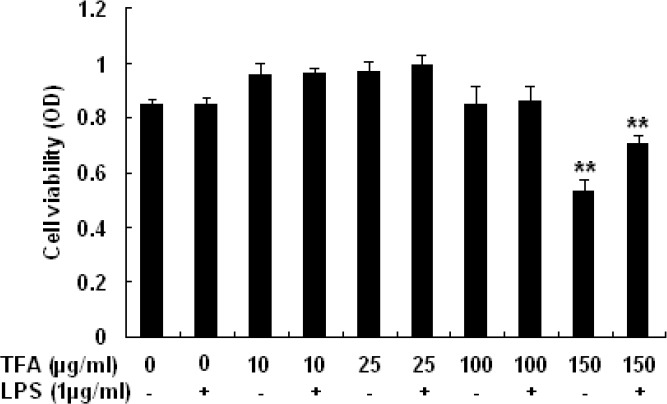
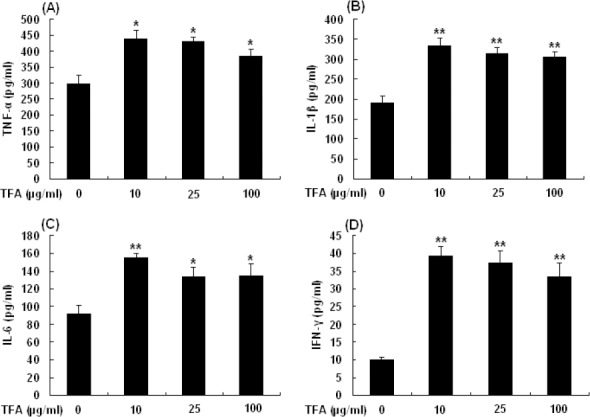
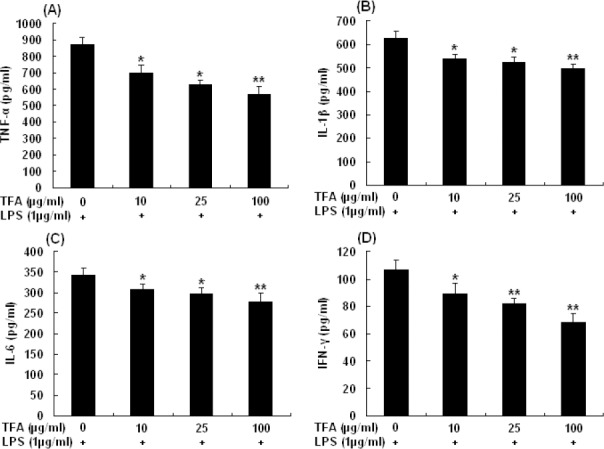
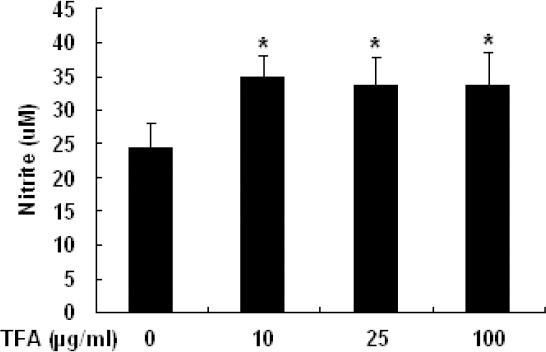
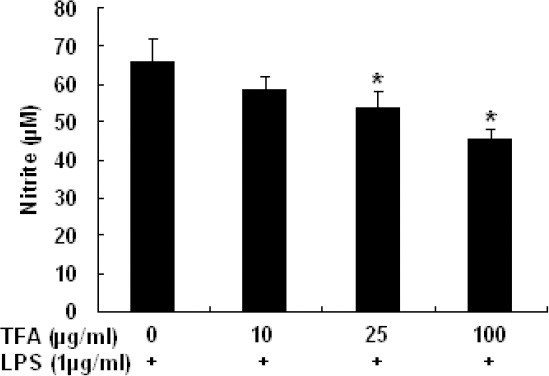
Results: The results of in vivo experiments showed that TFA enhanced macrophage phagocytic index, delayed type hypersensitivity, serum hemolysin level and immune organ index in mice, and attenuated mouse ear edema, rat paw edema, mouse vascular permeability and rat granuloma formation. The results of in vitro experiments showed that TFA stimulated the production of NO and cytokine TNF-α, IL-Ιβ, IL-6 and IFN-γ in un-stimulated RAW 264.7 macrophages, and inhibited the overproduction of these inflammatory mediators in LPS-stimulated RAW 264.7 macrophages in a dose-dependent manner without exerting cytotoxicity.
Conclusion: These results of this study indicate that TFA have potential immunostimulatory and anti-inflammatory effects.
Keywords: Anti-inflammation; Immunomodulation; In vitro; In vivo; Total flavonoids of Astragalus (TFA).
Figures
References
-
- Kim C, Ha H, Kim J.S, Kim Y.T, Kwon S.C, Park S.W. Induction of growth hormone by the roots of Astragalus membranaceus in pituitary cell culture. Arch. Pharm. Res. 2003;26:34–39. - PubMed
-
- Veterinary Pharmacopoeia Committee of PRC. Veterinary Pharmacopoeia of the People’s Republic of China, 2010 edition, Part 2. Chinese Agricultural Press; Beijing, China: 2011. pp. 414–416.
-
- McKenna D, Hughes K, Jones K. Astragalus Altern. Ther. Health M. 2002;8:34–40. - PubMed
-
- Cho W.C.S, Leung K.N. In vitro and in vivo immunomodulating and immunorestorative effects of Astragalus membranaceus. J. Ethnopharmacol. 2007;113:132–141. - PubMed
-
- Ryu M, Kim E.H, Chun M, Kang S, Shim B, Yu Y.B, Jeong G, Lee J.S. Astragali Radix elicits anti-inflammation via activation of MKP-1, concomitant with attenuation of p38 and Erk. J. Ethnopharmacol. 2008;115:184–193. - PubMed
MeSH terms
Substances
LinkOut - more resources
Full Text Sources
Other Literature Sources
Medical