


Genetic correlations between intraocular pressure, blood pressure and primary open-angle glaucoma: a multi-cohort analysis
- PMID: 28853718
- PMCID: PMC5643970
- DOI: 10.1038/ejhg.2017.136
Genetic correlations between intraocular pressure, blood pressure and primary open-angle glaucoma: a multi-cohort analysis
Abstract
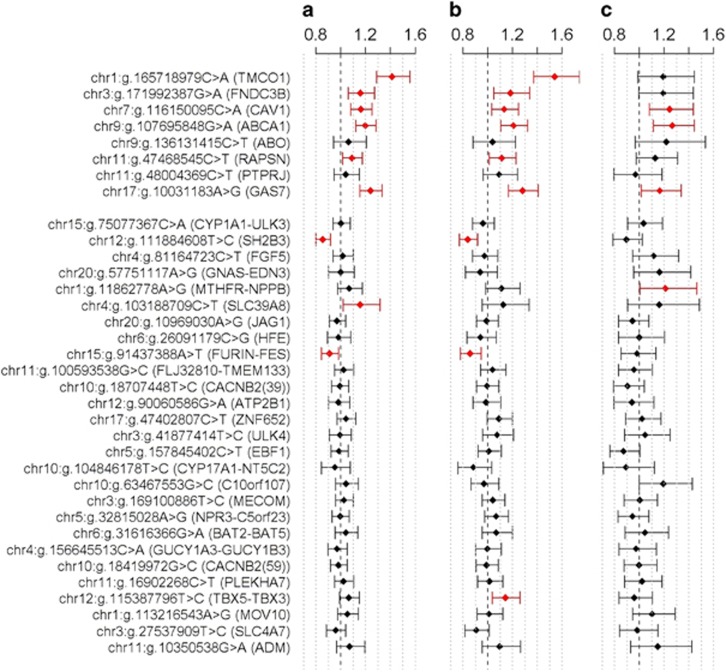
Primary open-angle glaucoma (POAG) is the most common chronic optic neuropathy worldwide. Epidemiological studies show a robust positive relation between intraocular pressure (IOP) and POAG and modest positive association between IOP and blood pressure (BP), while the relation between BP and POAG is controversial. The International Glaucoma Genetics Consortium (n=27 558), the International Consortium on Blood Pressure (n=69 395), and the National Eye Institute Glaucoma Human Genetics Collaboration Heritable Overall Operational Database (n=37 333), represent genome-wide data sets for IOP, BP traits and POAG, respectively. We formed genome-wide significant variant panels for IOP and diastolic BP and found a strong relation with POAG (odds ratio and 95% confidence interval: 1.18 (1.14-1.21), P=1.8 × 10⁻²⁷) for the former trait but no association for the latter (P=0.93). Next, we used linkage disequilibrium (LD) score regression, to provide genome-wide estimates of correlation between traits without the need for additional phenotyping. We also compared our genome-wide estimate of heritability between IOP and BP to an estimate based solely on direct measures of these traits in the Erasmus Rucphen Family (ERF; n=2519) study using Sequential Oligogenic Linkage Analysis Routines (SOLAR). LD score regression revealed high genetic correlation between IOP and POAG (48.5%, P=2.1 × 10⁻⁵); however, genetic correlation between IOP and diastolic BP (P=0.86) and between diastolic BP and POAG (P=0.42) were negligible. Using SOLAR in the ERF study, we confirmed the minimal heritability between IOP and diastolic BP (P=0.63). Overall, IOP shares genetic basis with POAG, whereas BP has limited shared genetic correlation with IOP or POAG.
Conflict of interest statement
The authors declare no conflict of interest.
Figures
References
-
- Tham YC, Li X, Wong TY, Quigley HA, Aung T, Cheng CY: Global prevalence of glaucoma and projections of glaucoma burden through 2040: a systematic review and meta-analysis. Ophthalmology 2014; 121: 2081–2090. - PubMed
-
- Boland MV, Ervin AM, Friedman DS et al: Comparative effectiveness of treatments for open-angle glaucoma: a systematic review for the U.S. Preventive Services Task Force. Ann Intern Med 2013; 158: 271–279. - PubMed
-
- Sommer A, Tielsch JM, Katz J et al: Relationship between intraocular pressure and primary open angle glaucoma among white and black Americans. The Baltimore Eye Survey. Arch Ophthalmol 1991; 109: 1090–1095. - PubMed
-
- Zhao D, Cho J, Kim MH, Guallar E: The association of blood pressure and primary open-angle glaucoma: a meta-analysis. Am J Ophthalmol 2014; 158: 615–627. - PubMed
-
- Leske MC, Wu SY, Hennis A, Honkanen R, Nemesure B: Risk factors for incident open-angle glaucoma: the Barbados Eye Studies. Ophthalmology 2008; 115: 85–93. - PubMed
Publication types
MeSH terms
Grants and funding
LinkOut - more resources
Full Text Sources
Other Literature Sources
Research Materials
