Review
. 2017 Oct 2;16(19):1765-1773.
doi: 10.1080/15384101.2017.1371886. Epub 2017 Aug 30.

Decoding telomere protein Rap1: Its telomeric and nontelomeric functions and potential implications in diabetic cardiomyopathy

Affiliations
Review

Decoding telomere protein Rap1: Its telomeric and nontelomeric functions and potential implications in diabetic cardiomyopathy

Yin Cai et al. Cell Cycle. .

Abstract

Mammalian Rap1, the most conserved telomere-interacting protein, beyond its role within nucleus for the maintenance of telomeric functions, is also well known for its pleiotropic functions in various physiological and pathological conditions associated with metabolism, inflammation and oxidative stress. For all these, nowadays Rap1 is the subject of critical investigations aimed to unveil its molecular signaling pathways and to scrutinize the applicability of its modulation as a promising therapeutic strategy with clinical relevance. However, the underlying intimate mechanisms of Rap1 are not extensively studied, but any modulation of this protein level has been associated with pathologies like inflammation, oxidative stress and deregulated metabolism. This is considerably important in light of the recent discovery of Rap1 modulation in diseases like cancer and cardiac metabolic disorders. In this review, we focus on both the telomeric and nontelomeric functions of Rap1 and its modulation in various health risks, especially on the heart.

Keywords: Rap1; diabetic cardiomyopathy; inflammation; metabolism; oxidative stress.


Figures
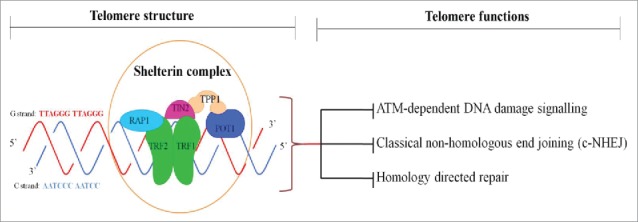
Figure 1.
Figure 1.
Telomere structure and functions. Mammalian telomere consists of TTAGGG repeats and end with 3′ G-strand overhang of up to a few nucleotides in length. Shelterin complex is formed by TRF1 (telomere repeat-binding factor 1), TRF2, Rap1 (repressor activator protein 1), TIN2 (TRF1-interaction factor 2), POT1 (protection of telomere 1) and TPP1 (POT1-organizing protein). Shelterin binds to double-stranded telomeric repeats and protects chromosome ends from ATM (ataxia telangiectasia mutated)- dependent DNA damage signaling, c-NHEJ (classical non-homologous end joining)-induced DNA repair, homology-directed repair.
Figure 2.
Figure 2.
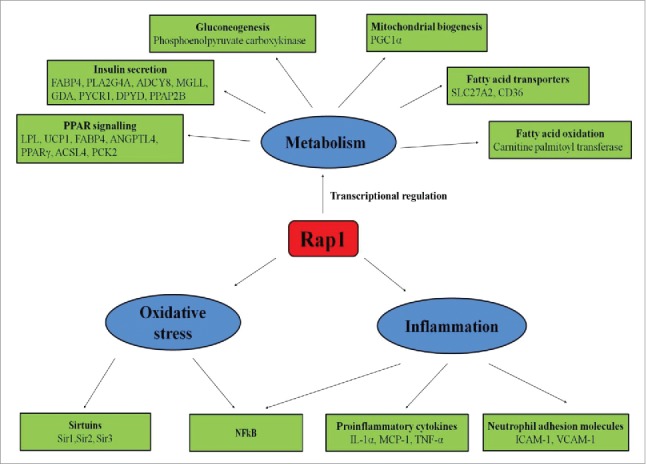
Nontelomeric functions of Rap1. Rap1 regulates various nontelomeric functions like metabolism, oxidative stress, and inflammation. Rap1controls energy metabolism by increasing fatty acid oxidation via increasing the expression of carnitine palmitoyltransferase, and fatty acid transporters such as SLC27A2 and CD36 and by increasing gluconeogenesis via increasing the expression of phosphoenolpyruvate carboxykinase. Rap1 also regulates mitochondrial biogenesis by increasing PGC-1α expression. Furthermore, Rap1 upregulates metabolic genes related to insulin secretion (FABP4, PLA2G4A, ADCY8, MGLL, GDA, PYCR1, DPYD, PPAP2B) and peroxisome-proliferator-activated receptor signaling (LPL, UCP1, FABP4, ANGPTL4, PPARγ, ACSL4, PCK2). In inflammation, Rap1 stimulates NFκB activations and upregulates the expression of proinflammatory cytokines such as IL-1α, MCP-1, TNF-α, and neutrophil adhesion molecules such as ICAM-1 and VCAM-1. Rap1 also modulates oxidative stress by increasing the expression of NFκB and sirtuins.

References

    1. de Lange T. Protection of mammalian telomeres. Oncogene. 2002;21:532-40. doi: 10.1038/sj.onc.1205080. PMID:11850778 - DOI - PubMed
    1. de Lange T. Shelterin: the protein complex that shapes and safeguards human telomeres. Genes Dev. 2005;19:2100-10. doi: 10.1101/gad.1346005. PMID:16166375 - DOI - PubMed
    1. Palm W, de Lange T. How shelterin protects mammalian telomeres. Annu Rev Genet. 2008;42:301-34. doi: 10.1146/annurev.genet.41.110306.130350. PMID:18680434 - DOI - PubMed
    1. Shore D, Nasmyth K. Purification and cloning of a DNA binding protein from yeast that binds to both silencer and activator elements. Cell. 1987;51:721-32. doi: 10.1016/0092-8674(87)90095-X. PMID:3315231 - DOI - PubMed
    1. Konig P, Giraldo R, Chapman L, Rhodes D. The crystal structure of the DNA-binding domain of yeast RAP1 in complex with telomeric DNA. Cell. 1996;85:125-36. doi: 10.1016/S0092-8674(00)81088-0. PMID:8620531 - DOI - PubMed

MeSH terms

LinkOut - more resources