. 2017 Jun 1;9(6):1725-1741.
doi: 10.1093/gbe/evx115.

Genomic Epidemiology of NDM-1-Encoding Plasmids in Latin American Clinical Isolates Reveals Insights into the Evolution of Multidrug Resistance

Affiliations

Genomic Epidemiology of NDM-1-Encoding Plasmids in Latin American Clinical Isolates Reveals Insights into the Evolution of Multidrug Resistance

Ricaurte Alejandro Marquez-Ortiz et al. Genome Biol Evol. .

Abstract

Bacteria that produce the broad-spectrum Carbapenem antibiotic New Delhi Metallo-β-lactamase (NDM) place a burden on health care systems worldwide, due to the limited treatment options for infections caused by them and the rapid global spread of this antibiotic resistance mechanism. Although it is believed that the associated resistance gene blaNDM-1 originated in Acinetobacter spp., the role of Enterobacteriaceae in its dissemination remains unclear. In this study, we used whole genome sequencing to investigate the dissemination dynamics of blaNDM-1-positive plasmids in a set of 21 clinical NDM-1-positive isolates from Colombia and Mexico (Providencia rettgeri, Klebsiella pneumoniae, and Acinetobacter baumannii) as well as six representative NDM-1-positive Escherichia coli transconjugants. Additionally, the plasmids from three representative P. rettgeri isolates were sequenced by PacBio sequencing and finished. Our results demonstrate the presence of previously reported plasmids from K. pneumoniae and A. baumannii in different genetic backgrounds and geographically distant locations in Colombia. Three new previously unclassified plasmids were also identified in P. rettgeri from Colombia and Mexico, plus an interesting genetic link between NDM-1-positive P. rettgeri from distant geographic locations (Canada, Mexico, Colombia, and Israel) without any reported epidemiological links was discovered. Finally, we detected a relationship between plasmids present in P. rettgeri and plasmids from A. baumannii and K. pneumoniae. Overall, our findings suggest a Russian doll model for the dissemination of blaNDM-1 in Latin America, with P. rettgeri playing a central role in this process, and reveal new insights into the evolution and dissemination of plasmids carrying such antibiotic resistance genes.

Keywords: Providencia rettgeri; antibiotic resistance; bacterial evolution; genomics; metallo-beta-lactamase; mobile genetic elements.


Figures

<sc>Fig</sc>. 1.
Fig. 1.
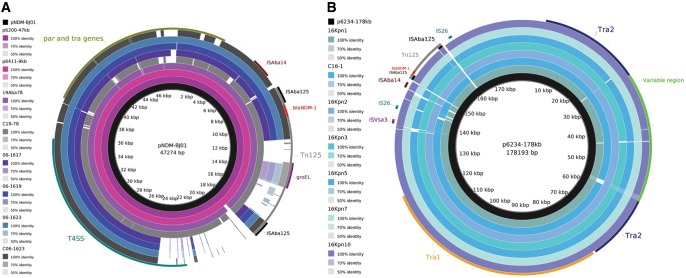
blaNDM-1-plasmids circulating among Acinetobacter baumannii and Klebsiella pneumoniae in Colombia. (A) BLASTn comparison of WGS assemblies of A. baumanni 19Aba78 from this study and its Escherichia coli transconjugant C19-78, the Providencia rettgeri NDM-positive isolates from Mexico (06-1617, 06-1619 and 06-1623) and the E. coli transconjugant C06-1623 against the plasmid pNDM-BJ01. Also were included the plasmids p6200-47kb and p6411-9kb previously reported in Colombia. (B) BLASTn comparison of WGS assemblies of K. pneumoniae isolates from this study and the E. coli transconjugant C16-1 against the plasmid p6234-178kb. Regions Tra1 and Tra2 common to IncA/C2 plasmids are highlighted (Fernandez-Alarcon et al. 2011); the Tra2 region is disrupted by a variable region. Black circles correspond to the reference plasmids p6234-178kb (A) and pNDM-BJ01 (B), included as internal control.
<sc>Fig</sc>. 2.
Fig. 2.
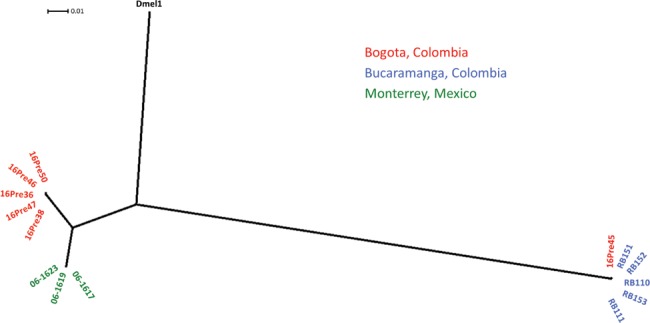
—Phylogenetic tree of Providencia rettgeri isolates based on core-genome SNPs. A Maximum Likelihood (ML) tree was built based on the SNPs in the core-genome assemblies of the NDM-1-positive P. rettgeri strains reported in this study (red, blue and green) with the P. rettgeri Dmel1 included as an outgroup control. Branch lengths are expressed in units of changes/nucleotide position (scale bar).
<sc>Fig</sc>. 3.
Fig. 3.
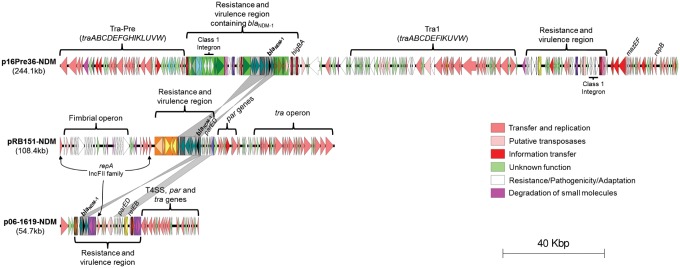
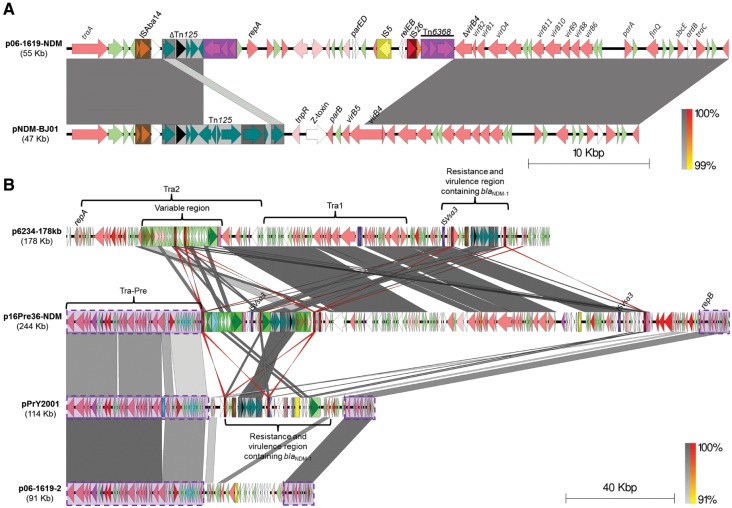
—General description of the blaNDM-1-positive plasmids from three representative Providencia rettgeri isolates sequenced in this study, including regions encoding genes for transposition and for replication, and virulence and resistance regions. Plasmid p16Pre36-NDM has two tra regions, one reported only for a P. rettgeri isolate (Tra-Pre) and the other reported in different IncA/C2 plasmids (Tra1). Plasmids pRB151-NDM and p06-1619-NDM have putative repA genes belonging to the IncFII family. Insertion sequences or transposons are shown as rectangles containing their respective CDS for transposition and accessory genes. Gray bars between pairs of sequences indicates >90% nucleotide identity in a window of 400 bp. The scale bar indicates sequence length.
<sc>Fig</sc>. 4.
Fig. 4.
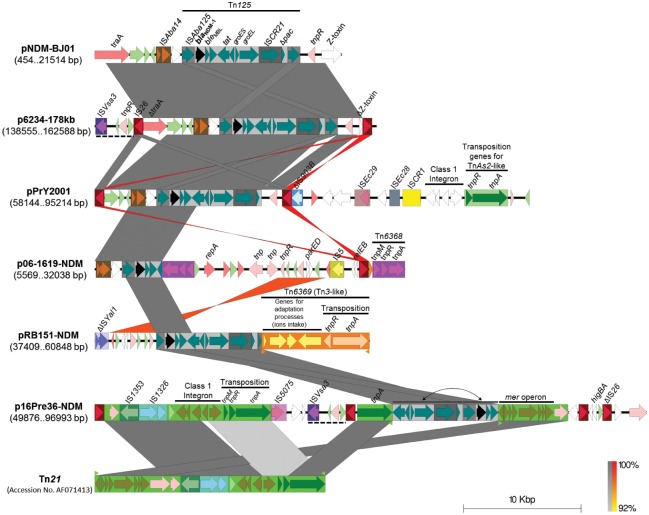
—Comparison of variable blaNDM-1-containing regions from plasmids p16Pre36-NDM, pRB151-NDM, p06-1619-NDM, p6234-178kb, pPrY2001 and pNDM-BJ01. Insertion sequences or transposons are shown as rectangles containing their respective CDS for transposition and accessory genes in different colors. Outside orange and green triangles correspond to the inverted repeats of a putative Tn3-like (Tn6369) and a Tn21, respectively. The prototype sequence of the Tn21 was included (Liebert et al. 1999). Dashed lines indicate the 2,928-bp sequence containing ISVsa3 carried by p6234.178kb (once) and p16Pre36-NDM (twice). Gray and red (inverted matches) shading between pairs of sequences indicates >90% of nucleotide identity in a window of 400 bp. The scale bar indicates sequence length.
<sc>Fig</sc>. 5.
Fig. 5.
—BLASTn comparison of (A) pNDM-BJ01 with the related p06-1619-NDM plasmid from Providencia rettgeri, and (B) pPrY-like plasmids (p16Pre36-NDM, pPrY2001 and p06-1619-2) from P. rettgeri with the IncA/C2 related p6234-178kb plasmid reported in Klebsiella pneumoniae. Conserved pPrY-like region is highlighted in purple rectangles with dashed lines. Gray and red (inverted matches) shading between pairs of sequences indicate >90% of nucleotide identity in a window of 400 bp. The scale bar indicates sequence length.
<sc>Fig</sc>. 6.
Fig. 6.
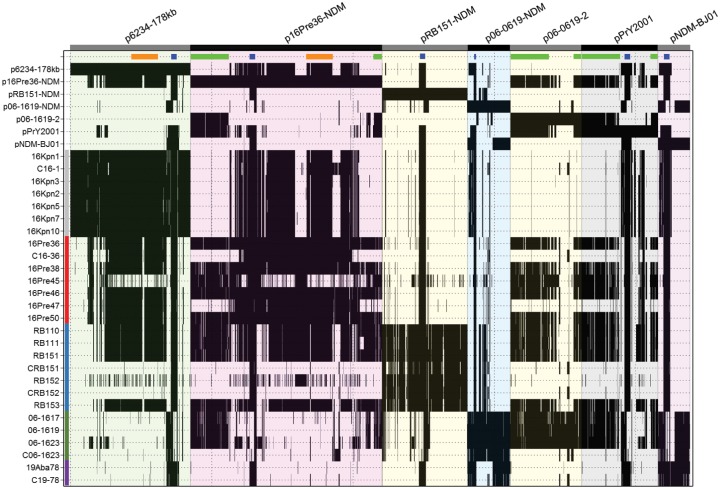
—Presence of blaNDM-1-plasmids in the clinical isolates and transconjugants. Complete sequence of blaNDM-1-plasmids circulating among Colombian and Mexican NDM-1-positive isolates and some related blaNDM-1-positive (pPrY2001 and pNDM-BJ01) and blaNDM-negative (p06-1619-2) plasmids are shown along the x axis. Black shading indicates a match of ≥90% nucleotide identity in a window of 300 bp, calculated by comparing the query sequence (x axis, reference plasmids) against the consensus from mapped reads for each strain (y axis). Horizontal orange and light green bars represent the Tra1 and pPrY-like regions, respectively; blue rectangles represent the Tn125 (or remnants) region in each plasmid. Vertical bars correspond to: gray for Klebsiella pneumoniae from Bogota (Colombia), red for Providencia rettgeri from Bogota (Colombia), blue for P. rettgeri from Bucaramanga (Colombia), green for P. rettgeri from Monterrey (Mexico), purple for Acinetobacter baumannii from Cali (Colombia). Simulated reads for the reference plasmids were included as an internal control.
<sc>Fig</sc>. 7.
Fig. 7.
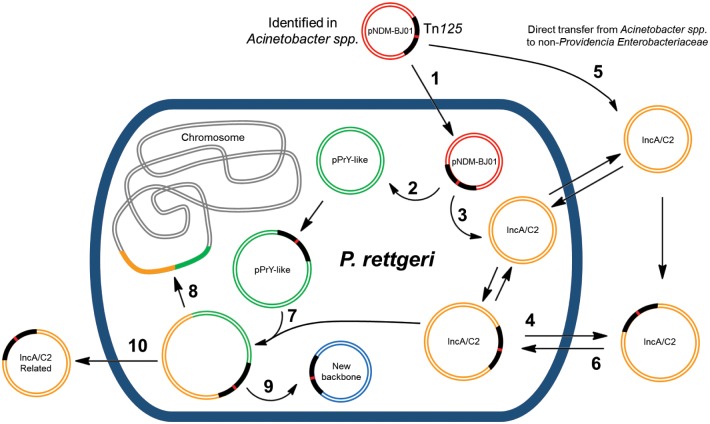
—Possible roles of Providencia rettgeri in blaNDM-1-plasmids evolution in Latin America. In an initial stage pNDM-BJ01-like plasmids are acquired from Acinetobacter spp. (−1). Shortly after, blaNDM-1 is transposed to pPrY-like plasmids (from P. rettgeri circulation; −2) or IncA/C2 plasmids (from Klebsiella pneumoniae, Escherichia coli or other Enterobacteriaceae; −3) via Tn125 transposition or by mean of other mobile genetic elements surrounding the Tn125 (or its remnants). IncA/C2 blaNDM-1-plasmids could be transferred to a broad bacteria host range (−4). It is also possible that a non-Providencia Enterobacteriaceae could capture a pNDM-BJ01-like plasmid and transposes Tn125 to a broad host range IncA/C2 plasmid (−5); later this IncA/C2 blaNDM-1-plasmid could be conjugated to P. rettgeri (−6). An interesting finding of the present study is the generation in P. rettgeri of new plasmids by mean of co-integration of pPrY-like plasmids and IncA/C2 plasmids (−7). These chimeric structures can also be transposed to the P. rettgeri chromosome (−8). The Tn125 (or its remnants) could be transposed to new plasmid backbones with possible implications upon its dissemination (−9). Additionally, by mean of partial conjugation could be disseminated IncA/C2-related (repA negative) blaNDM-1-plasmids (−10).

References

    1. Al-Marzooq F, Mohd Yusof MY, Tay ST.. 2015. Molecular analysis of antibiotic resistance determinants and plasmids in Malaysian isolates of multidrug resistant Klebsiella pneumoniae. PLoS One 10:e0133654. - PMC - PubMed
    1. Alikhan NF, Petty NK, Ben Zakour NL, Beatson SA.. 2011. BLAST Ring Image Generator (BRIG): simple prokaryote genome comparisons. BMC Genomics 12:402.. - PMC - PubMed
    1. Altschul SF, Gish W, Miller W, Myers EW, Lipman DJ.. 1990. Basic local alignment search tool. J Mol Biol. 215:403–410. - PubMed
    1. Bankevich A, et al. 2012. SPAdes: a new genome assembly algorithm and its applications to single-cell sequencing. J Comput Biol. 19:455–477. - PMC - PubMed
    1. Barrios H, et al. 2013. Isolation of carbapenem-resistant NDM-1-positive Providencia rettgeri in Mexico. J Antimicrob Chemother. 68:1934–1936. - PubMed

MeSH terms