


Adaptive Prediction Emerges Over Short Evolutionary Time Scales
- PMID: 28854640
- PMCID: PMC5570091
- DOI: 10.1093/gbe/evx116
Adaptive Prediction Emerges Over Short Evolutionary Time Scales
Abstract
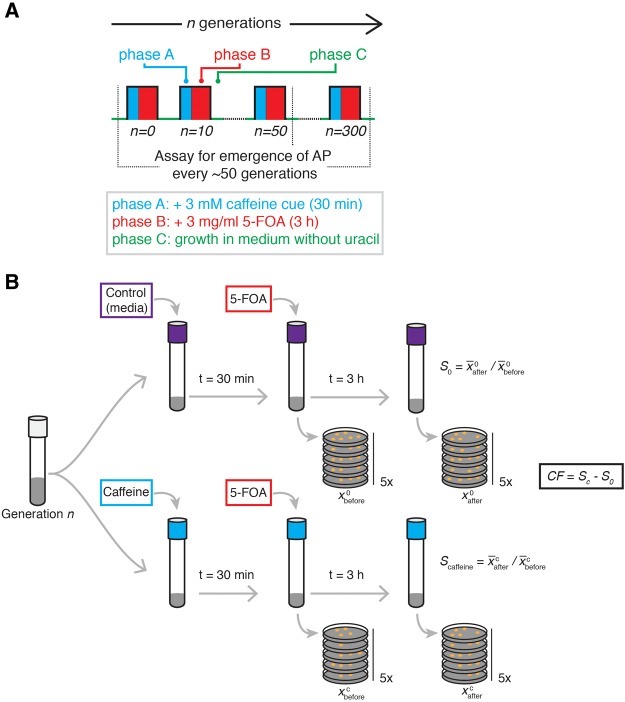
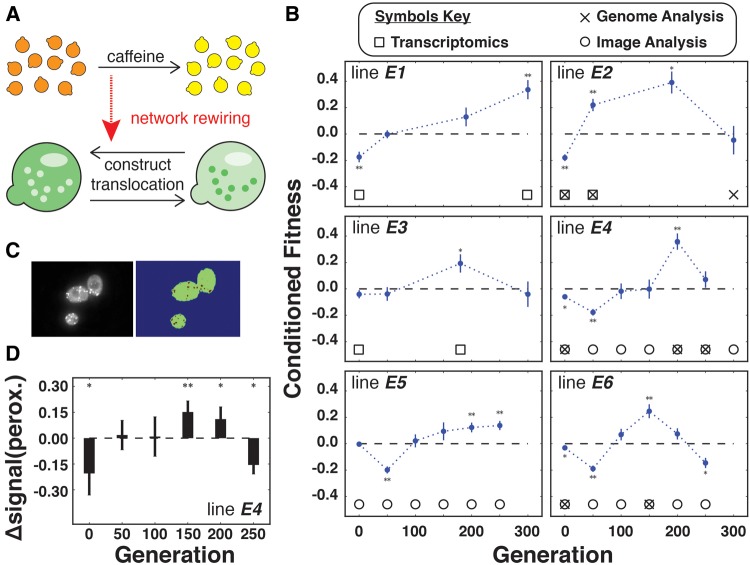
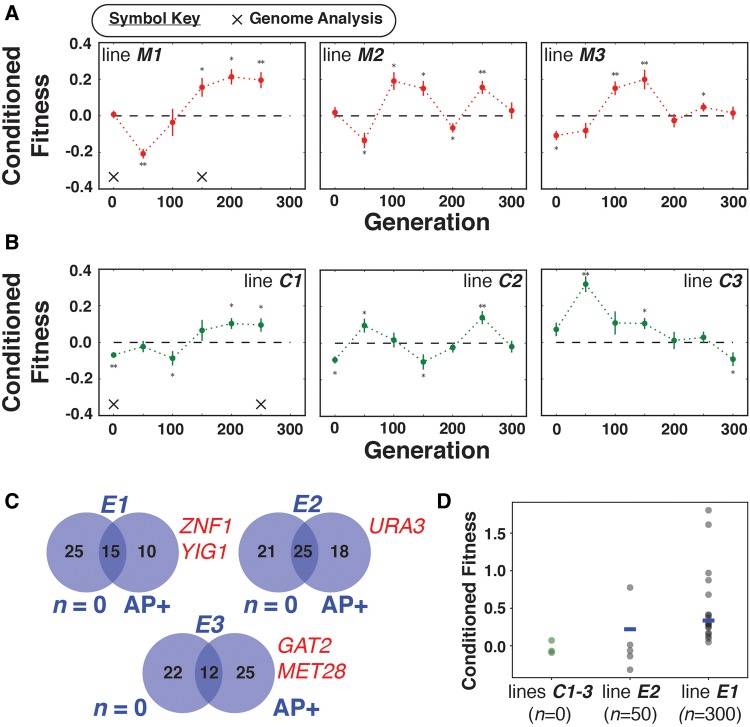
Adaptive prediction is a capability of diverse organisms, including microbes, to sense a cue and prepare in advance to deal with a future environmental challenge. Here, we investigated the timeframe over which adaptive prediction emerges when an organism encounters an environment with novel structure. We subjected yeast to laboratory evolution in a novel environment with repetitive, coupled exposures to a neutral chemical cue (caffeine), followed by a sublethal dose of a toxin (5-FOA), with an interspersed requirement for uracil prototrophy to counter-select mutants that gained constitutive 5-FOA resistance. We demonstrate the remarkable ability of yeast to internalize a novel environmental pattern within 50-150 generations by adaptively predicting 5-FOA stress upon sensing caffeine. We also demonstrate how novel environmental structure can be internalized by coupling two unrelated response networks, such as the response to caffeine and signaling-mediated conditional peroxisomal localization of proteins.
Keywords: adaptive prediction; conditioned fitness; peroxisomal translocation; structured environments; variant analysis.
© The Author(s) 2017. Published by Oxford University Press on behalf of the Society for Molecular Biology and Evolution.
Figures
References
-
- Beaumont HJE, Gallie J, Kost C, Ferguson GC, Rainey PB.. 2009. Experimental evolution of bet hedging. Nature 462:90–93. - PubMed
-
- Boeke JD, LaCroute F, Fink GR.. 1984. A positive selection for mutants lacking orotidine-5’-phosphate decarboxylase activity in yeast: 5-fluoro-orotic acid resistance. Mol Gen Genet. 197:345–346. - PubMed
-
- Calhoun LN, Kwon YM.. 2010. The effect of long-term propionate adaptation on the stress resistance of Salmonella enteritidis. J Appl Microbiol. 109:1294–1300. - PubMed
MeSH terms
Substances
Grants and funding
LinkOut - more resources
Full Text Sources
Other Literature Sources
Molecular Biology Databases
