


Whole-genome sequencing study of serum peptide levels: the Atherosclerosis Risk in Communities study
- PMID: 28854705
- PMCID: PMC5886054
- DOI: 10.1093/hmg/ddx266
Whole-genome sequencing study of serum peptide levels: the Atherosclerosis Risk in Communities study
Abstract
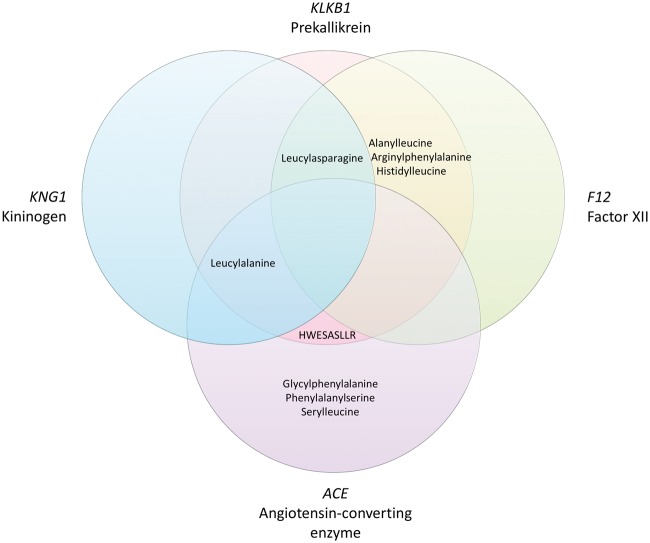
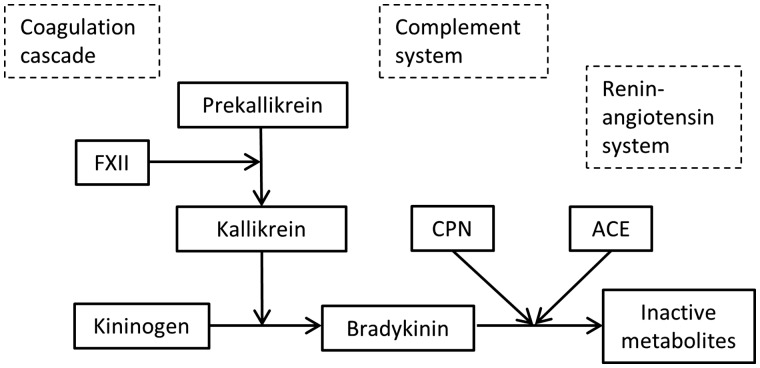
Oligopeptides are important markers of protein metabolism, as they are cleaved from larger polypeptides and proteins. Genetic association studies may help elucidate their origin and function. In 1,552 European Americans and 1,872 African Americans of the Atherosclerosis Risk in Communities study, we performed whole-genome and whole-exome sequencing and measured serum levels of 25 peptides. Common variants (minor allele frequency > 5%) were analysed individually. We grouped low-frequency variants (minor allele frequency ≤ 5%) by a genome-wide sliding window using region-based aggregate tests. Furthermore, low-frequency regulatory variants were grouped by gene, as were functional coding variants. All analyses were performed separately in each ancestry group and then meta-analysed. We identified 22 common variant associations with peptide levels (P-value < 4.2 × 10⁻¹⁰), including 16 novel gene-peptide pairs. Notably, variants in kinin-kallikrein genes KNG1, F12, KLKB1, and ACE were associated with several different peptides. Variants in KLKB1 and ACE were associated with a fragment of complement component 3f. Both common variants and low-frequency coding variants in CPN1 were associated with a fibrinogen cleavage peptide. Four sliding windows were significantly associated with peptide levels (P-value < 4.2 × 10⁻¹⁰). Our results highlight the importance of the kinin-kallikrein system in the regulation of serum peptide levels, strengthen the evidence for a broad link between the kinin-kallikrein and complement systems, and suggest a role of CPN1 in the conversion of fibrinogen to fibrin.
© The Author 2017. Published by Oxford University Press. All rights reserved. For Permissions, please email: journals.permissions@oup.com.
Figures
References
-
- Babizhayev M.A., Deyev A.I., Yermakova V.N., Semiletov Y.A., Davydova N.G., Kurysheva N.I., Zhukotskii A.V., Goldman I.M. (2001) N-Acetylcarnosine, a natural histidine-containing dipeptide, as a potent ophthalmic drug in treatment of human cataracts. Peptides, 22, 979–994. - PubMed
-
- Suhre K., Raffler J., Kastenmuller G. (2016) Biochemical insights from population studies with genetics and metabolomics. Arch Biochem. Biophys., 589, 168–176. - PubMed
MeSH terms
Substances
Grants and funding
- HHSN268201100012C/HL/NHLBI NIH HHS/United States
- RC2 HL102419/HL/NHLBI NIH HHS/United States
- HHSN268201100009I/HL/NHLBI NIH HHS/United States
- HHSN268201100010C/HL/NHLBI NIH HHS/United States
- HHSN268201100008C/HL/NHLBI NIH HHS/United States
- HHSN268201100005G/HL/NHLBI NIH HHS/United States
- HHSN268201100008I/HL/NHLBI NIH HHS/United States
- HHSN268201100007C/HL/NHLBI NIH HHS/United States
- HHSN268201100011I/HL/NHLBI NIH HHS/United States
- HHSN268201100011C/HL/NHLBI NIH HHS/United States
- R01 HL086694/HL/NHLBI NIH HHS/United States
- U01 HG004402/HG/NHGRI NIH HHS/United States
- U54 HG003273/HG/NHGRI NIH HHS/United States
- HHSN268201100006C/HL/NHLBI NIH HHS/United States
- HHSN268201100005I/HL/NHLBI NIH HHS/United States
- HHSN268201100009C/HL/NHLBI NIH HHS/United States
- HHSN268201100005C/HL/NHLBI NIH HHS/United States
- HHSN268201100007I/HL/NHLBI NIH HHS/United States
LinkOut - more resources
Full Text Sources
Other Literature Sources
Medical
Miscellaneous
