


Platelet-Rich Plasma Injections as a Treatment for Refractory Patellar Tendinosis: A Meta-Analysis of Randomised Trials
- PMID: 28854761
- PMCID: PMC5596405
- DOI: 10.5792/ksrr.16.055
Platelet-Rich Plasma Injections as a Treatment for Refractory Patellar Tendinosis: A Meta-Analysis of Randomised Trials
Abstract
Purpose: Patellar tendinosis (PT) is a common condition amongst athletes. In this study, we perform a meta-analysis on randomised controlled trials (RCTs) to evaluate the use of platelet-rich plasma (PRP) for refractory PT.
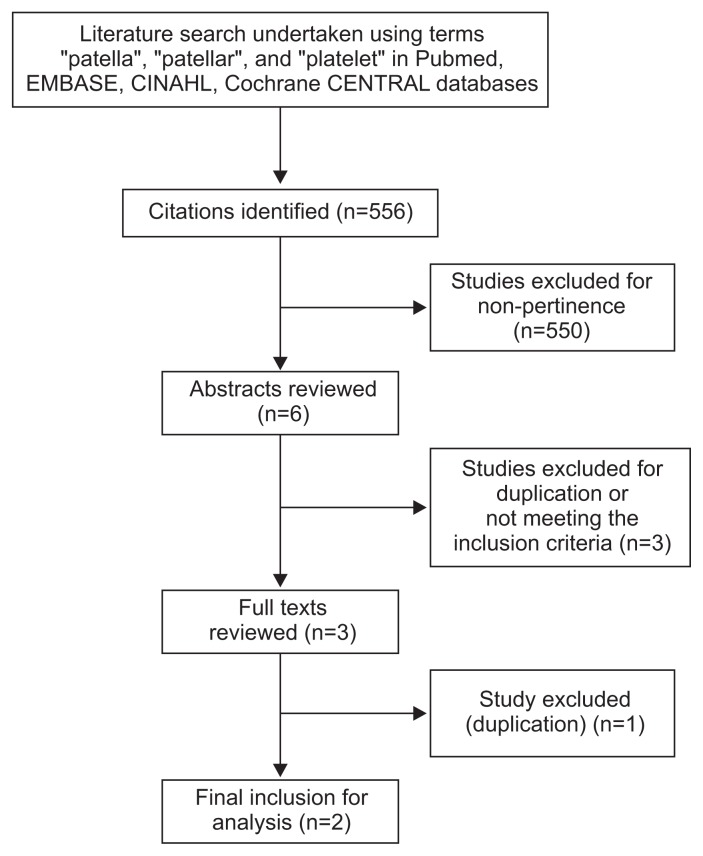
Methods: A literature search was undertaken in various databases from their year of inception to October 2015. The primary outcome measure was the Victorian Institute of Sports Assessment-Patella (VISA-P) score.
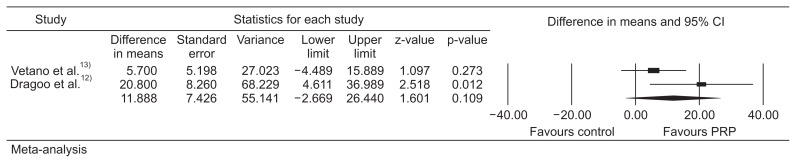
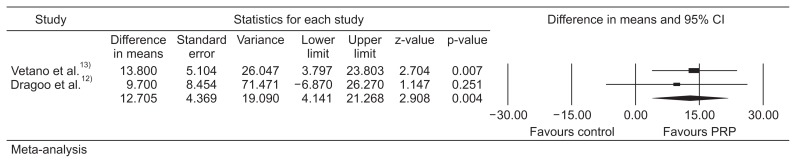
Results: We identified 2 RCTs comparing PRP injections to alternative treatment options (extracorporeal shockwave therapy [ESWT] and dry needling of the tendon). Meta-analysis showed no significant difference in mean VISA-P scores between PRP injection and control at early assessment (2 or 3 months; estimated difference in means, 11.9; standard error [SE], 7.4; 95% confidence interval [CI], -2.7 to 26.4; p=0.109). However, PRP was statistically better than control with regards to VISA-P scores at longer follow-up (6 months or longer; estimated difference in means, 12.7; SE, 4.4; 95% CI, 4.1 to 21.3; p=0.004).
Conclusions: There is a paucity of RCTs evaluating the role of PRP in PT. Our results suggest that, based on limited evidence, PRP is superior over other established non-surgical treatments (dry needling and ESWT) for refractory PT. Larger RCTs may allow better characterisation of the role of PRP in this condition.
Keywords: Injection; Patella; Platelet-rich plasma; Tendinopathy.
Conflict of interest statement
No potential conflict of interest relevant to this article was reported.
Figures
References
-
- Halpern B, Chaudhury S, Nguyen J, Hayter C, Hough L. Clinical and magnetic resonance imaging outcomes following platelet rich plasma treatment for elbow tendinosis. J Arthritis. 2015;4:182. doi: 10.4172/2167-7921.1000182. - DOI
Publication types
LinkOut - more resources
Full Text Sources
Other Literature Sources
Medical
Research Materials
Miscellaneous